Tuesday, June 09, 2009

Mount TBR


The Book Nook, Flippist World Headquarters

Most of the "keepers" in our book collection are stored in a corner of the bedroom. "Mount TBR" is a phrase I first heard used by correspondent Niranjana to indicate that pile of books "To Be Read." It struck a chord (C#dim 7th?) in me, for although I'm pretty much a one-at-a-timer as far as the reading of books goes, I do have those books which I know I'll revisit. I tend to purge my library of anything I know I won't read. So, just for the fun of it, let's take a "widescreen" peek at my "special" corner of the Batty library, those books I'll probably open again:


Of course Laxness leads the way, presented in order of publication, I'm only missing The Happy Warriors. I've even got Under the Glacier in Icelandic! Going down the row are various Sagas and "teach yourself Icelandic" books (I haven't given up hope yet!) and even a copy of Kristin Lavransdatter which I MUST re-read someday. A couple of Indriðason´s mysteries and my treasured Bill Holm. Going down a row, into the Biography section, Björk, Dylan and Gág share space with Huxley and Mary Magdalene. Further on are myths and tales; the rest of bookshelf contains mostly reference works.

The Weaver's shelf holds more modern literature; our tastes overlap; but there are some differences:


Snoop to your heart's content... ...UPDATE! Rose's Mount TBR is here... and Niranjana's is here...
By Professor Batty


Comments: 11 


Tuesday, August 16, 2011

The Virgin Suicides

Novel by Jeffrey Eugenides, 1993

Film by Sofia Coppola, 1999


Paramount Classics

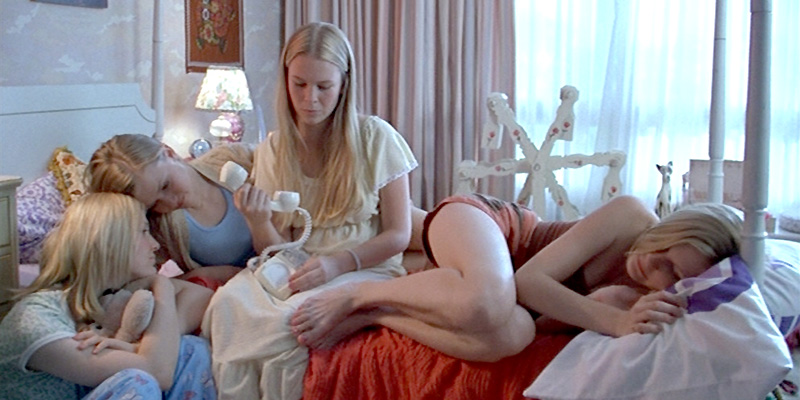
More impressions from my summer reading/viewing. I was only dimly aware of this story, but enough references to it kept cropping up to force it on my mount TBR. The story is told from a first-person plural narrative- a group of men tell the story of and try to come to grips with the suicides of five sisters in a Michigan suburb, set in the early seventies, when they were teenagers.

The book is terse, the narrator(s) are not particularly eloquent, but meticulous in its description of the suburban life-style and the fantasy world of adolescent males. The sisters exist in a parallel reality, mostly unattainable, imprisoned by well-meaning parents. The film "fleshes out" the story with strong visuals, and in the process creates a considerably different impression. Not better or worse, but the appearance of the girls and boys charges the story with a realistic sexuality which the book somehow fails to project. The book is almost like a dirty joke, the film is a ballet- indeed, one could watch this movie with the sound off and probably get just as much out of it.

Sophia Coppola's films as a director (Somewhere, Marie Antoinette, Lost in Translation, The Virgin Suicides) feature a certain distance between the characters in them; "Modern" in the sense of lack of resolution. Perhaps that is the type of story which intrigues her. TVS certainly fits that genre. The book's ending felt like it was a bit of a cheat to me, the film's didn't. The girls' vapid languor resonated more on screen; on the page they were quite remote. As a coming of age film, this is hardly Pretty in Pink, or even Heathers. It has been compared to Twin Peaks, but in the film (and the novel) the horror is of the banal, not the perverse. It is an anti-Hollywood ending.

By Professor Batty


Comments: 0 


Tuesday, May 04, 2010

Buffalo - a Book and Food Review


Custer National Park, South Dakota, 1993

Buffalo For The Broken Heart
Restoring Life to a Black Hills Ranch

by Dan O'Brien

Slowly, very slowly, I am climbing my "Mount TBR" from last Christmas- any new books will now be considered as "summer reading", I'm afraid. This book was a gift from my eldest, along with a package of frozen buffalo (American bison) meat. The meat was fantastic- everything that feedlot beef is not. I knew already that bison meat is low in fat and possesses a delicious flavor when not over-cooked. This book explained a lot of about how modern buffalo ranching has developed in the last twenty years, and about how raising buffalo in an environmentally sound fashion not only produces the highest quality meat, but also how it can restore the prairie grasslands, and even how it could restore broken spirits.

Dan O'Brien is a veteran writer of both fiction and non-fiction. He is also a bit of a dreamer, and a modern cowboy, a man for all seasons, who took it upon himself, in the aftermath of a broken marriage, to start a buffalo ranch in South Dakota. He had done cattle ranching- which is always a sketchy proposition in that semi-arid climate- and failed, when he decided to try raising buffalo. Dan's story flows naturally as he gives background on the struggle between the people and the land, and how buffalo are suited to it, and how they can also restore it in a way cattle cannot.

There is a lot of heartbreak and anguish in this book, but there is also hope, especially in O'Brien's descriptions of the ways buffalo behave and interact with each other and the land. This is a great book, one of the very best books I've read about living in balance with the land and the animals who inhabit it.

Dan's operation is still going strong after a decade, if his prices seem steep remember; this is the highest quality mammalian protein you can get. Anyone with any kind of discerning palate will be aware of this in the first bite. There are many other buffalo operations now, we got ours from Paradise Buffalo Ranch in Bagley, Minnesota, perhaps not quite as "wild" as Dan's, but not as expensive either.

By Professor Batty


Comments: 2 


Friday, January 08, 2010

Mount TBR 2010


As promised, here is a brief rundown on my new books (with another look at my ever-expanding Halldór Laxness collection!), bottom row, left to right:

The Encyclopedia of Witchcraft and Demonology, by Rossell Hope Robbins, Crown, 1959. Pretty tedious reading, but full of cool vintage woodcuts.

Stories from The New Yorker, 1950 - 1960, various, Simon and Schuster, 1960. All the big hitters of short fiction in the '50s. Really exceptional.

Buffalo for the Broken Heart, by Dan O'Brien. Random House, 2002. Received as part of a combo gift with 10 pounds of frozen bison. Heartache, buffalo and redemption on a South Dakota ranch.

Icelander, by Dustin Long. Grove/McSweeney's, 2006. Post modern mystery, not about Iceland at all.

Arctic Chill by Arnaldur Indriðason. Minotaur, 2009. I'll be writing a review when I've finished this.

Swedish Folktales & Legends. See last Tuesday's FITK.

The Chain Letter of the Soul, The Heart Can Be Filled Anywhere On Earth,
The Music of Failure
All by Bill Holm. I've been reading Bill a lot lately, These three books span the last thirty years. I may be writing an overview of his essays sometime in the future. The title essay of Music is about as close to perfection as Bill ever got in his writing.

Björk by Nicola Dibben, Indiana University Press, 2009. A scholarly treatment of Björk, her career and her music. Somewhat pedantic, but its section analyzing her music gives a greater understanding of her unique approach to composition.

TOP ROW: 14 Halldór Laxness titles and counting...

By Professor Batty


Comments: 10 


Tuesday, January 05, 2010

Books, Books, Books...


Elsa Beskow

Christmas brought me a whole new "Mount TBR" this year, I try to cover it in a little more depth (with a little more height?) later on. For now, I'd like to share with you a little from Swedish Folktales & Legends, edited by Blecher and Blecher (Pantheon, 1993.)

Drawing primarily on 19th and early 20th century sources, this is an amusing collection, not quite on a level with the Brothers Grimm, but considerably earthier, almost ribald at times. All the permutations of evil stepmothers are here, along with clever and courageous children, and oodles of monsters and trolls. Some are pithy observations on the facts of life:

The Fussy Fiancé

Once there was a man who left his fiancé after she happened to fart.
Later, when he passed by her house, he saw her outside searching
through a pile of garbage. He asked her what she was looking for.
"I'm looking for a pin," she answered.
"You'll never be able to find it, " he said.
"Well, I'm as likely to find a pin in a pile of garbage as you are
to find a wife who never farts."
He considered this, and took her back.

By Professor Batty


Comments: 3 


Tuesday, January 19, 2010

Mount TBR Redux

My post of the 8th was a day early, for the very next day I received a belated Xmas gift from Rose, the librarian/blog pal/berserker from Virginia. It was McSweeney's Quarterly Concern, #15 (2004), which featured Icelandic authors. In proper Icelandic first-name-only fashion, the back cover blurb states:

The latest in contemporary Icelandic fiction:
Sjón, Hallgrímur, Bragi, Gyrðir, and more."


Those of you familiar with Björk will recognize Sjón, his Fridrik and the Eejit, along with Hallgrímur's America are the two standout stories of this mixed bag. I've run across several of the other authors in various film, theater and music endeavors, most are very good as well. Half of the book consists of the work of various other (mostly American) writers. The book as a whole is the perfect companion for a cozy winter-nights read.

Thanks again Rose!

By Professor Batty


Comments: 1 


Tuesday, February 15, 2011

Making the Best of a Hard Time


Taliesin (detail), Spring Green, Wisconsin

Frank Lloyd Wright Collected Writings Volume 4, 1939-1949, Edited by Brooks Pfeiffer, Rizzolini, New York, 1994

I've been working my way through my Christmas Mount TBR, this non-fiction book is by far more fantastic than any work of fiction I received.

Frank Lloyd Wright's works and influence are so monumental that even now, over fifty years after his death, there is almost an entire industry devoted to publishing works about every aspect of his life. This massive tome (one of a five volume set) is full of Wright's own writing about architecture, social planning, and an almost mystical view of the Art of Form and its organic relationship to the human spirit. One problem with any study of Wright is that he was always restless, changing and forward-looking: these books only look at the past.

The physical manifestation of these ideas was realized in the Taliesin Fellowship, Wright's attempt to create a new generation of designers who would learn by doing (and in the process bring in income and a source of labor for the endless process of maintaining Wright's estate and studio.) Many of Wright's essays in this book concern these individuals who worked with Wright in the depth of the depression. It was a fluid group, most members stayed for a year or less. Wright's account of this communal experiment in education remains a fascinating example of pulling oneself up by ones bootstraps. In our current climate of financial gloom, it is inspiring to see how much Wright accomplished with so little, even if he tended to lean heavily on his benefactors and exploit his students.

The book is also full of Wright's social criticism of government, capitalism, and small-minded "planners." The whole book plays like a fugue, with a recurring motif of a "New Reality", "Truth" and "Progress." One disadvantage of any collection of writing is that there is redundancy- the same ideas are presented again and again, each time intended for a different audience, Wright's polemics can become numbing at times. The book ends just as Wright was entering the last, most prolific phase of his career, and these writings can be seen as the blueprints for his legacy- love him or loathe him, his work abides and continues to inspire with its elegance, passion and beauty.

By Professor Batty


Comments: 3 


. . . . . . . . . . . . . . . . . . . . . . . . . . . . ©Stephen Charles Cowdery, 2004-2026 . . . . . . . . . . . . . . . . . . . . . . . . . . .