Friday, September 13, 2013

Permanence

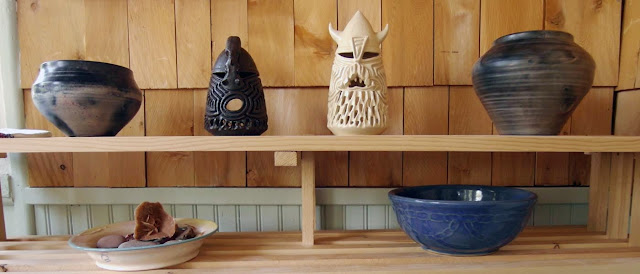
In the last twenty years I have been slowly acquiring ceramic pieces; an accidental collection which seemed to grow of its own accord. The elegant Paul Epple raku jars flank a pair of cartoonish Listvinahúsið Viking candle holders, while beneath a flat Joan Mooney porcelain dish is paired with a family heirloom mixing bowl (circa 1920, maker unknown):


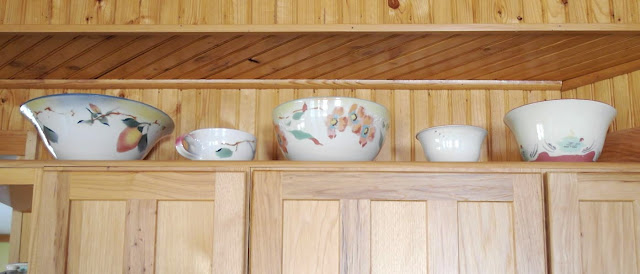
More Mooney porcelain. Beautiful and functional, these get used:


This window wall greets me as I arise every day:


A theme-less collection, I display what I enjoy, nothing here has any real monetary value.

Ceramics are one of the foundations of modern civilization, enabling humans to keep food and liquids safe from vermin and were also used as a text recording device! Of all the things I’ve posted about this week (books, photos, digital media) only these humble pots have a good chance of lasting into the next century and they are certainly the only things which could last into the next millennium. They might even survive a meteor strike (if it wasn’t a direct hit!)

By Professor Batty


Comments: 0 


Friday, January 23, 2026

Hafmey

Guðmundur Einarsson

Guðmundur Einarsson from Miðdalur in Mosfellssveit (1895-1963) was an Icelandic artist who was a draftsman, graphic artist, painter, sculptor, filmmaker, writer, and mountaineer. He was most often called Guðmundur from Miðdalur and is considered one of the most important artists in Iceland. He married twice. In 1926 he moved to Iceland from Germany with his first wife Therese Zeitner, a model and artist, to Iceland. Therese was seven years older than Guðmundur. She had one daughter with the chemist Paul Sternberg in Munich in 1911, but they had never gotten married. Three years after the couple arrived in Iceland Therese's daughter Lydia, who had just completed her studies in pottery, moved to Iceland to live with her mother and Guðmundur. Shortly after, Lydia and Guðmundur began a romantic relationship. Guðmundur and Theresa eventually divorced, but she lived more or less with Guðmundur and Lydia until her death. Guðmundur and Lydia later married and had four children; their love affair was controversial but lasted until the end of his life. Guðmundur left thousands behind of works; oil paintings, sculptures, glass works, watercolors, graphics and ceramics (in which he was a pioneer), drawings, furniture that he designed, along with jewelry, copper and silver objects, gardens, individual houses and wall decorations, books, photographs and films. He was a pioneer of mountaineering, an explorer, an active conservationist and a forester.

My interest in this fascinating artist was kindled when I saw, on the grounds of Vesturbæjarlaug, a statue of a woman embracing a fish (shown below). It isn’t featured on most maps of public sculpture in Reykjavík, perhaps the erotic nature of the piece (along with Guðmundur’s notorious reputation) has led to its current exile in Melar. His smaller ceramic pieces are popular with collectors, he and Lydia were instrumental in promoting ceramic arts in Iceland, Listvinahúsið (Skólavörðustígur 43, 101 Reykjavík) is descended from a gallery established there in the 1930s.
Biography source: https://gamla.mannlif.is/frettir/innlent/gudmundur-var-umdeildur-giftist-dottur-eiginkonu-sinnar-og-gat-af-ser-fimm-born/
Portrait by Willem van de Poll, 1934

By Professor Batty


Comments: 0 


Friday, March 05, 2021

In Situ - #2

More art from Flippist World Headquarters:
The mantle clock (on top of the modern mantle-the TV cabinet) is a real Art Nouveau piece, probably from around 1890-1910. It has a French movement in what is most likely an English case. It keeps good time! Next to it is a Jan Mitchell art glass plate, Jan works out of Christiansted, USVI, we’ve got another.
This fearsome viking-head candle holder is a real Icelandic curio, from the noted Listvinahúsið studio. This is more of a tourist trade item, but they also do art pieces. It seems at home among some of my Icelandic-themed books.

As long as we are in Iceland, our kitchen wall is graced with a Má Mí Mó fur-trimmed purse, circa 2004. Its maker, Guðlaug Halldórsdóttir, is still designing fanciful creations:
The background piece is a vintage Icelandic weaving, possibly a seat cover for a bench. All the colors of the Icelandic fall countryside are in it.

By Professor Batty


Comments: 4 


. . . . . . . . . . . . . . . . . . . . . . . . . . . . ©Stephen Charles Cowdery, 2004-2026 . . . . . . . . . . . . . . . . . . . . . . . . . . .