Monday, February 19, 2018

The Minnesota Trilogy


The Land of Dreams
Only the Dead
The Raven


by Vidar Sundstøl
Translated by Tiina Nunnally
University of Minnesota Press 2013, 2014, 2015

My winter of Scandinavian murder mysteries takes an inside-out turn with these books set along Highway 61 on Minnesota’s north shore. The author is a native Norwegian who lived in the Arrowhead district between Duluth and Canada for several years. He put his considerable powers of observation to work on the peoples, cultures and geography of this location, overlaying it with an appreciation of its history. The story centers on a “forest cop” Lance Hansen who becomes involved with the a brutal murder of a Norwegian tourist near the shore of Lake Superior. It is spread out over three books, with the bulk of the middle book consisting of flashbacks to an incident that occurred in the area over one hundred years ago. There is a great amount of detail in the trilogy: history of both immigrants and Native Americans, local businesses, family dynamics, and the personal struggles of the protagonist. I do think that the three books (700+ pages total) could have been made into one shorter book that would have had just as much impact. That said, you never want a well-written book to end, right?

The translator is the incomparable Tiina Nunnally, you won’t find a better one.

These books were a big hit in Norway. It was very interesting seeing what a gifted foreign writer can do with a novel set in my own home state. I wonder if Jono has read these?

Here is a great interview with the author as well as in-depth reviews of each volume of The Minnesota Trilogy.

By Professor Batty


Comments: 1 


Monday, November 21, 2011

Book Meme

Now that snow shoveling season has returned, my guilt at staying indoors and reading has diminished considerably. In order to further justify my indolence, I've joined this "5 things" meme:

1. The book I’m currently reading:

Dylan's Vision of Sin by Christopher Ricks.
Yes, The Oxford Book of English Verse, Christopher Ricks. If you've ever had a yen to see if Bob Dylan's lyrics hold up to a close reading under the "classical" microscope, this is the book for you. Although he may not cover your favorite Dylan song, those which Ricks does analyze are covered in depth: in their construction, in their relationship to other poetry, and in their meaning. At over 500 extremely verbose pages this is neither a quick nor easy read. It is, however, refreshingly free of the usual Dylan biographical sidetracks as Ricks takes each song as a stand-alone creation and doesn't dwell on what Dylan ate for supper the day he wrote it.

2. The last book I finished:

Snow Country by Yasunari Kawabata. One of my Nobel Laureate "series", is a small gem of a novel concerning a sad affair between a middle-aged Japanese man (Shimamura) and a young woman (Komako, a geisha) who try to create a meaningful relationship in a mountain ski resort and spa. As it develops it shows various nuances of the very Japanese situation. It was hard for me to warm up to the characters in the book, Shimamura is aware of imbalance in their relationship but can do little or nothing to change it, his passivity lacks empathy. Komako, who seems to be somewhat different than other geisha girls, remains trapped in her role as well.


3. The next book I want to read:

Laterna Magica by William Heinesen. I found this book when I was in Seattle, one of several Faroese connections I made that weekend.
I had recently read Heinesen's The Lost Musicians, along with several pieces in Faroese Short Stories. This book contains more short fiction- it is his final book- and was published in Seattle by Tiina Nunnally for the Fjord Press in 1987 (Tiina translated Peter Høeg's immensely successful Smilla's Sense of Snow).
I've peeked at it; I'm sure I'll devour it once I'm through with the Dylan book.

4. The last book I bought:

The Greenhouse by Audur Ava Olafsdottir, translated by Brian FitzGibbon. This is a leap of faith, I've seen numerous favorable reviews, it is still a risky bet though. I've been burned before by on-line recommendations but have been pleasantly "warmed" by others. Outside of crime fiction writers, I am woefully ignorant of modern Icelandic fiction.

It's in my Amazon queue, I'll put off actually ordering it until after I make the rounds of the Minneapolis booksellers.


5. The last book I was given:
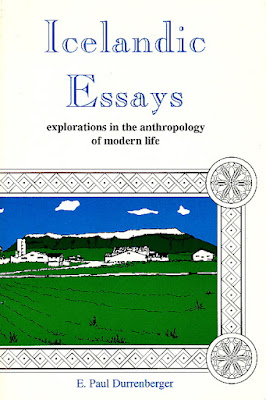
Icelandic Essays, explorations in the anthropology of modern life by E. Paul Durrenberger, Rudi Press, 1995.

This gifted book was a complete surprise from my blog-pal "Rose". It contains a series of anecdotal essays tying modern life in Iceland to its history and culture. Written just before the crazy economic expansion in the 2000's, its greatest value may line in its "time capsule" description of that time of transistion. While this book would have limited appeal for the general reader, Rose knows exactly what appeals to my fancy.

This meme is from Simon, via Niranjana...

By Professor Batty


Comments: 6 


Thursday, December 08, 2011

The Last Book

Laterna Magica


By William Heinesen
Translated from the Danish by Tiina Nunnally
Fjord Press, Seattle, 1987

The road out to Gray Skull Wharf, where everything ends, is a long one. With many twists and turns and cul-de-sacs, it passes through a thousand-year-old city.

We are in no hurry, and on this belated journey we will not take things like chronology and causality too seriously either. We feel just like children playing in the twilight, who are reluctant to go home to bed as long as there is still light in the sky and the beautiful day is not entirely over. And the old boatman, sitting in his ferry and waiting at the end of the world, is a wise man, after all. He knows the whims and caprices of the human heart, and its untimely yearning for the unreachable. He will surely grant us a reprieve for a little longer. You'll see– he has probably lit his pipe and is sitting there in his gray wolfskin enjoying himself as he gazes out over the deep with experienced seaman's eyes, to where the beginning and the end meet and shake hands with each other, as the darkness falls.


William Heinesen was born at the turn of the 20th century in Tórshavn in the Faroes, a group of islands in the North Atlantic between Scotland and Iceland. He was considered the greatest of the Faroese writers and although he wrote in Danish, his work revolves around everyday life in the Faroes. This collection of stories, loosely connected by the thread spun in the preface reprinted above, was written with the intention of being his final work. Tiina Nunally's elegant translation is always concise and poetic.

Heinesen's intention was to have one last go at telling the stories of the people of his life, they are tales from a time that is long gone, an old man's look at those memories of things that have stayed with him over a long life. The stories are simultaneously magical and realistic. Love unrequited, passions leading to ruination, life in a small town in all its facets- with all its joys and heartbreaks.

These are simple stories, told in a straightforward manner. A travelogue, if you will, to the ends of the earth and the center of the human heart.

Highly recommended.

By Professor Batty


Comments: 1 


. . . . . . . . . . . . . . . . . . . . . . . . . . . . ©Stephen Charles Cowdery, 2004-2025 . . . . . . . . . . . . . . . . . . . . . . . . . . .