Friday, March 30, 2018

San Francisco - Recap


In the month since we’ve been back there hasn’t been a day that I haven’t spent thinking about San Francisco and our trip. I’ve even read a rash of San Francisco-based mysteries, in hopes of extending the “high”, all of them featured numerous places we saw. They were OK, perhaps more memorable as sinister travelogues than as literature. I even read a couple of Armistead Maupin’s Tales of the City books, more like outlines than novels, but still trashy fun. Of course I had to watch Alfred Hitchcock’s Vertigo again, a more sublime type of fun. I’ve even printed up some of the images featured here on FITK and put them on display in Flippist World Headquarters so I would be reminded of SF on a daily basis. The were photos that I didn’t take when I was in SF, however. The numerous homeless people, some in extreme circumstances, were a constant presence in the downtown area. The jarring juxtaposition of wealth and poverty was constant.

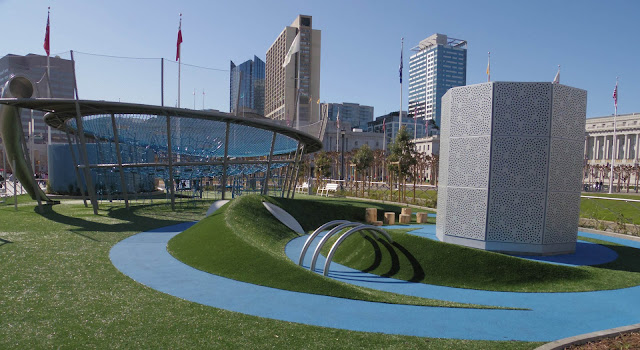
Other scenes were more pleasant. There are numerous small playgrounds for children (adults must be accompanied by children!) that were absolutely inspired:


The museums were very good as well, The de Young was exceptional. The SFMOMA had several “major works” but somehow seemed less focused. A highlight of SFMOMA was the few minutes I shared on a bench with a five-year-old girl as we gazed at a magnificent Rothko. She was just as magnificent as the painting, in her own way. The Asian Art Museum had the best layout, even with many groups of school children on field trips it never seemed crowded.


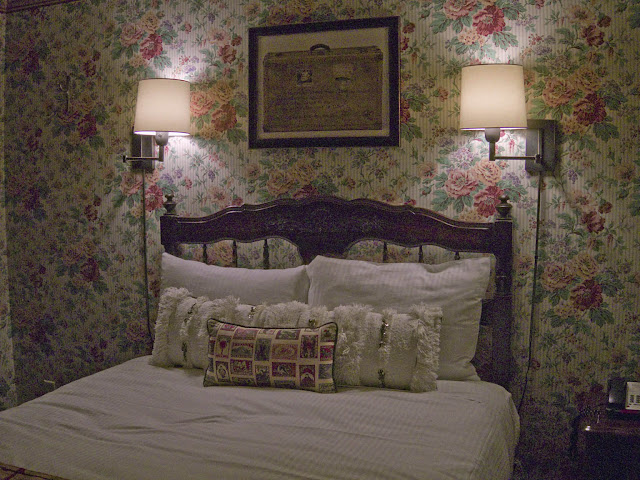
Petite Auberge, San Francisco

I was relaxing on the bed in our hotel after the last day of traipsing around San Francisco. The Weaver asked me what it was I that was thinking about.

I had been thinking of a variety of things; being in a new city kind of forces a new perspective on a person. Over the weekend I had met two of my long term blog-pals (as well as their partners), and I was still “processing” those experiences. The idea that one could establish relationships, albeit casual, with people outside of your physical existence and develop them, however imperfectly, via a computer still seems unreal. To do it such a stimulating place as San Francisco made it almost magical. Those feelings might say more about the insular nature of my existence than it does about the nature of reality, but I’ll take it. The reluctant searcher, finding more than I imagined.

“I am blessed,” was my answer.


See all the FITK San Francisco posts here.

By Professor Batty


Comments: 0 


Wednesday, February 23, 2022

Bay Area Blues

A quadruple-dip today in my erratic pursuit of tasty San Francisco mystery novels:


City of Whispers
A Sharon McCone Mystery
by Marcia Muller, 2011

I’ve covered Marcia Muller’s work here before, her Sharon McCone series of mystery novels is old enough to drink, and I should have had a drink before I started this one.

City is a decade old, a time when smart phones were still a new “thing.” That’s about it as far as any time references are concerned. Sharon’s half-brother, a Native American, needs help and Sharon’s dilemma is two-fold: her relative is in some kind of trouble, trouble that may be related to an unsolved murder of a wealthy heiress a few years prior. He is on the run and Sharon and her cohorts set off a chase throughout SF and other parts of California—even up into Oregon and Canada. The plot is well defined—there aren’t any big surprises—and comes to a satisfactory conclusion. A quick read, and the San Francisco elements are handled well. When the action leaves the bay area it loses some of its appeal. Overall a decent ‘meal’, but not very memorable.

Unsub
A novel
by Meg Gardiner, 2017

The “Unsub” of the title is an UNknown SUBject, a Zodiac-style killer who has reappeared after 20 years and whose gruesome murders have police stumped. Detective Caitlin Hendrix is the daughter of Mack Hendrix, who was a detective on the still unsolved first cases. This situation creates plenty of tension, and as the book progresses the murder rate increases and the killer’s taunting of the police. There is hardly a moment to spare for Caitlin so, thank goodness, the reader doesn’t have to endure the genre’s seemingly obligatory (and usually gratuitous) sex scenes. The killer’s M.O. includes changing locales to keep the police off-balance as much as possible making the book really  more of a Bay Area rather than a San Francisco novel. The story careens to a climax, leaving the reader with a twist that would seem to indicate further books.

Meg is a hot writer now—this book series has already been optioned for television. I found reading this book is akin to chugging down a big glass of Soylent Green.

Black Karma
A novel
by Thatcher Robinson, 2014

My SF mystery/culinary trip leads to this gritty novel based in San Francisco and the Bay area. Bai Jiang is a female, independently wealthy souxun (“people finder”) who is hired (on commission) to find out why a SFPD drug sting involving Mexican and/or Chinese gangs went wrong. The story is set in the recent past and the dialog is hard-boiled and slangy. Lots of quips and double entendres pepper the spaces between plentiful shootings, stabbings, and beatings. There is also a nice inter-twined sub-plot about Bai’s dating dilemmas; a sub-plot with a teen-aged Mexican prostitute is not as successful. The whole thing does have more than a whiff of cultural appropriation but at least the author is trying to bring some new twists to the P.I. genre.

Like a typical American-Chinese-food dinner, Black Karma left this reader hungry for more.

The Painted Gun
A novel by Bradley Spinelli, 2017

Finally, this mystery-within-a-mystery is a curious dish.

Set in the dawn of the San Francisco Bay-area tech boom some twenty years ago, this has a lot of the tone and mood of a pulp crime novel of the fifties. David “Itchy” Crane is a failed newspaper writer turned private investigator who is down on his luck when an old client (who had stiffed him previously) makes him an offer—$25,000 down, $25,000 upon finding Ashley, an artist who has gone missing. The plot becomes more complex (ridiculous) as paintings of the detective start appearing and shady characters and shootings multiply.

Spinelli is relatively young, but has learned the genre well. Its odd to read a novel set in 1997, when advances in technology were just coming into their own (an 8 megabyte flash drive!) and smart phones are still a decade away. The San Francisco locales are generally good, although the author insists on call the transportation system “the BART” which no self-respecting local would do. The end becomes a history lesson about the production and importation of bananas! The Painted Gun is the literary equivalent of a burrito: full of beans but tasty.

See all the FITK San Francisco posts here.

By Professor Batty


Comments: 0 


Friday, April 06, 2018

Mysterious San Francisco


Never one for moderation, my recent trip there triggered a reading binge of San Francisco-based mysteries. I knew that San Francisco is a literary Mecca, but I was unaware of the hundreds (thousands?) of modern mystery novels set there. The variety of its human experience, coupled with its unique architecture and geography in a relatively small area, has inspired creative people for years in both the popular and fine arts. Here is a short “culinary” tour of SF mystery novels I’ve “devoured” recently:

Bill Pronzini’s “nameless detective” series is a modern update to the pulp fiction potboilers of the forties and fifties. His Femme is terse, fast-moving, and short. Not great literature by any means, but effective. The SF locations are handled well and the plots are basic: no muss, no fuss. Burger and fries.


Kelli Stanley’s City of Sharks is a homage to the forties, set on the eve of World War II. Miranda Corbie is a foul-mouthed female private eye with a two-pack a day habit. When a noted publisher is killed a missing manuscript about goings-on at Alcatraz, “the city of sharks,” sets into motion a dizzying merry-go-round of names and places. Several scenes take place at Playland, where even the animatronic “Laffing Sal” is given a vivid cameo.

This all sounds great, but Kelli’s leaden prose and her fixation on cigarettes (“sticks”) quickly becomes tiresome, as does her constant name-dropping and product placement mentions. I think this book may not have even been edited—at times it reads like fan-fiction. Meat and potatoes, heavy on the salt.


The next author, Brian Freeman, is thoroughly modern:


These have what I like to call “smart phone plots”, novels that couldn’t exist without Steve Jobs’ blessing/curse of the modern world. Both concern serial killers, both books have lone wolf homicide detective Frost Easton with a personal interest in the case. One problem that is endemic with this genre is that the villain is always possessed with superhuman, almost god-like powers, straining the reader’s belief. These are well-written but gruesome, The Voice Inside goes over-the-top, bordering on snuff-porn at times.
UPDATE: His latest (2019) book in the series, The Crooked Street, is a better entry, with a more logical plot and a doozy of an ending. Gourmet salads with an emphasis on bitter greens.

The Last Ferry Home by Kent Harrington, was a big let down for me. It started out well, Michael O’Higgins is a SFPD homicide detective just returning to duty after a medical leave due to his wife dying in a boating accident some months earlier. O’Higgins also suffers from PTSD from time spent in the military in Iraq. A double murder of two Indian nationals throws him back into the thick of things, probably too quickly, it is obvious that he still has some major issues that impede his investigations. Another complication is that he had met the prime suspect, a beautiful Indian woman, on the ferry a week earlier where they were attracted to each other. This novel is well-written but about halfway though the tone shifts and becomes sleazy, the detective’s horny behavior destroys the mood of the story. Towards the end everything became quite chaotic, leaving this reader with indigestion.

Jonathan Moore’s first San Francisco book, The Dark Room, is set in the present and concerns Gavin Cain, a SFPD homicide detective who becomes involved with a blackmail/murder plot involving the mayor as well as events that transpired several years earlier. The two plots converge, leading to an uninspired finish. Moore’s second SF novel, The Night Market, is a near-future dystopia. Inspector Ross Carver is literally taken on a wild ride through a decaying San Francisco that is even more class-polarized than the present. Moore’s writing can be quite complex. A reader’s reaction to it will depend on how much baloney they can stomach:


Someone Always Knows, by Marcia Muller, is one of a long series of Sharon McCone mysteries, a franchise that may have run its course a while ago. Sharon and her husband run a detective agency that is threatened when a dodgy ex-partner turns up with unspecified threats. At the same time she is asked to investigate the ownership status of a crumbling Victorian mansion and, of course, there has to be a relationship between the two events.

The San Francisco locales are handled well, but this is uninspired formula writing, a predictable plot and drab characters. The Weaver has read many of these in the past, evidently they were better then. This is the literary equivalent of eating in a good restaurant on a bad night, tasty and you won’t starve, but there are much better “dining” options.


Saving the best for last, Cynthia Robinson’s The Barbary Dogs is whimsical, clever and a literate delight. Max Bravo is a bisexual half-Gypsy opera singer with a spectral grandmother who drops in from time to time to offer him her advice from beyond the grave. Max is surprised when an old friend jumps off the Golden Gate Bridge and he is stuck with the job of settling his affairs. A great supporting cast of characters help/hinder Max on this task which quickly gets out of control, ensnaring him in a century-old mystery when he would prefer frittering his life away eating and drinking and periodically performing in second-rate opera troupes. He keeps trying to avoid this unwanted “quest” but finally submits to fate in a bang-up finish. This is a very funny book, written with a college-level vocabulary. The title is metaphorical, although Max does have a dog. The first book in the series, The Dog Park Club, is just as delicious. A perfect dessert!

See all the FITK San Francisco posts here.

By Professor Batty


Comments: 4 


Wednesday, May 13, 2020

Mysterious San Francisco Redux


Blood Relations
by Jonathan Moore
Mariner Books 2019

Vanishing in the Haight
by Max Tomlinson
Oceanview Publishing 2019

It has been quite a while since I reviewed any mystery novels set in San Francisco.

The day before the start of the Covd-19 restrictions I had picked up a whole batch of books from my library but I had finally run out of the unread ones. Fortunately, it recently started a curbside pickup service where I could order materials online and pick them up a few days later. I was hungry for some ‘fresh meat’ from the literary butcher-shop AKA The San Francisco Mystery Genre.

The first novel I consumed after my hiatus was by an author whom I had previously read—Jonathan Moore. Moore’s work always has modern technological twists in them and Blood Relations is no exception. The somewhat sleazy private investigator Lee Crowe, while working on an unrelated case, comes across the corpse of a beautiful young woman embedded in the roof of a Rolls-Royce in the Tenderloin district of SF. Crowe isn’t above exploiting someone’s personal tragedy to make a few bucks; he takes a picture of the victim and sells it to a tabloid publication. He soon regrets that action when he becomes ensnared in a bizarre plot involving a rich dowager, mistaken identities, a movie star and some gruesome thugs. Written in first-person singular with a linear time-line, it easy to follow the plot. Its San Francisco and California settings are well handled, almost cinematic at times. It has been said that Alfred Hitchcock’s North By Northwest was the first James Bond movie; this book fits perfectly in that genre. Blood Relations is a delicious change of pace—like good gastropub cuisine paired with a fine wine.

The other book I got was Max Tomlinson’s Vanishing in the Haight, a Colleen Hays Mystery. This is the start of a new series featuring a woman who had been recently released from prison (on dubious charges) and who is trying to break into the private investigation racket in San Francisco in 1978. This is a very straightforward and realistic, which is another way of saying dull. All the pieces fit, but the leaden prose and its predictability made Vanishing a bit of a slog for me. Greasy burger, soggy fries served with a flat Coke.


See all the FITK San Francisco posts here.

By Professor Batty


Comments: 0 


Friday, February 05, 2021

Double Scoop of Sharon

The Night Searchers
A Sharon McCone Mystery
By Marcia Muller, 2014

The Color of Fear
A Sharon McCone Mystery
By Marcia Muller, 2017

A sure sign of mid-winter madness is my hungering for San Francisco mystery novels.

I’ve reviewed one of Marcia Muller’s Sharon McCone books before; she cranks out about one per year and has been doing so for three decades! They are easy to digest and about as flavorful as vanilla ice cream. I read these strictly because they were set in San Francisco, and Muller does not stint in her use of the Bay Area. They also contain undercurrents of social awareness with themes touching homelessness, racism, and SF real estate.

The Night Searchers concerns a client who is sure that there are Satanic Cults doing human sacrifice in building sites. The Color of Fear starts off with Sharon’s father, a Native American Artist of some renown, being attacked in an apparent race-related crime. Those premises are certainly more than enough to get the plots rolling and both books are certainly “breezy”, moving along at a rapid clip with some nice set-pieces that are truly exciting.

If you are familiar with San Francisco it helps in filling out the story, there are even some locales that I wish had been developed further. Like a vanilla cone, any additional scoops are the same.

Not exactly high cusine, but it does satisfy, in an empty calorie sort of way.

See all the FITK San Francisco posts here.
By Professor Batty


Comments: 0 


Friday, April 13, 2018

Travelogues of Hell


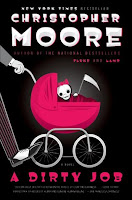
In keeping with my San Francisco-themed reading and at the suggestion of a trusted blog-pal, I dove into the horror/humor oeuvre of Christopher Moore (not to be confused with Christopher G. Moore.) Mr. Moore’s snarky/sexy/silly stories of the undead and their acquaintances are found in five books: a trilogy of Vampire novels (Bloodsucking Fiends, You Suck, Bite Me) and a pair of “underworld of the dead” tomes (A Dirty Job and Secondhand Souls). All of the books are set in modern San Francisco. The characters and story lines flow between them, it would be possible to make a mammoth mash-up of all of them.


The vampire “love stories”, as they are called, center on Jody, a recently “turned” vampire and her minion/lover Tommy, as they try to adjust to life in a city where their bizarre appearance and behavior goes almost unnoticed among its other strange inhabitants. I didn’t read the first book but I found the latter two quite amusing in a very dark way. Bite Me features “Abby Normal”, a 16 year-old vampire “wannabee” whose diary entries elevate the madness to another level.


The two “Death Merchant” books feature various “soul collectors” who are entrusted with the task of transferring the souls of recently departed to vessels and then to other people. I think. Much in the same ”vein” as the others, but these two also have a more serious side that touches upon families, dying and grieving.

All the books have a liberal seasoning of observations of life in San Francisco, the relationships between the sexes, and modern life in general. The supporting characters (some of whom are truly bizarre) are well developed and establish a continuity between the two series.

For humor, I liked Bite Me the best. For substance, I found Secondhand Souls to be the most satisfying. I read them out of order but found that it didn’t matter too much. Moore has written several other books, mostly literary parodies.

See all the FITK San Francisco posts here.
By Professor Batty


Comments: 2 


Friday, March 26, 2021

Tim Maleeny


The Cape Weathers Investigations

Stealing the Dragon
Beating the Babuska
Greasing the Piñata
Boxing the Octopus


Jump (stand-alone)

by Tim Maleeny

These 21st-century-San Francisco-novels are armchair tourist delights. In the Cape Weathers series the protagonist is an ex-reporter-turned-investigator who operates out of a one-man office overlooking The Embarcadero. Although set in the recent present, the writing style is strictly old-school. Cape’s one-liners and his repartee with the other characters would fit right in with Dashiell Hammett, with a liberal helping of Elmore Leonard added to the tasty mix.

Stealing the Dragon starts the series off with a bang—a freighter with a human cargo of refugees crashes into Alcatraz island, setting into motion a yarn of intrigue involving a shadowy Chinese crime dynasty with flashbacks to a ninja school and modern excursions into the underworld of San Francisco’s Chinatown. Beating the Babuska finds Cape working for a movie studio that may be involved in a rival gang war between Italian, Chinese and Russian mobsters. In Greasing the Piñata Cape visits Mexican drug lords, while Boxing the Octopus explores corrupt high finance, an octopus is one of the supporting characters!

Cape has help from supporting cast of interesting recurring characters: Sally, a lesbian ninja; Linda, a electro-phobic reporter, The Sloth, an unlikely computer expert; and Beau and Vincent, SFPD homicide investigators who reluctantly put up with Capes shenanigans. The plots are tight, the action moves along at a brisk clip (James-Bondish at times) and the writing is clean. All of them feature San Francisco as a backdrop and, if the story does leave the city for a while (especially in Greasing), I found myself waiting for its return to the bay area. These are each about 300+ pages—maybe a little long for an airplane flight but just about the right length for a rainy weekend read. Literary fast food.

Jump, the stand-alone, stars the recently retired cop Sam cop who is drawn into an investigation when his landlord apparently commits suicide by jumping from the fire escape of his building. This is very black and grisly comedy, with every quirky tenant on his floor a suspect and a shady drug lord thrown into the mix. This is a trashy, sleazy novel with no literary nutritional values—in other words: a perfect waste of time.

Qualified recommendations.


See all the FITK San Francisco posts here.

By Professor Batty


Comments: 0 


Friday, March 09, 2018

San Francisco - Part VII


Sharon Spotbottom is just my cup of tea… Illustration: Karen Heathwood     

Art Appreciation

There are many people who helped make our San Francisco vacation a special one. If I were writing this thirty years ago I would have consulted with a travel agent, queried relatives and friends who had made a similar trip, and bought a guidebook. Now, with the magic of the internet (although I suppose anyone who grew up with it wouldn’t consider the internet ‘magic’), I received several suggestions from people who I wouldn’t have known back in those dark ages. I’ve mentioned DJ Cousin Mary’s help previously and, of course, “NorCal” Shoshanah who grew up in the area. Interestingly enough, most of the commercial travel sites on the ’net weren’t very helpful—either outdated with dead links or just fronts for numerous tour offerings. We did use the Muni and Bart sites a lot however; public transportation in San Francisco is superb and having a Clipper Card made getting around a breeze.  Most parts of the city are within a short walking distance from routes and the various buses, streetcars, and cable cars run often.

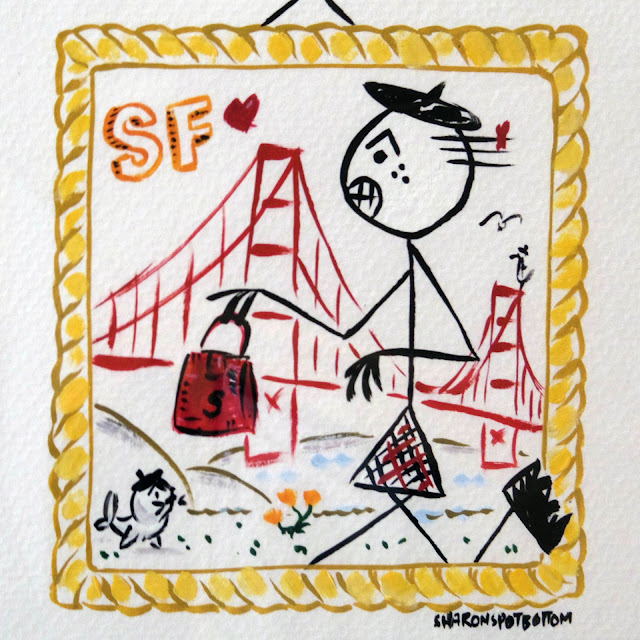
One very special blog-pal who contributed to our trip planning was Karen Heathwood: artist, illustrator and inventor. Her travel suggestions were all spot-on. Karen is also the creator of my favorite demented stick figure Sharon Spotbottom (who has been featured on FITK many times.) The Weaver and I arranged to meet her and her partner Elaine at the de Young Museum in Golden Gate Park. Many amusing and informative stories were exchanged between the four of us, including artistic assessments of the exhibits. We had tea and coffee in the museum café, and posed for pictures afterward:


Sharon, Batty, Karen at the de Young Museum, February 25, 2018

To top it off, Karen gifted me this original Sharon Spotbottom panel:


Without getting too gushy, I have to say that Karen is one person who has truly enriched my life. Her little single panel comics have amused, enlightened and even touched me on many occasions. More subtle than commercial comic strips, Sharon Spotbottom’s adventures were often reflections on the human condition and the situations we all face as we go through life. Of course some were just whimsy, and some went to some very strange outposts of the human psyche. Karen even encouraged me to try my hand in creating glimpses of Sharon’s world. The kid is alright.

Thanks again to everyone who helped make our trip a success.

See all the FITK San Francisco posts here.

By Professor Batty


Comments: 3 


Friday, March 02, 2018

San Francisco - Part I


First Impressions

Our recent San Francisco trip began when we landed in the SFO airport and then took a fragrant trip via the Bart to the downtown area. After checking into our quaint hotel room we headed out for a stroll along Post Street where we discovered the astounding Britex fabric shop:


Nearby was the site of the Frank Lloyd Wright-designed V.C. Morris gift shop, now an Italian menswear store. Fortunately, its original decor has been retained:


The shop’s most congenial doorman tried to interest the Weaver in the purchase of this stylish scooter, $7k, about the same price as eight dress shirts were inside:


Afterwards, we ate at Sear’s (autoplay video at the link), a venerable San Francisco restaurant.  We passed on its famous Swedish pancakes, enjoying a proper dinner while admiring the faux photographic family history that adorned its walls:


See all the FITK San Francisco posts here.

By Professor Batty


Comments: 1 


Tuesday, March 06, 2018

San Francisco - Part V


Chinese Lunar New Year


As chance would have it, the end of the Chinese New Year celebrations landed in the middle of our stay with a two-day street fair and the famous parade that snaked around Union Square:


In case you weren’t aware of it, we are now in the Year of the Dog:


Various organizations were represented with colorful pageantry:


And what would a San Francisco parade be without princesses on cable cars?


Or fantastic floats?


And feats of derring-do?


See all the FITK San Francisco posts here.

By Professor Batty


Comments: 4 


Friday, May 25, 2018

Sammy and the Cheese


Noir

A novel by Christopher Moore
Harper Collins, 2018

One more San Francisco crime novel for the pile.

Christopher Moore is a parody novelist, his send-ups of various literary tropes are consistently amusing and, at times, hilarious. This entry in his oeuvre is set in 1947 San Francisco where “Sammy”  (Samuel Tiffin) is a hot-headed bartender with a shady past, while “The Cheese” is Stilton, a curvaceous and mysterious blonde who has secrets of her own. The supporting cast of characters includes a douche-bag bar owner, various Chinatown denizens, a racist Irish cop, an Air Force general, the Bohemian Grove, a foul-mouthed nine year-old boy, mysterious men in black (wearing sunglasses, natch), a deadly snake and even a space alien to keep thing interesting. The writing is peppered with 40s idioms, as well as Moore’s gags and wordplay. It is very non-PC and gets more and more outrageous as it progresses, even becoming juvenile at times, but it is all done in fun.

If this premise sounds familiar, I recently reviewed Kelli Stanley’s City of Sharks, a private-eye novel which was set in the same era and used similar lingo (and many of the same locations), albeit in a more ham-fisted fashion. Moore’s book is lighter in tone, its frivolous nature might turn off a serious reader, but if you enjoy Carl Haissen you would probably dig this.

See all the FITK San Francisco posts here.

By Professor Batty


Comments: 0 


Friday, March 16, 2018

San Francisco - Part X


Distinctive Dining

The Del Popolo restaurant had a definite “You’re not in Kansas anymore” aura about it.

It was right next door to our hotel and I had read some good reviews about it. I should have read the bad reviews. The austere gray concrete interior (Lord, will I be glad when the gray phase in decorating is over!) hadn’t deterred other patrons; the place was full. We ordered a pizza and received a cow-flop of raw dough that was burnt on top. There may have been a flavor in the sauce, but I’m not exactly sure about that. We should have sent it back (as did another couple who was staying in our hotel) but soldiered through. I thought that maybe it was a California thing—a hipness beyond the ken of us hopeless rubes from flyover land. The only non-gray decor was a wall of hideous portraits. When I asked out server about them she said the owner had bought them on eBay:


A couple of people had suggested that we try the legendary Tonga Room, in the basement of The Fairmont Hotel:


With a water-filled lagoon, simulated thunderstorms (with rain!) palms, thatch and tiki motifs, the Tonga Room’s decor did not disappoint:


And the food was good, with a wide choice of “Asian-but-not-too-weird” selections:


The only thing that really diminished the experience was the crappy modern pop music on the sound system. This may be just a geezer rant on my part, but there are hundreds of great Lounge or Exotica albums available, a random playlist of these would have made for a super night out. I suspect that the hotel is contractually locked into a music service that is subservient to the big record conglomerates aiming at the 20-somethings demographic.

For a real “walk on the mild side” for our last night we tried our luck at the “Level III”, another restaurant in a hotel, this time it was the JW Marriot, a block from Union Square. It was our last night and after the previous attempts at memorable dining we didn’t feel like going out on a limb. Note: the picture below is not the entry, a doorman had to direct us to an unmarked entrance that led to an elevator:


The host explained that the actual restaurant was being remodeled so we were offered dinner in a re-purposed conference room! With office chairs! And AV hook-ups at each table! There was a video projector overhead and a drop-down screen; I was half-expecting to see a Powerpoint demonstration of the menu:


But the food was very good, perhaps the best we ate on our trip:


San Francisco has almost unlimited dining options (one place near our hotel offered a prix frie dinner for two for $650!) but we only had seven nights. We ate at Hopwater Distribution a couple of times, and the pleasant, if not distinguished, Roxanne Cafe, once. Sear’s Fine Dining was also pleasant.

See all the FITK San Francisco posts here.

By Professor Batty


Comments: 1 


. . . . . . . . . . . . . . . . . . . . . . . . . . . . ©Stephen Charles Cowdery, 2004-2025 . . . . . . . . . . . . . . . . . . . . . . . . . . .