Saturday, October 29, 2016

Wayward Heroes

Here’s a new post from my Laxness in Translation website:


Viking Invaders, Bayeaux Tapestry

This is Philip Roughton’s new translation of the great Icelandic novelist Halldór Laxness’Gerpla, (previous English title: The Happy Warriors). It is a retelling of the Fóstbræðra ("Sworn Brothers") Saga. This translation completely supersedes the Katherine John translation from the Danish. That version was written in an awkward psuedo-Middle English style and had also eliminated the Icelandic characters ð and þ from the text. Roughton also chose to preserve the Saga literary device of changing from past to present tense at dramatic events, a device that Laxness had retained but was lost in the John translation. It gives the narrative an added dimension, as if it was being presented orally (as the Sagas were originally presented) rather than as a dispassionate history. While reading it in the new translation, I got a better sense of the sarcastic edge that Laxness gave to the narrative, particularly in the dialog of the women in the story, who offer a counter-point to the two hapless “heroes” on their misguided quest for glory. Roughton also supplies the reader with helpful end-notes about some of the more obscure points in the story.

Historical fiction, if it is to succeed in transporting the reader to a distant era, must impart a sense of verisimilitude in the events it depicts. Even more difficult is the re-creation of the literary style of a past era. The crowning achievement is, of course, the creation of a truly great novel. Wayward Heroes succeeds on all three counts. First published as Gerpla in 1952, it is written in a strict Saga style. The story of two “oath-brothers”, Þorgeir Hávarsson and Þormóður Koalbrúnarskáld, and their quest to recreate the glory of the warriors of old. In the changing world of 11th century Europe they are both out of date and in over their heads, for the majesty and power of the pagan ways has been supplanted by the strange cult of Josa mac Dé: Christianity. The old Viking “pillage and plunder” economic model has been supplanted by trade and cooperation. After a few Icelandic misadventures they split up: Þormóður the poet becomes distracted by a woman’s wiles and domesticity while Þorgeir, the would-be heroic champion, ends up in England and France in the service of Olaf Haraldsson (later to become the self-made King Olaf.) Disenchanted with the European ways of warfare, Þorgeir returns to Iceland where he meets an ignoble end. After much brooding on the death of Þorgeir, Þormóður leaves his wife and children to undertake a quest of vengeance for Þorgeir’s death. Traveling to the far northern reaches of Greenland, living with the Inuits and enduring much suffering and hardship, he fails in his mission. Crippled and bitter, Þormóður makes it back to Iceland and then, finally, to Norway, where he seeks out and meets Olaf on the eve of the Battle of Stiklestad. Þormóður finally comes to the realization that his dreams of heroism and glory have led to only death and destruction.

This is a book full of strange and terrible things, sprinkled with archaic words and obscure references. A familiarity with the Sagas and that era (c.1000-1030) would be a definite aid in comprehension. Laxness’ literary mastery manages to come through, the language is powerful and direct, its archaic aspects only add to the story. Laxness introduces some social criticism, starting subtly and building steadily. By the final scene, which culminates in a moving climax, Laxness’ message is felt all the more for its prior restraint.

By Professor Batty


Comments: 2 


Friday, July 15, 2022

Summer Reading

It’s been a while (five years!) since I’ve done one of these “Summer Reading” posts; a recent spate of new titles has given me the fuel to stoke my literary fires.

Kalmann
An Icelandic Mystery
By Joachim B. Schmidt
Translated from the German by Jamie Lee Searle


The biggest surprise in this batch was Joachim B. Schmidt’s Kalmann, an elegant and original mystery set in the northernmost Iceland town of Raufarhöfn. Kalmann is an intellectually challenged shark fisherman who is tolerated by the townspeople even though he has had some behaviorial issues in the past. After Kalmann discovers a pool of blood near a monument he sets out, in his own peculiar way, to solve the mystery. This is a wonderfully well-written book, it captured my attention from the start and the plots meanders to a satisfying conclusion. It is very funny at times, Kalmann is an exasperating yet endearing character; he has been described as an Icelandic Forrest Gump.

Highly recommended.

The Volunteer
A Novel
By Salvatore Scibona

Dense and complex, The Volunteer is a completely different sort of book, although it too could be classed as a mystery. Vollie Frade, the main character, is a farm boy who joins the U.S. Marines and does several tours of duty, one of which is a black ops affair that finds him stripped of his identity. The story shifts focus from Vollie to a sort-of adopted son who abandoned a child in an airport and leapfrogs to various parts of the United States, Asia and Europe from the 1950s to 2039. It is generally well-written, and covers a lot of serious issues but, ultimately, is a shaggy-dog story—an extremely dark Forrest Gump.

A marginal recommendation.

Karitas Untitled
A Novel
By Kristín Marja Baldursdóttir
Translated from the Icelandic by Philip Roughton

Karitas Untitled was written in 2004 but has just been translated and published by Amazon Crossing. This is sort of an Icelandic Little Women: “Spanning decades and set against a breathtaking historical canvas.” I actually bought the book based upon a recommendation but no matter how hard I tried I couldn’t buy into its premise. Karitas is one of a brood of sisters living in the Icelandic country in the early 1900s. She has a gift for drawing, the story tells of her trials in coming to grips with her education and the larger world. It has won a ton of awards but I found the writing to be so prosaic and formulaic (think YA) that I couldn’t finish it.

No recommendation.

The Locked Room
A Ruth Galloway Mystery
By Elly Griffiths

I am big fan of the Ruth Galloway series (when will the BBC have this on Masterpiece?) so I have been eagerly awaiting The Locked Room, the latest entry in the series. I had read that Ruth has to deal with Covid crisis so my curiosity was doubly piqued. All the “gang” is here, the biggest strength of this series is the interaction between the regular characters, regular people who have to deal with regular problems in addition to the mysteries and mayhem that besets them. The Covid material is deftly integrated into the plot—it brought me back to the early days of the pandemic (too soon?) As with the other Galloway titles, this book should really be read in published order, the characters age and and their relationships grow in a realistic fashion.

Recommended for fans of the series (which should be read in order.)

Outside
A Mystery
By Ragnar Jónasson
Translated from the Icelandic by Victoria Cribb

Reading Ragnar Jónasson has been a bit frustrating for me; his Icelandic mysteries are generally competent but often uninspired. Ragnar has been heavily influenced by Agatha Christie and his latest effort, Outside, is no exception. In this stand-alone mystery, a small group of friends go on a weekend ptarmigan hunting trip in the Icelandic highlands in late November—what could possibly go wrong? An unexpected blizzard and a surprising discovery in a shelter hut upsets their plans. This is a tight tale, told in short episodic chapters that alternate the POVs of the four main characters. It would make a good movie, perhaps not worthy of a major cinematic release, but definitely worth streaming—Agatha would be proud.

Marginal recommendation.

Salka Valka
By Halldór Laxness
Translated from the Icelandic by Philip Roughton

Finally, saving the best for last, is the new translation of Salka Valka, Halldór Laxness’ earliest masterpiece.

This is a tremendous book and Philip Roughton brings it into the modern world with a terse vitality that the older translation (from the Danish) lacked. Don’t take my word for it, the Laxness in Translation website has several reviews of the book in its first translation as well as links to reviews of the latest version.

Very highest recommendation.

By Professor Batty


Comments: 1 


Friday, October 03, 2025

Chillin' with Phil and Maria

TWO Icelandic media events in ONE day!

Now that I am less than a month away from returning to Iceland, I find that the frequency of Icelandic references that impinge on my consciousness are increasing. Seeing as the temps here reached the high 80s yesterday some Icelandic chill was definitely appropriate.
I consider Phillip Roughton to be the top Icelandic to English translator alive.

The Icelandic Roots genealogy group sponsored a Zoom meeting with him yesterday concerning his translation of the Halldór Laxness novel Iceland’s Bell (Íslandsklukkan). I've been a a fan of Phil’s since I read it back in 2003 when it was first published and have followed his literary efforts ever since. The meeting was well attended with over 30 members from around the world, most of whom had actually read the book. Roughton had, in his navïeté, started this translation while still in college, only later to learn that some Icelandic scholars considered it to be untranslatable. Fortunately, he persevered (for 9 years!) and the world is a better place for his efforts. He was aware of my Laxness in Translation site (he called it “beautiful”!) after I gushed (like the fanboi that I am) over his efforts.
Maria Alva Roff is also a translator and is also old blog-pal of mine. We’ve interacted numerous times over the last 21 years and met in person several times, most recently in 2022. Yesterday I listened to a podcast she did with Anna Liebel in 2023 about “burn-out” in Icelandic society. The podcast takes a while to get going but by 10:00 one gets to the Icelandic portion. It is always a treat to hear Maria’s insights about Iceland.

By Professor Batty


Comments: 0 


Monday, June 04, 2012

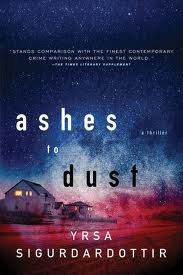
Ashes to Dust

by Yrsa Sigurðardóttir, Philip Roughton (Translator), Minotaur Books, New York, 2012

The third of the Þóra Guðmundsdóttir series (anglicized to Thóra Gudmundsdóttir in the US edition), this mystery continues the adventures of the Icelandic lawyer/sleuth who is drawn into the investigation of four old murders and one modern one. Most of the action takes place in the Westmann Islands where houses which had been buried since the 1973 Eruption are being unearthed for a "Pompeii of the North" attraction. The discovery of three bodies and a head in one of the buildings sets off a chain of events concerning the usual family and small town secrets which are Yrsa's stock in trade. Competently written, although Phillip Roughton's translation is a bit clunky at times, the multiple characters and the minutæ of plot elements remained clear throughout. Not so well handled was any sense of plausibility. The story wrapped up a bit too neatly for all of its messy details.

I've already reviewed to first two entries in the series; this one is a little better that the second (My Soul to Take) and much better than the first (Last Rituals). If your taste in mysteries tends toward the "jigsaw puzzle" type, these books might be just the thing you are looking for. The Icelandic references ring true, especially how the unique set of circumstances around the eruption created a massive upheaval in the lives of those who were present. Just after I finished this book, Rúv broadcast a feature on an actual house which had recently been uncovered! (In Icelandic.)

By Professor Batty


Comments: 3 


Monday, August 21, 2023

Another Kind of Doll Story

The Girl By the Bridge
A Detective Konráð Novel

By Arnaldur Indriðason
Translated by Philip Roughton
Minotaur Books, 2023

It was October, 2018. The Weaver and I were heading into Reykjavík from the airport when I spotted an electronic billboard touting Stulkan hjá brúnní, the latest title from Iceland’s most renown mystery writer. It wasn’t until this year that I was able to read it in translation.

It was worth the wait.

The novel begins on the small bridge over Tjörnin, the pond in the center of Reykjavik, a place where I have walked dozens of times. It is 1961 and a young man spies a doll in the water at the pond’s edge. He investigates further and finds the body of a girl. The narrative jumps to a birthday party a few weeks later where we are introduced to Eygló, a 12 year-old girl with psychic abilities, who has an encounter with an apparition of another girl who mysteriously disappears after saying “I lost her.”

Flash-forward nearly sixty years and we find retired Detective Konrád who is called upon to conduct an informal search for the granddaughter of a notable Icelandic couple. The story takes off from there, with the usual mix of druggies and lowlife who are somehow tied into the death of the girl who was found at the bridge. Eygló reappears with information about the dead girl. Konrád’s back story is nicely integrated into the plot, I’m looking forward to seeing how the long arc of that story develops. In a pleasant deviation from the usual dectective novels, Konrád does not develop a love interest (perhaps because he's in his seventies.)

This is solid writing, terse, with a good translation by Roughton. Lots of local references makes it fun to read if you’ve spent time walking the streets of Reykjavík (if so, have a map handy when you read this). All of that said, as with most of Arnaldur’s novels, there are lots of interviews with elderly witnesses, not exactly thriller material. Multi-generational cover-ups are a recurring theme of Arnaldur’s books. There are three more books in the series yet to be translated.

I’ve reviewed most of Arnaldur’s translated output over a time span which matches this blog’s existence exactly. During that time he’s sold millions of books while all I have this goofy blog with its 20-30 daily visitors! Recommended.

By Professor Batty


Comments: 0 


Friday, October 17, 2025

A Parish Chronicle

               This is the music you remember when you live to be 100
    ******** AN EXCLUSIVE WORLD PREMIERE REVIEW ********

A Parish Chronicle (Innansveitarkronika)
By Halldór Laxness
Translated by Philip Roughton
Introduction by Salvatore Scibona
Archipelago Books, 2026

My other identity, my real world identity, is that of a mild-mannered administrator of a website devoted to the English translations of the work of Icelandic author Halldór Laxness, 1955 Nobel Laureate in Literature. When I started that endeavor fifteen years ago there were few English translations of Laxness titles in print and references to him were scattered about the internet; some had already disappeared due to link-rot. That site, Laxness in Translation, is now the preeminent English-language internet resource about the man and his works. Many thanks to Archipelago Books for my advance reading copy.


The unifying thread in this short novel is a small parish church in Hrísbrú, Mosfellsbær, near Reykjavík, Iceland. The church in question was slated for demolition and the parish congregation was expected to relocate to a new one in a lower valley a short distance away. The church had fallen into disrepair, was dismantled and then (in a surprising turn of events) a new one arose. Several intertwined threads merge to form a satisfying climax. A reader not familiar with the intrigues of Icelandic church politics might be baffled by this story arc, but this chronicle deals with more fundamental issues than theology. The conflict here is between the locals and those outside forces working for the destruction of this humble place, in the process effectively erasing the identities of the people who lived there.

What can a story of a small parish church in rural Iceland possibly offer the worldly reader?

The book opens with a discussion about the bones and, in particular, the skull of ‘Iceland’s national hero and chief poet’ Egill Skallagrímsson. Those remains may have been interred at the first church in the parish in the 12th century although he was a heathen.

Are you still with me?

Further chapters elaborate on the history of the place, introduce the farmer Ólafur (and his bed-ridden wife, Finnbjörg), travails with Priest Jóhann and his maid Guðrún, parish council chairman Kolbeinn, ash-collector Láki and his son Stéfi, and the machinations that ensue when the order to demolish the church is given (an order which had been made a century earlier!) Laxness even refers to himself as the narrator “Inky” in numerous side-stories making for an incredibly rich panorama in such a short book.

I recently participated in a Zoom meeting with the book’s translator, Philip Roughton. During the session he told the story of how he had become intrigued by Icelandic literature while he was doing research for his masters thesis. He was struck by how time and time again features of the countryside were related to historical events by his guides—some of those stories had been written down many hundreds of years ago. In a similar vein, A Parish Chronicle is an intensely local book where most of the story takes place within a few miles from where Halldór had grown up and, later in life, had built Gljúfrasteinn, his home for 50 years. While A Parish Chronicle is fictional, the characters in it were no doubt based on histories of the locals. Laxness and his keen powers of observation are evident in all his novels (this book is no exception) with characters and situations richly drawn; anyone that has grown up in a small community will find much here to smile about. The first draft of this book was made in Rome in 1963 and finished in 1970 as a ‘memoir-novel.’

In 2015 I took a bike trip through this area where I photographed a picturesque church sitting on a small hill. I had no way of knowing that it was the church in this story:
Mosfellskirkja, 2015

Still, many believe that God’s wisdom and long-suffering achieved a certain victory in this matter here in Mosfellsdalur, even if it took some time, and the world might well take notice of this, although there may may in fact be something to the viewpoints of those who think differently.

The world would do well to take notice of this slender volume.

Highest Recommendation.

By Professor Batty


Comments: 0 


Monday, April 29, 2024

Your Absence is Darkness

A Novel
By Jón Kalman Stefánsson
Translated by Philip Roughton
Biblioasis International Translation Series

Whew!

This is a roller-coaster of a tale from one of the leading modern Icelandic authors.

On its surface it is the story of three generations of over-lapping Icelandic families and their successes and failures in love. It is told from the point of view of an anonymous narrator (who is also the author of the book) sprinkled with dialogs between him and a mysterious coach-driver (who happens to have a faint smell of sulfur about him.) As the tale unwinds, the coach driver interacts with the narrator—even suggesting rewrites!

It begins with the narrator finding himself in a church in a northern town in Iceland. He suffers from amnesia; people know him, but he only has glimmerings of who they are and why he is there. The narrator has fits of automatic writing from time to time, wherein he tells the story of a woman in Snæfellsness who, years ago, wrote a monograph about earthworms that caused her to look beyond her bleak existence and passionless marriage. There are about 20 other characters who interact with the story line, fortunately there is a dramatis personæ.

While it is set in modern, post-Covid, times there is a lot of rural Icelandic life and the narrative is quite earthy at times. There is also a playlist of mostly modern pop songs! 

What the book is really about is how passions and mortality shape our lives. Stefánsson also delivers numerous little digressions about various meanings of life throughout:
Each person has his own way in life. Some are open, other less so. Some people have a great need for companionship and a social life, others are inclined toward solitude. In whatever direction you lean, it doesn’t necessarily imply anything about your disposition towards your neighbour, those who matter to you. each has his own way, and no one should go against his nature. And naturally, everyone carries his own luggage. His wounds. His knots. Some struggle with them all their lives. And it appears that certain knots can only be undone by death…
There is a distinct presence of Halldór Laxness’ influence felt throughout, Under the Glacier in particular. It is, like all of Stefánsson’s work, well-written, but it becomes a bit much at times. Roughton’s translation is as invisible as one could hope for, given the novel’s peculiar nature.

Qualified recommendation.

By Professor Batty


Comments: 0 


Monday, September 20, 2021

Mondays in Iceland -#121

Summer Light, and Then Comes the Night

A Novel by Jón Kalman Stefánsson
Translated by Philip Roughton
Harpervia, 2021

A masterpiece of literary art.

Now that those preliminaries have been dealt with, I’ll delve into some details about this wonderful book.

It takes place in a small town on the Icelandic coast, somewhere north-west of Reykjavík. The story  develops over about ten years, spanning the turn of the 21st century. There are modern innovations; the computer revolution, DVDs and other pop culture, but the people inhabiting the area remain relatively isolated—from the world at large and each other—seemingly living with a foot in the past and an inability to openly express themselves. Eight inter-twined stories examine the foibles and passions of these people, seasoned with a fair amount of parenthetical philosophy along the way. It gives the reader a broad and unflinching look at Icelandic mores and mentality. The love-affairs that thread throughout the stories portray participants who are part of a grander scheme of things that they can only dimly see and barely comprehend: the eternal struggle between love and biology is never far from the surface. At times it is very funny and, at other times, it is heart-breakingly sad. It has been filmed and is in post-production, many of Iceland’s greatest actors are in it (including Ólafur Darri Ólafsson and Kristbjörg Kjeld), if it is only half as good as the book it should be glorious.

The writing is magnificent and Roughton’s translation flows:
We speak, we write, we tell about big things and small to try to understand, try to grasp something, even the essence itself, which is, however, constantly moving away, like a rainbow. Old stories say that a man cannot behold the face of God, that doing so would destroy him; and without doubt, it’s the same for what we seek—the search itself is our purpose; the result will deprive us of it. And of course it’s the search that teaches us the words to use to describe the splendor of the stars, the silence of the fish, a smile and sadness, the end of the world and summer’s light. We do have a task, apart from kissing lips; do you know, by chance, how you say “I desire you” in Latin? And how you say it in Icelandic?
This is one of the greatest books I’ve ever read.

Highest recommendation.

By Professor Batty


Comments: 5 


Wednesday, November 02, 2016

Weasel Words

Land of Love and Ruins
by Oddný Eir
Restless Books 2016
Translated by Philip Roughton

Oh, my. I should never read other people’s diaries.

Especially this one.

This book is a lightly fictionalized account of a late thirties-something dilettante dabbling in issues of commitment, career, family and society in Iceland after the Kreppa of 2008. The author blithely brings up issue after issue, never making a decision, while sprinkling the text with weasel words: maybe, perhaps, I should, I hope, vaguely, didn’t, don’t, couldn’t and lots and lots of question marks. I’m not doubting her sincerity, not one bit, but I just don’t want to read about someone floundering purposelessly through life. The story centers on the author, of course, and her almost-but-not-quite relationships with her ornithologist lover Birdy and her archaeologist brother, Owlie, both of whom are ill-defined. This fragile triangle plays out over a plethora of cultural references, both modern and historical, Icelandic and European, but none are developed to any extent; a hint of incest is brought up but dropped more than once. The diarist constantly flits from topic to another, often several times on a single page. It does get a little better toward the end, where some family history starts to shape a narrative, but in the book’s final pages her weasel words—might, depending, would, could—negate the book’s impact.

I’ve interacted with many Icelandic women in the last twelve years. They have been, as a rule, self-assured, opinionated and decisive, and pretty much, to me at least, a source of unmitigated joy. Oddný, with her shallow and aimless neurotic musings, breaks that streak. For a much better book about the internal life of a modern Icelandic woman, I recommend Alva’s 88.


By Professor Batty


Comments: 2 


Monday, October 28, 2024

Trilogy By Stefánsson

Heaven and Hell, The Sorrow of Angels, The Heart of Man


A trilogy by Jón Kalman Stefánsson

I’ve tangled with this Icelandic author before; I raved about Summer Night, and Then Comes the Night and had mixed feelings about Your Absence is Darkness.

This dense trilogy almost did me in. Its major theme is fatalism—death surrounds its protagonist, ‘The Boy’, as he blindly makes his way through ordeals in the unforgiving Icelandic sea, land and psyche. Not for the reader who is faint-of-heart. Stefanssón’s prose (and Philip Roughton’s translation) is always excellent, but where his other books were flights of imagination, these three are heavier, even turgid at times. I sensed a bit of dèjá vu (particularly in Sorrow) where I got the impression that this was recycled Halldór Laxness (without the humor.) If you are wondering where the authors who revel in elaborate language went, look no further.

One problem I had in reading these books is that I have burned out on Icelandic culture (I’ve been infatuated with it for nearly a quarter century) and, sometimes, enough is enough. If you are up for a challenge, and enjoy dense, grim books ruminating about death and despair, you might enjoy this journey. If not, beware!

By Professor Batty


Comments: 0 


Wednesday, March 19, 2014

The Hay Officer of Hörgár Parish

Reply to a Letter from Helga

A novel by Bergsveinn Birgisson
Translated by Philip Roughton
AmazonCrossing, Las Vegas, 2013

A letter sent to an old lover constitutes this short novel of desire and regret. This is a deep look at the psyche of an Icelandic farmer, Bjarni, a man who is torn between farming and the allure of a woman and a modern life in Reykjavík during its occupation during World War II.  It would be hard to find a story about Icelandic farming that didn't include sheep, this book is no exception. Sheep are the third partner in this triangle and although the story is somewhat sad it is a sadness born not of despair but of conflicting desires.

Bjarni tells the story of his life and in doing so tries to justify his actions to Helga via a series of anecdotes, some of which are very funny, some are quite sad, others are quite earthy; most are a mixture of the three. There is a lot of rural Icelandic culture here, as well as many literary references which are fortunately explained in a glossary. I found the book to be fascinating, although a casual reader without any experience in Icelandic Literature might have a hard time warming to the distinctive perspective of this book.


By Professor Batty


Comments: 1 


Friday, September 02, 2022

Fall Fête

Archipelago Books is an independent publisher located in Brooklyn, New York.

They specialize in books in translation; works they have deemed worthy of a wider readership. My connection to them is with the Icelandic author Halldór Laxness (the laughing man seen above) and buying those titles of his that they have released: The Great Weaver From Kashmir (2008), Wayward Heroes (2016), and Salka Valka (2022). They have been supportive of me as well, linking to my other blog: Laxness in Translation. Later in the month they will be having a “Fête”, a chance for like-minded individuals to meet over libations and canapés, and I have been invited! It would certainly be interesting and it would definitely take me out of my comfort zone. Translator Philip Roughton will probably be there—meeting him for a translation nerd like myself would be like meeting Bob Dylan!

I am really in debt to Archipelago; they have been exemplary in their efforts to raise the level of Literature with high-quality yet affordable editions. This fête would be quite a trip to arrange on such short notice, however, as well as being breathtakingly expensive for three hours of canapes and libations.

YOLO, I guess?

By Professor Batty


Comments: 2 


Friday, April 06, 2007

Salka Valka

I have previously alluded to a third party in my mini-vacation, Icelandic readers will know her already: Salka Valka, the titular protagonist of the novel by Halldór Laxness, whose story filled my spare moments in our weekend cabin. This book is somewhat obscure in the USA (look for it fetching a premium on Amazon.) It was originally published in Iceland in two parts (Þú vínviður hreini and Fuglinnn í fjörunni) in the early thirties where it created a sensation in the Scandinavian countries. It was published in England in 1936 (translated from the Danish: last printing 1964.) This is one of Laxness's earlier works, written just before Independent People and covering some of the same territory, but focusing on life in a fishing village rather than on a sheep-farm. The scene is set on the first page:
"When one goes by boat along these coasts on these freezing mid-winter nights, one can't help thinking that there can hardly be anything in the whole wide world so tiny and insignificant as a little town like that, glued to the foot of such immense mountains. God knows how people live in such a place! And God knows how they die! What can they say to each other of a morning when they wake? How do they look at one another of a Sunday? And how does the parson feel when he gets into the pulpit at Christmas and Easter? I don't mean what does he say, but, honestly, what can he think? Must he not see that nothing here matters a bit? And what does the merchant's daughter think about when she goes to bed of an evening? Indeed, what kind of joys and what kind of sorrows can there be around those dim little oil lamps?"
This is a novel about fish. And love. And, surprisingly, gender and feminism. Salka is an unlikely heroine, homely, coarse and ignorant; but not stupid. She is in possession of a vitality which cannot be defeated. Salka's struggle to find her place in a hostile world—a fickle mother, faithless lovers and lack of close friends—is the common thread woven throughout the work. The book has a complicated mix of sub-themes: illegitimacy, incest, class, domestic abuse, infant mortality, hypocrisy, poverty, Socialism, Capitalism, and Christianity. As a novel of Social Realism, it can be ranked with the finest of Dickens, or even Zola's Germinal. Sprinkled throughout is Icelandic folk wisdom, dark humor, fatalism and a strong sense of the absurd. A tremendous book—certainly worthy of a new translation—but considering that Laxness's great Iceland's Bell wasn't translated into English at all until 2003, English readers may have to wait a while for the proper return of Salka Valka, or else trouble themselves to learn Icelandic! *

I'll end with a final excerpt from the book, this one concerning love and fish:
"Aren't we to talk about love at all at this time?" he asked. "I must go out and dry fish," she said.
*UPDATE: A new translation of Salka Valka (by Philip Roughton) will be out in May of 2022!

More on Halldór Laxness at Laxness in Translation

By Professor Batty


Comments: 4 


. . . . . . . . . . . . . . . . . . . . . . . . . . . . ©Stephen Charles Cowdery, 2004-2025 . . . . . . . . . . . . . . . . . . . . . . . . . . .