Monday, November 19, 2018

Iceland Airwaves Recap

The Song Remains the Same


                      Jofriður Ákadóttir, 2009                                                      Jofriður Ákadóttir, 2018

After having had a week to process the experience of the 2018 Iceland Airwaves, it is still impossible to come to any definitive conclusions about such a multifarious event. The wide assortment of musical styles presented has always been a feature of this most diverse musical festival. That said, times change; there were certainly more rap and hop-hop acts this year as well as, for the lack of a better word, “Swedish Style” glossy and formulaic pop music. There were fewer guitar-rock groups (I didn’t see a single Stratocaster!) and not quite as many singer-songwriter-troubadours as there were when I was there was in 2009. Even EDM seemed to be down—there was no main venue devoting a whole night to it as there once was.

A significant difference in the Airwaves Festival this year is the number of female acts. It has reached parity over all styles, a most welcome development. There seemed to be more string sections in use as well, even some of the acts performing in the small off-venues utilized them. They were all very good, although the quality of the arrangements varied. One tradition which has been upheld is the inclusion of carefully chosen new acts doing original music. This isn’t American Idol, where carefully groomed acts reenact hits of the past, but rather young (in some cases very young) musicians create something new and unshaped by the crushing effects of mass marketing. There were also numerous established but quirky “only in Iceland” acts singing in Icelandic—always a joy to behold—and the over-all level of musicianship has increased since I last attended ten years ago.

The past few Airwaves have lost boatloads of money, mostly due to the importation of big and expensive foreign acts. This year, under new management, reversed that trend, giving the locals a better representation and, hopefully, financial solvency. The festival organization was excellent, with well-trained and friendly staff making sure things ran smoothly. No late start times (in one case even early!) and the scheduling was arranged that there were not too many long lines. There were fewer off-venues this year, but the ones we attended were uniformly excellent, even transcendent at times.

A big thank-you has to go to the Icelandic musicians themselves, a close-knit community that is supportive and used to collaborating in various ways. In a festival situation that can backfire, but when it works it is simply magical. Jofriður Ákadóttir (JFDR), pictured above, was a great example of this, performing in at least five different shows. She is the most creative act in Iceland right now; her musical imagination is seemingly unlimited and she even has her own candy bar! To see her growth from humble beginnings in 2009 to today is remarkable, even for Iceland. Not a “one-trick-pony,” she transcends genres while remaining true to her central vision. I saw her backing the astounding Nini Julia Bang with three other performers (Liva Mo, Sóley, Áslaug Magnusdóttir) at the Nordic House playing to an audience of 25. She was just as into it then as she was a few days later when she played to a crowd of a thousand at Harpa.

There isn’t any really good way to sum up Airwaves, but I’ll end this with a list of some of the acts that I saw, where they played, and why I found them memorable:

Skúli Sverrisson og Bára Gísladóttir, KEX Hostel: a two bass hit!

Sóley and her father, Grund: the emotional high point of Airwaves.

Gróa, Ten Tónar: Teen-age rockers with unlimited potential.

Grúska Babúska, Húrra: Icelandic gypsy band: absolutely over-the-top fun.

Ateria, Húrra: Spooky teen-age Folk-Goth girls..

Reykjavíkurdætur, Art Museum: polished Feminist Rap collective.

Nini Julia Bang, Nordic House: voice artist, best act of the festival.

Vicky, Gaukurinn: hard rockers with no compromises.

Hugar, National Theatre: extremely disciplined ambient guitar/synth duo.

Högni, National Theatre: music, poetry, and theatrics perfectly combined.

Ólafur Arnalds, Nation Theatre: ambient/classical from the master.

Liva Mo, Nordic House: delightful singer, even better raconteur.

Bláskjár, Nordic House: songs from the heart, very touching.

Between Mountains, Gamla Bíó: yin/yang duo with unlimited potential.

Sólstafir, National Theatre: highly evolved metal, great spectacle.

Sóley, National Theatre: evocative electronica, Lynchian.

Hekla, Hitt Húsið: more music from the heart, very poignant and sincere.

Jóhanna Elísa, Hitt Húsið: very smooth pop with classical overtones, delightful.

Eivør, Harpa Flói: Faroese Valkyrie with a great drummer (Høgni Lisberg).

JFDR, Harpa Flói: bad venue, bad crowd, bad sound, still electrifying.


Looking back at this list it becomes pretty obvious that The National Theatre (Þjóðleikhúsið) was the premiere main venue, while The Nordic House (Norræna Húsið) was the best off-venue. Húrra had the best sound and Floí the worst. The most charming performance? A children’s choir at Fríkirkjan on Sunday (not an Airwaves event, but so worth it.)

Will I go back?

Never say never.

By Professor Batty


Comments: 4 


Wednesday, November 14, 2018

Airwaves and Gender


Jófríður Ákadóttir, Áslaug Magnúsdóttir, Nini Julia Bang, Norræna Husið, November 9, 2018

The overwhelming takeaway I got from the 2018 Airwaves is of its opening up of gender and sex roles. Half of the performers (240+ acts) (and half of the event staff) were women, and not just specialty acts either: neo-punk (Gróa), electronica (Sóley), Hard rock (Vicky), Folk-Goth (Ateria), Hard-core Feminist rap (Reykjavíkurdætur), Power-pop (Between Mountains), Eastern European (Gruska Babuska), Valkyrie warrior-women (Eivør), several neo-classical string sections and, of course, numerous singer/songwriters.

In this reactionary time in the United States, being at Airwaves was like stepping into a parallel reality. My blog pal Carrie Marshall was writing about gender suppression in her blog at the very same time that I was at Airwaves so I sent her a little note about how much I appreciated her analysis of the situation.

Being a fully-realized human being requires an inherent respect for other people. The world of musical performance has long been dominated by men, especially in the more technical genres. This is changing rapidly, no where is this more in evidence than in Iceland in general and Iceland Airwaves. It isn’t a utopia, by any means, but it is a start. There is always be shifting dynamics between people regardless of their gender or sexual orientation, it’s what makes us human, it is what makes life worthwhile.


Þjóðleikhúsið, November 9, 2018

By Professor Batty


Comments: 1 


Friday, October 23, 2009

Iceland Airwaves - Recap


Having had a few days to recover from the 2009 Iceland Airwaves music festival a few thoughts about the experience as a whole, and some of the acts in particular, are in order:

First, the festival's organization was excellent. Almost all of the acts were on time, and despite the occasional full venue, I could usually have a choice of interesting acts to see. Those shows whose demand for tickets exceeded the venue capacity, particularly the Kings of Convenience at Fríkirkjan, were usually balanced with another high-demand show at another venue. The special wristband queue for Kings was probably as bad as it got, but the queue was a place to socialize, so that was at least partially redeemed.

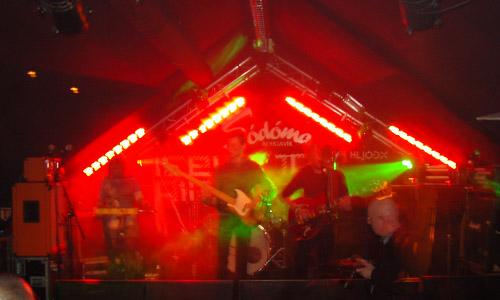
The venues were generally good, and although the Reykjavík Art Museum's set-up and lighting wasn't as nice as it was in 2006. It did have a high enough stage to make sight-lines good for all but the shortest patrons- and risers along the sides and back would have helped with that, too. NASA, a large club, was a little better, except when it was crowded. Sódóma and Grand Rokk were both second-floor clubs, which meant low ceilings and low stages, but both were fine when not too full. Grand Rokk, kind of cruddy to begin with, was downright scary when over-stuffed. Still, none was as claustrophobic as the old Gaukurínn used to get. Iðno seemed a little less inviting this time- the stage set-up was a bit darker and the PA risers which flanked the stage took away from the room's considerable charm (along with the performances of several sub-par acts which I did not review.) Hressó's courtyard tent was a most informal and comfortable venue possessing very organic vibe. I missed Batteríð- the few acts I wanted to see there always had a long line.

The off-venues have greatly expanded since 2006; there was music everywhere. Most of these mini-concerts were in record stores and funky coffee-houses. The big stage in Skífan probably had the most effective presentation, with the most incongruous being at Eymundsson's bookstore (nice view of the jail, though!)

But the best venue by far, large or small, was the Nordic House, with its cozy 50 seat auditorium. Although it had no stage per se, the intimate nature of the mostly acoustic performances there didn't need one. Some acts, like Pascal Pinon, Oh Land! and Casio Kids suited the room perfectly. Kudos to Sari Peltonen and all the people at Nordic House for an unforgettable series of ten concerts (and Q & A sessions) over three days. It is well worth the trek across a windy heath.


Finally, the main reason I love the Airwaves is that the chance of seeing something new and exciting is always high. Even groups whose musical styles I don't care for had good things going on- Captain Fufanu, two teen-aged technos, have the potential to become monsters. Cosmic Call showed themselves capable of creating solid rock tunes, while Útidúr and Rökkurró both expanded the usual musical boundaries of pop-rock. All of the orchestral/fusion groups (Hjaltalín, DJ Margeir, Daníel Bjarnason) were exceptional. Musical considerations aside, some acts were just plain fun to see (Vicky, Dr. Spock, 22, Casio Kids, Ultratechnomegabandið Stefán) and there were many singer-songwriters (maybe a few too many) who showed promise (Toggí, Oh Land!, Uni, Hraun, Björt) and just some good old hard-rock bands (Æla, Bárujárn, Darling Don't Dance.)

I saw over 40 acts, less than a quarter of the total, and all were within walking distance of each other- some of the venues were only meters apart. Reykjavík is a fun city, day or night, with many shops, galleries and places to eat. Almost all of them are original concepts, not franchises:


In general, the Icelandic bands were, by far, the most exciting and innovative. I might have to wait a few years before I return, if only to give a new crop of Icelandic acts time to develop and mature.

By Professor Batty


Comments: 3 


Thursday, October 15, 2009

Iceland Airwaves Update - Day Two

Things were off to a roaring start today (or rather last night, when the winds were well in the 50 mph range after midnight) but (almost) everything was sunshine and flowers at a small off-venue concert held in the early afternoon at the Nordic House, a Scandinavian library and cultural study institution located near the University:


Hafdís Huld, an experienced singer-songwriter performed catchy pop-rock with her band in the intimate auditorium. Very professional, very positive and upbeat in personality, Hafdís charmed the small crowd:


Hraun, whose leader/singer/songwriter Svavar Knútur is from the Westfjords (his promo shot shows him bottle-feeding a lamb!) is about as close to an elf as you can get. His reworking of Darling Clementine into something quite new was exceptional. He got the audience to sing along on a couple of tunes, and we were great as well:


Just for Rose: here's a little library porn:


Rokkurró, what some might call a "shoegazer band", did some art-rock on the main stage at the Reykjavík Art Museum. With a strong vocalist who doubled on cello they were pretty good, in their way, in a short set:


I didn't know what to expect from Björt, so I headed over to Hressó, where they had a stage set up under a big tent- beer garden style. She came on with a full rock band, but sang songs with titles such as "Happy Memories" and "With Love to my Parents", I know that it sounds corny but she was sincere and it was very nicely done:


Next up was a trip back to the Grand Rokk to see something completely different, Vicky:


And they were great. Sample song titles: Robutussin and My Black Lesbian Lover. They definitely had the most fun performing of any group I've seen so far. I LOVE RIOT GRRRLS!

To complete this most eclectic night, I went back over to Fríkirkjan to see Hjaltalín perform with a TWENTY PIECE ORCHESTRA! Every Iceland Airwaves usually has a few moments that are simply mind-blowers and this was definitely one of them: Fully orchestrated songs with overtones of Ligeti, Stravinksy, and Spector... Phil Spector, that is. Conducted with inspiration by Daniel Bjarnason, this was a full hour of magnificent music. Stunning.


And The Airwaves isn't even half over!

By Professor Batty


Comments: 5 


Friday, November 09, 2018

Iceland Airwaves Day Two


Residence window display, Bergtaðastræti

We spent the day walking about; we spotted my old blog-pal Auður on the street, giving a tour. We didn’t interrupt her when she was working. The Weaver bought some wool and I went into 12 Tónar, picking up some CDs and the EP/Chocolate bar of JFDR’s:


I’d say that you’ve really made it when they make a personalized chocolate bar.

A mix of acts today we saw Petúr Ben and Nini Julia Bang at the Nordic House off-venue. Petúr was accomplished but Nina was supernatural, singing her spooky folk songs with help from JFDR and Sóley:


Petúr Ben


Nini Julia Bang

Nina’s performance was the highlight of the festival so far:


The evening was a bit of a blur, but here are some pix to give you an idea. The first act we saw was Vicky, I had seen them in 2009, they were a little older, but could rock just as hard now as they did then. The SiriusXM personality, Rolling Stone and Mojo journalist David Fricke was in attendance:


Vicky

We went over to Iðno to see Ateria end their set, they were just as spooky as they were the night before:


Ateria

We then bopped over to Fríkirkjan, a  nineteenth-century church that was featuring a young chamber orchestra playing divinely:


Gabriel Ólafs

Back to Iðno, where Gyða was playing with a string section, with the great Shahzad Ismaily on percussion:


Gyða with Shahzad Ismaily

Over at the National Theatre, the duo Hugar was doing some trippy things with guitar, synths and trombone:


Hugar

The highlight of the evening was Högni. I had seen him play with Hjaltalin in 2009, this was a whole ’nother thing. A string quartet was, at times, “directed” by Högni from one of the boxes at the side of the auditorium. This gave way to a wild hipster-ish rant about life and time. Very theatrical and musical:


Högni

At midnight Ólafur Arnalds, neoclassical composer and conceptual artist, performed a series of ambitious pieces that somehow lacked focus for me. Pretty, though:
Tomorrow’s Airwaves coverage…

By Professor Batty


Comments: 2 


Friday, October 16, 2009

Iceland Airwaves Update - Day Three


The day program at the Nordic House is getting better and better, with interesting acts doing personal and intimate songs in this cozy auditorium. The first act today was billed as Oh Land, (Nanna Øland Fabricus), a gifted natural singer from Denmark who played her beautiful songs on piano (both grand and toy) with a bassist. Her song I Feel Like Running described her feelings when she had been told that she would never dance again (she had been a ballerina). Heavy stuff:


A bass-less Casio Kids (from Norway) normally play the big venues (as they would later that night) but fit in here just as well with their "acoustic" set. They've been known to do a kindergarten tour from time to time, but make no mistake, they are great musicians- George Martin even produced one of their albums:


The next act was Toggí, who usually fronts a band, but played solo today. His well-crafted songs were interspersed with hilarious banter. If he decided to pursue stand-up he would be a knock-out. A group of preschoolers came in to enjoy the show as well:


Finally, Agent Fresco performed completely acoustically. Their lead singer contacted me, complaining about what I had posted, so I deleted all my references to them.

I ran into Wim Van Hooste (sitting behind the photographer in the Toggi shot), whose Icelandic music blog I've followed for years. He introduced me to his Icelandic friend Heiða and we all shared notes. I managed to squeeze in a couple more off-venue shows including the Nick Cave-inspired Hudson Wayne at the fabled 12 Tonar record store:


For the start of the evening festivities I saw the Icelandic Surf band Bárujárn ("Bare Iron") ripping it up at Sódóma. The addition of a theremin gave the music a nice coloration. Great, loud, crazy, with a bit of a tendency toward heavy metal, but I'm not a purist:


Stopped by Iðno and heard composer Daníel Bjarnarson and his chamber orchestra. Real classical music, although seeing Daníel conduct at the keyboard of a Fender Rhodes piano gave me a little flashblack of Gil Evans. The first piece, All Time to Silence Comes was a tone poem and most effective. They played some additional works which were all well received:


I hadn't got quite my fill of riot grrrls, so I returned to Grand Rokk to see the Danish group Darling Don't Dance. Not as polished as last night's Vicky but more in the style of the old Minneapolis group Babes In Toyland. They even did some effective feedback solos. Makes my heart glad to see these young women empowered with high-power Marshall amplifiers- AND THEIR GUITARS WERE IN TUNE!:


By Professor Batty


Comments: 3 


Thursday, October 14, 2010

Warming Up- Iceland Airwaves 2010- Thursday

Have breakfast with my favorite riot grrls, Vicky at Prikið (10:00), they are an absolute joy:
If they bring their Marshall Amps you might need earplugs, but they are oh so worth it!

For a complete change of pace, the Nordic House has their acoustic afternoons starting today (13:00-17:00), all the Icelandic groups are great, and they even have acts from the Faroes and Greenland as well. It's worth the walk across Hringbraut and the heath, and the Nordic house is very cool, with a nice restaurant (Dill). Check it out on Friday and Saturday, too.

Hressó has a good late afternoon off-venue program as well- between here and the Nordic house you can see 6 hours of music before the night even starts!

Today there is a very special appearance from Steindír Anderson and Hilmar Örn Hilmarsson at 12 Tónar (17:30)- well worth standing in line for. Night shows of note: Risið has the wonderful Pascal Pinon at 20:20:


photo:Steffans Schmid, Gig-Net.com


while Amiina starts a few minutes later at the art museum across the street:


Nasa and Tjarnarbío have full lineups of good Icelandic groups, you can't go wrong at either place:


Nasa Crowd, 2009

By Professor Batty


Comments: 1 


Monday, July 01, 2013

Faktorý

I recently learned that the venue in Reykjavík (where I took the images below) will be razed in August for yet another hotel. Grrrrr. It seems as if many of the places I've enjoyed "discovering" in Reykjavík over the last 13 years are vanishing, including Sirkus, NASA, Hemmi og Valdi and now Faktorý.  This club (as well as its previous incarnation Grand Rókk), was a main venue of the Iceland Airwaves music festival; the sometimes sweltering confines of the intimate second floor room was perfect for showcasing new acts.

Here are a few images of memorable shows I attended in the now soon-to-be-history venue:


Retro Stefson, 2006 (debut)


Vicky, 2009

Sprengjuhöllin Panorama
Sprengjuhöllin, (debut), 2006


Samaris, 2012

Útidúr, 2009 (debut)


Pascal Pinon, 2009 (debut)

By Professor Batty


Comments: 2 


. . . . . . . . . . . . . . . . . . . . . . . . . . . . ©Stephen Charles Cowdery, 2004-2025 . . . . . . . . . . . . . . . . . . . . . . . . . . .