Friday, June 03, 2022

Sixty Kilos of Silja and Hallgrímur

It looks as if I booked my upcoming Iceland trip a couple of months early.

I found a site soliciting for a three-day trip in northernmost Iceland in September. Here is the Google translation of the prospectus:

Course in Siglufjörður, 9 - 11 September 2022

With Hallgrímur Helgason and Silja Aðalsteinsdóttir

The travel agency Mundo is a real pleasure to offer sixty hours of education and joy for the curious, bookish and travel-thirsty. During the course, Silja Aðalsteinsdóttir and the author himself, Hallgrímur Helgason, discuss the prize book Sixty kilos of slaps and of course the course will be held in Siglufjörður. This is a true education, entertainment, culture and training where participants get to drink from the well of wisdom of Silja and Hallgrímur as well as go around Siglufjörður and the nearby fjord. In this way, readers get to know the storyline of the book closely, in addition to which we look into the Folk Music Center and look at the Herring Museum with the book in mind. Weather permitting, sailing will cost extra. Örlygur Kristfinnsson, the forerunner of the Herring Museum, will be our special guide in sailing and hiking outside the fjord.


While I am truly travel-thirsty and eager to drink from Hallgrímur’s and Silja’s well of wisdom the fact that it will all be in Icelandic and that the book in question has not been translated (nor has the previous book in the series), will keep me from attending—even if I had the time. I have previously spoken with both of these literary greats and I am sure that this will be a most stimulating weekend for those curious and bookish travelers fluent á Íslensk.  Hallgrímur is a wonderful writer, he is usually featured in Best Modern Icelandic Authors listings.

By Professor Batty


Comments: 0 


Monday, October 08, 2018

Iceland Airwaves Countdown #5

31 Days!

The Hitman’s Guide to Housecleaning

A Novel by Hallgrímur Helgason
Amazon Crossing 2012

This review, masquerading as an Airwaves update, actually has some connections to that event. Most of it takes place in Reykjavík in 2006, the year I first went to Iceland Airwaves. One of the main characters works for the Airwaves and much of the action takes place in and around familiar Reykjavík landmarks. I was completely swept up in the location and events of the setting. Hallgrímur Helgason is a satirist who specializes in skewering Icelandic culture, his outlook is always acidic; the protagonist of this book is one Tomislav Boksic, formerly a Croatian paramilitary soldier who became a hitman for the Croatian mafia in the U.S. scoring 65 kills with a hitch until he messed up big-time with the 66th—a FBI undercover agent. This sends him fleeing; he is spotted in the airport waiting to catch a flight to Zagreb so he kills a priest in an airport bathroom and assumes his identity and flight plan, ending up in Iceland.

Hallgrímur wrote this book, his first in English, and he has a knack for clever word-play, in both English and mangled Icelandic. It is very dark—at times almost revolting—but that is an essential element of the book’s premise. It is also very funny. That it is set in a particular era and has numerous references to events of that time gives it a historical feel; the mid-aughts were special in Iceland. It was a time and a place that I was aware of as well as a participant. That said, the book might not mean as much to someone who is less aware of the milieu from which it sprang.

By Professor Batty


Comments: 6 


Wednesday, August 13, 2014

Hallgrímur's Magnificent 7%

The most memorable cultural event which I had during my 2004 trip to Iceland was experiencing a National Theatre production of a play adapted from Hallgrímur Helgason’s 1994 novel Þetta er allt að koma (This is all coming).

My mind was, to use an overworked cliché, blown.

After the play I had realized that there was a lot more to Icelandic culture that I had imagined—where had these collective hallucinations sprung from?

Ten years on and I am still learning.

While it has been hard for me to explain to my friends my obsession,  Hallgrímur expresses an eloquent case for The Arts in his essay The Magnificent 7%  published in the Reykjavík Grapevine. It is a great, great summation of why Icelandic art and culture has become so important in the last thirty years. My impressions are, of course, shaped by a limited experience. But Hallgrímur’s Grapevine piece really gives an excellent overview to a vibrant scene, and why The Arts so are important, not just to the people in Iceland, but to everyone, everywhere.

Image: DV

By Professor Batty


Comments: 0 


Monday, February 20, 2023

Summit at Sandholt

Chapter 8 of Search For a Dancer, a serial memoir about a week I spent in Iceland. Mondays on Flippism is the Key
I spotted her immediately.

We were meeting at the Sandholt Hotel/Bakery/Restaurant/Haberdashery for a late lunch. Even though it was after 1400 hours the restaurant was still crowded. She walked in just before me; I had to hustle a bit to catch up to her. I touched her shoulder lightly and said “Silja… ” She turned and said “I was wondering if you would recognize me.” I assured her that it wasn’t a problem. Although it had been 10 years since we last met her visage had been featured in numerous articles that I had read online since then. Her face showed her years but her posture and the sparkle in her eyes belied her age.

When it comes to Icelandic literature, Silja is the real thing: a writer, an editor, a translator and even theatre critic. In her presence I felt as if my Flippism blog-posts on Icelandic culture were the work of a poseur—a literary wannabe—as was the Laxness in Translation website that I had developed years ago. That site (about the works of Icelandic author Halldór Laxness), was how we came to know each other. She had written an essay on the novel Salka Valka that had been published in The Reykjavík Grapevine, an English language weekly tabloid newspaper. It had been easy to get in touch with her via Já.is  (a national directory) and she had been willing to let me publish her essay. The LIT site was fledgling then but in the last decade it had become sort of a de facto international clearinghouse for information on the author and his work. Our previous meeting was rewarding and I was looking forward to talking with her again.

Salka Valka, first published in 1931, had recently been republished in a new translation, creating quite a stir in literary circles and garnishing many favorable reviews in the print media including The New Yorker, The Washington Post, and The Wall Street Journal. At my mention of it Silja became more and more animated as she described her participation in a recent seminar. Halldór’s biographer Halldór Guðmundsson was scheduled to lead a discussion group about Salka Valka and had a scheduling conflict so he asked Silja to take over. She jumped at the opportunity; “I was on fire… ” she said, eyes dancing, “… and the reception was most enthusiastic.” Adults of all ages had been captivated by the story of the poor girl who grew up unwanted in a fishing village. More than just a character, her struggle with the injustices of society was and is an inspiration to thousands of Icelandic women. We talked about how the book presaged the #MeToo movement, and how it was also a critique of both Capitalism and Socialism.

I had read that she recently participated in a literary retreat with renown Icelandic writer and artist Hallgrímur Helgason. I spoke of it and the topic of conversation turned to him: “Hallgrímur, what a wonderful man,” she said, gushing with obvious affection. She noted that in spite of his often pointedly satiric novels and plays, he had a great love for Iceland and its people, about how he had embraced the #MeToo movement with an article about his rape experience. I mentioned speaking with Hallgrímur (on Zoom) about his play Þetta er allt að koma and she remembered it vividly, commenting on its fantastic set design. She also brought up the play’s lead, Þorunn Erna Clausen, and rued that she had not pursued her theatre career further, I mentioned that she had been featured in Documentary Now! (a parody show that featured Fred Armisen) and she was also on the television series Trapped! At our first meeting she had given me some tips on Icelandic theatre productions; I then discovered that she had published ‘amateur’ reviews in TMM (a literary magazine) which were a fount of information that I consulted whenever I went to the theatre in Reykjavík. Being a critic in a small country like Iceland requires a great deal of tact and her reviews reflected that, but her lack of animosity made them invaluable for an outsider like me—just the basics—there was no literary baggage to unpack. I told her of my wife and I and seeing Páll Óskar in The Rocky Horror Show in 2018. “Ah! I saw him in that when he was in college!” she said, smiling at the memory.

Silja related a story about the James Joyce tower in Dublin—a writer’s dream vacation—which turned into a nightmare after she fell and broke her leg, severely. One of the Irish EMTs who attended her wanted to take her to a local clinic, but the other one thought it serious enough to go to the main hospital where a group of doctors operated and reset her leg with pins. They must have done a great job in that she was able to walk so well now. “My son-in-law helped me, I couldn’t live at home because of the stairs, so he took care of me every morning, with a hot breakfast and fresh-squeezed orange juice, he was an angel. Now my house is for sale—my late husband said that when we can’t handle the stairs we would move out; that time is now.”

We talked a bit about blogs, I said that although the traffic to the Laxness in Translation website was steady there wasn’t much of a surge when Salka Valka was republished. I mentioned that my personal blog, Flippism is the Key, was still holding on in its 18th year, but that I could see a time when I would stop posting on it. She looked at me closely and then asked, “How old are you?” “72,” I replied. “Oh, you’re just a baby!” she exclaimed, “I’m 79, and I just finished translating Jane Austen’s Sense and Sensibility into Icelandic!” I have often been in awe of my Icelandic correspondents achievements and this was one of those times. After we had been talking for about an hour she said “I haven’t spoken English a long time.” Her use of the language was impeccable.

We finished our meals, and then prepared to leave. “I’ll take care of this,” I said, picking up the check, “It makes me feel like a big shot.” Silja gave me a side-eye. We went out and walked the half-block to the bus-stop on Hverfisgata. As we waited for her bus our conversation flowed on. My thoughts went to the word Sprakkar, an Icelandic word meaning outstanding or extraordinary women, recently used by the ‘first lady’ of Iceland, Eliza Reid, married to Guðni Thorlacius Jóhannesson, Iceland’s president. Here was a sprakkar, standing right in front of me, being extraordinary and outstanding. After thinking of Eliza, I mentioned that I was going to see the President of Iceland speak on Thursday morning, to which she replied: “Oh!, My daughter is his secretary.”

Of course. Everybody in Iceland knows Silja.


Search for a Dancer Index…

By Professor Batty


Comments: 0 


Wednesday, January 31, 2018

Woman at 1000 Degrees

A Novel by
Hallgrímur Helgason
Translated by Brian Fitzgibbon
Workingman Press 2018

I've traveled down some of Hallgrímur’s literary paths before. Most famous for Reykjavík 101,  the novel upon which the film was based and arguably the leading satirical Icelandic author, his specialty is skewering hagiographic biographies. This is a different sort of biography, partly based upon real people and events, but ultimately a work of fiction.

The woman of the title is one Herra Björnsson, born in 1929, and telling the story from 2009, living in a converted garage in downtown, lying on a bed all day with a hand grenade, a personal computer, cigarettes and memories. And what memories they are!  Europe in World War II, Argentina in the late forties and early fifties, partying with the Beatles in Hamburg, mothering (in a fashion) four children and having numerous sexual partners but few real lovers.

This is a book that closely examines the human condition, with a special emphasis on war and how it destroys the lives of women and men, even if they survive the battle. Iceland, and its relative lack of importance in the scheme of things is a recurring sub-theme, as is how the cult of personality destroys lives. Helgason’s writing is always sharp, and the translation is excellent. That said, this book might be a little too quirky for a mass audience, I got a lot out of its small details, especially the Icelandic history, but the average reader might find it fussy and odd; the protagonist doesn’t generate much sympathy; the other characters even less. It is a funny book at times, but not a happy one.

By Professor Batty


Comments: 1 


Monday, September 27, 2021

Mondays in Iceland -#122

A One-Hour Cultural History of Iceland
Icelandic author and artist Hallgrímur Helgason and interviewer Eleanor Wachtel discuss Iceland in general, touch upon other modern Icelandic novelists, and delve into Hallgrímur’s life and work in particular: Well worth a listen.

This is one episode of the excellent CBC radio series Darkness and Light: The Nordic Imagination.

By Professor Batty


Comments: 0 


Monday, February 08, 2021

Mondays in Iceland - #101

Lovers, Ráðhús Reykjavíkur and Tjörnin, Reykjavík, October, 2012

My Covid Confinement musings have returned to Iceland with the gradual rollout of the vaccines giving me hope for one more visit in the not-too-distant-future (I already have a ticket!) And what better way to nurse these dreams than by resuming this weekly photo feature?

Some other good news about Iceland, besides their effective Covid control measures (4 cases diagnosed in the last two weeks!), is that the canceled Iceland Writers Retreat of 2020 is going to happen, albeit virtually. While it won’t be the same as being there, it will actually have a wider slate of writers, and I’ll be able to take in as many seminars as I want. Hallgrímur Helgason will also present there, a fact which makes me very happy!

Much more on Iceland

By Professor Batty


Comments: 2 


Monday, October 30, 2017

Þjóðleikhúsið Revisited

NOTE: This is an expanded version of a FITK post from 2004

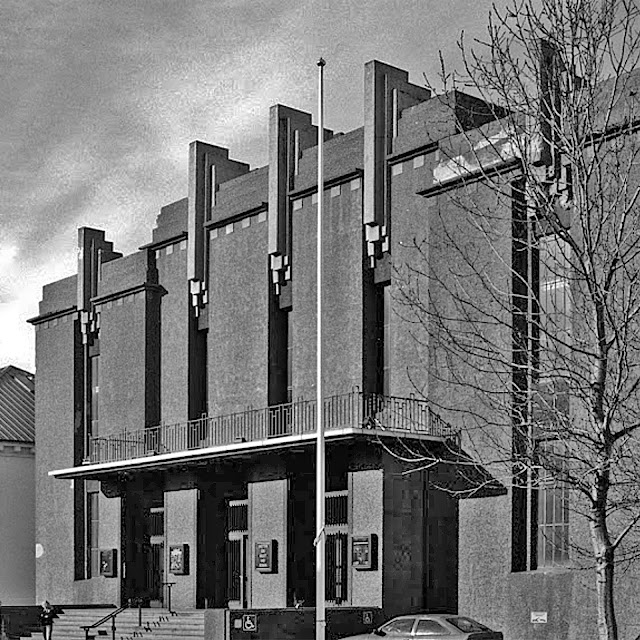
The National Theatre of Iceland is located in a severe, stucco-covered building on Hverfisgata in the old part of Reykjavík. It is not a big tourist destination (it is closed in the summer and the plays are presented in Icelandic.) This is serious theater and is a challenge for even the most open-minded visitor.


Last winter, I had the opportunity to attend a performance of Þetta er allt að koma (“This is all coming”), adapted and directed by Baltasar Kormákur from the satirical Hallgrímur Helgason novel:


In a series of sometimes bizarre vignettes, the story of the aspirations and setbacks of an aspiring performer and her extended Icelandic family is portrayed.


While watching this marvelous production (with a brilliant set design) I felt as if in a waking dream; a dream where I usually couldn’t follow the dialogue; it always seemed as if I was missing a piece of the puzzle:


At the end of the play, with a grand finale in a wedding reception, I was laughing and applauding the triumph of the actors’ skill in portraying the human condition—no translations were needed.


Although Icelandic Theatre is not available here in the US, (that would be a small niche market!) there are several Icelandic movies that can be found if one is diligent. 101 Reykjavík, Noi the Albino, The Laughter of the Seagulls, and Cold Fever are all worthwhile (and have many of these same fine actors in them.)


Production stills: Þjóðleikhúsið

By Professor Batty


Comments: 1 


Wednesday, October 15, 2014

Dramatic Reykjavík

Those of you interested in exploring Icelandic culture may find that a visit to one or both of the two major theater companies in Reykjavík to be most rewarding. They aren't usually listed in most tourist guides for a couple of reasons: they are not active in the high tourist season and the plays are all in Icelandic. If you do happen find yourself in town between September and May you would be wise to check them out:


Þjóðleikhúsið, Reykjavík

Þjóðleikhúsið, the National Theater, is located in an intimidating structure on Hverfisgata, with a smaller "box" theater situated on the street behind it—Lindargata. Þjóðleikhúsið produces a mixture of plays every season, including serious drama by foreign playwrights, modern Icelandic drama, several productions for children, and contemporary Icelandic comedy. These are world-class productions with fantastic sets and brilliant direction. They feature many of the fine actors you've probably already seen in Icelandic films. The smaller Kassinn (box) venue features intimate productions and are usually somewhat "edgier". Baltasar Kormákur's 2006 production of Peer Gynt was the most intense theater experience I've ever had. The main stage offers a little more traditional fare (but only a little), Hallgrímur Helgason’s Þetta er allt að koma in 2004 was a wild ride through Icelandic consciousness.


Borgarleikhúsið

Borgarleikhúsið is the City Theater. Located on the south end of Kringland, it usually runs a little lighter in tone, with an emphasis on musicals and family fare (Mary Poppins, for example). The smaller theater offers current playwrights; on a recent visit I saw John Logan's Red (Rautt), a Tony-award winning play about the artist Mark Rothko. The theater complex is newer than the Þjóðleikhúsið and contains a vast lobby (for both venues) well worth a visit on its own.

Don’t let the language barrier prevent you from attending one of these plays. You might want to avoid overly "talky" dramas, but I've found that the expressive acting in most plays usually makes up for my lack of literary comprehension. A play you are familiar with, for example Shakespeare's Macbeth, would lose little in translation. The tickets are reasonable (4400 kronur, about $35 or £24) and while it is possible to order on line, it requires some help from Google translate. You might want to visit the box office a couple of days in advance for the performances often sell out. If you are by yourself, or can't convince your traveling partner to come along, you'll have a better chance of scoring a single ticket to a popular show. Part of any theater experience is people watching during the intermission and the Icelanders do enjoy dressing up for the occasion so dress up yourself—and you'll become part of that show! The matinees are somewhat less formal.

A big part of Iceland's appeal for me is its spoken language. Attending a play there is an opportunity to hear it at a very high level. This form of Icelandic culture, when distilled into a dramatic context, creates memories which you'll never forget.

Note: a slightly different form of this post was originally written for the I’d Rather Be in Iceland Blog.

By Professor Batty


Comments: 0 


. . . . . . . . . . . . . . . . . . . . . . . . . . . . ©Stephen Charles Cowdery, 2004-2025 . . . . . . . . . . . . . . . . . . . . . . . . . . .