It looks as if I booked my upcoming Iceland trip a couple of months early.
I found a site soliciting for a three-day trip in northernmost Iceland in September. Here is the Google translation of the prospectus:
Course in Siglufjörður, 9 - 11 September 2022
With Hallgrímur Helgason and Silja Aðalsteinsdóttir
The travel agency Mundo is a real pleasure to offer sixty hours of education and joy for the curious, bookish and travel-thirsty. During the course, Silja Aðalsteinsdóttir and the author himself, Hallgrímur Helgason, discuss the prize book Sixty kilos of slaps and of course the course will be held in Siglufjörður. This is a true education, entertainment, culture and training where participants get to drink from the well of wisdom of Silja and Hallgrímur as well as go around Siglufjörður and the nearby fjord. In this way, readers get to know the storyline of the book closely, in addition to which we look into the Folk Music Center and look at the Herring Museum with the book in mind. Weather permitting, sailing will cost extra. Örlygur Kristfinnsson, the forerunner of the Herring Museum, will be our special guide in sailing and hiking outside the fjord.
While I am truly travel-thirsty and eager to drink from Hallgrímur’s and Silja’s well of wisdom the fact that it will all be in Icelandic and that the book in question has not been translated (nor has the previous book in the series), will keep me from attending—even if I had the time. I have previously spoken with both of these literary greats and I am sure that this will be a most stimulating weekend for those curious and bookish travelers fluent á Íslensk. Hallgrímur is a wonderful writer, he is usually featured in Best Modern Icelandic Authors listings.
A Novel by Hallgrímur Helgason
Amazon Crossing 2012
This review, masquerading as an Airwaves update, actually has some connections to that event. Most of it takes place in Reykjavík in 2006, the year I first went to Iceland Airwaves. One of the main characters works for the Airwaves and much of the action takes place in and around familiar Reykjavík landmarks. I was completely swept up in the location and events of the setting. Hallgrímur Helgason is a satirist who specializes in skewering Icelandic culture, his outlook is always acidic; the protagonist of this book is one Tomislav Boksic, formerly a Croatian paramilitary soldier who became a hitman for the Croatian mafia in the U.S. scoring 65 kills with a hitch until he messed up big-time with the 66th—a FBI undercover agent. This sends him fleeing; he is spotted in the airport waiting to catch a flight to Zagreb so he kills a priest in an airport bathroom and assumes his identity and flight plan, ending up in Iceland.
Hallgrímur wrote this book, his first in English, and he has a knack for clever word-play, in both English and mangled Icelandic. It is very dark—at times almost revolting—but that is an essential element of the book’s premise. It is also very funny. That it is set in a particular era and has numerous references to events of that time gives it a historical feel; the mid-aughts were special in Iceland. It was a time and a place that I was aware of as well as a participant. That said, the book might not mean as much to someone who is less aware of the milieu from which it sprang.
SPECIAL NOTE: I’m in Reykjavík RIGHT NOW and will be giving updates on new performances including Nýtt eldhús eftir máli (tonight) and Ormstunga (tomorrow afternoon.)
Þjóðleikhúsið (National Theatre)
Over the last two decades a recurring topic of FITK has been Icelandic Theatre. Is it ironically appropriate in that the National Theatre building is the same age as me?
Borgarleihusið (City Theatre)
Like many aspects of Icelandic Culture, the dramatic arts have had an outsized influence in the world. Not the stage productions themselves (although the 2006 production of Pétur Gautur did play in London) but through Icelandic and world cinema and television productions. Notable actors (Ólafur Darri and Ingvar Eggert Sigurðsson, Anita Briem) and stage director Baltazar Kormákur have been part of big-budget films. Film composers Jóhann Jóhannsson and Hildur Guðnadóttir (who both started out in Icelandic theatre) have won numerous awards including: Golden Globes, Baftras, Emmys and even an Oscar. The first woman elected president in the world, Vigdís Finnbogadóttir, was the director of the city theatre when she was elected.
I’ll list the productions I have seen in chronological order.
Þetta er allt að koma by Hallgrímur Helgason, d. Baltazar Kormákur, 2004, Þjóðleikhúsið, Main stage:
My Icelandic theatre crawling started with a bang with this wild satire of a talent-challenged performer who always believes that “Things are going great” as her life falls apart in various picturesque ways. The most inventive set I’ve ever seen in a stage play, much of it is set in a huge furry box with a multi-section floor continuously sliding back and forth. I did manage to speak with the playwright (via Zoom) twenty years later. Alas, there were no new plays from Hallgrímur on the horizon. The next production I saw was also directed by Baltazar and was, in some ways, even wilder.
Pétur Gautur (Peer Gynt) by Henrik Ibsen, 2004, Þjóðleikhúsið, Black Box stage:
One of Ibsen’s most intense plays, and it was doubly so in the intimate confines of the small ‘black box’ theatre on Lindargata. My companion and I were almost within touching distance of the actors! The fish cleaning scene (with real fish) was memorable, and they eliminated the ‘second wall’ when the fire escape double door in the back of the stage was opened and the action went outdoors - with people on the street walking by in the background! The play ended with the stage floor covered in blood, money, and ashes as the lights went out.
Frida, vida la vida… written, directed and starring Brynhildur Guðónsdóttir, 2009, Þjóðleikhúsið, Main stage:
This was a very stylized production, with Frida Kahlo’s paintings becoming a part of the set. Figures from them, most notably Óxlotl, her dog (and also the Aztec dog of the underworld), and La Catrina, the Mexican goddess of death, came alive on stage. Frida’s life, including her disfiguring accident and her stormy relationship with Diego Rivera, was told in a grim, nightmarish fashion that became frightening at times. Ólafur Darri Ólafsson was Rivera with a commensurate stature appropriately larger than life. Frida’s politics were also covered, even Leon Trotsky made a memorable appearance. That a regional Icelandic theatre would produce an original play about Frida shows what an influence her art and life has had worldwide. The Selma Hayek movie version was visually stronger, as would be expected from a Hollywood movie, but this production brought out the internal struggles of Frida in a more compelling way. The cognitive dissonance in this production was pretty high, which added to the play’s surreal quality.
Jónsmessunótt, by Hávar Sigurjónsson, 2012, Þjóðleikhúsið, Black box stage:
Kristbjörg Kjeld and Arnar Jónsson are the parents of an unruly clan meeting for a reunion on midsummer’s day. The father, who has numerous affairs over the years, is deluded in thinking that his family respects him but in reality they all know he is a philandering fraud. The set featured clever intersecting boardwalks used in numerous ways:
As the audience filed in the actors mimed as if they were a continuous loop in a DVD menu.
Rautt (Red), by John Logan, Borgarleihusið 2012, small stage:
THE Icelandic drama reviewer Silja Aðalsteinsdóttir personally recommended this play to me. Although the play was quite wordy, the context (late fifties New York art scene) and numerous instances of name-dropping in the script helped me follow the gist of the story. Mark Rothko (Jóhann Sigurðarson) and his fictional assistant (Hilmar Gudjonsson) have heated conversations about the meaning of modern art vs. pop culture:
The play’s major conceit is the real-time creation of Rothko’s art on 2x2 meter canvases. As Silja had mentioned to me earlier, Jóhann was exceptional as Rothko.
Heimkoman by Harold Pinter, 2015, Þjóðleikhúsið, Main stage:
The Homecoming is a strange two-act play which explores the dynamics of sexual power in an English family. Teddy, the eldest son, brings his “wife” Ruth home from America to the seedy house where his father, an uncle, and two other brothers live. In the version I saw, in preview, the stage had morphed into a service garage complete with operating plumbing. This sleazy psychodrama unfolded in this hyper-realistic yet surreal set. I could understand few of the words, but the emotional language of the actors was quite clear, as was the full male nudity added to the mix. In a short conversation with the woman sitting next to me (who goes to ALL the plays), I mentioned some of the more memorable plays I had seen there and her appraisals more or less matched mine. In this play, she was put off by Pinter’s 1960s sensibilities.
The Rocky Horror Show By Richard O’Brien, Borgarleihusið 2018, Main stage (lobby shown below):
This was a blockbuster hit in Iceland, with its first run selling out almost instantly. Iceland music legend Páll Óskar reprised his role as Frank-N-Furter which he had performed as a college student twenty-eight year earlier. A true extravaganza, with an intricate set design and first-rate singing actors in all the major roles. My companion and I had never seen the play (nor the film) and were blown away by the excess of it all. Special note must be made of Minnesota’s own Surfin’ Bird by the Trashmen being played during intermission—twice! Rather than have me blather on about the production anymore, here is a video of the Páll’s opening number, you can judge for yourself:
Vertu Ulfur (Be a Wolf) directed by Unni Ösp Stefánsdóttir, 2022, Þjóðleikhúsið, Main stage:
I can’t even begin to explain it, much less justify it.
The one-man stage play is based on Héðin Unnsteinsson's autobiographical narrative of the same name. It was described as a crazy journey through the “… dangerous places of the mind into a world of anarchy and despair and back again, the struggle of a man who manages to break out of the vicious cycle and manages to turn his most terrifying experience into the strength needed to change.”
This production really pushed me out of my comfort zone with its 100+ minutes of Björn Thors’ nearly nonstop monologues in Icelandic, imaginative stagecraft and his masterful emoting. I was enthralled throughout.
Why would anyone go to see a play in a foreign country, performed in an incomprehensible language? I’ve done stranger things, but not many. This production had been a rousing success, with over 100 performances seen by tens of thousands of people, including many middle-school students who were there in abundance that night:
Between trigger warnings and censorship, I can’t see that a performance as intense as this one would be allowed to have an audience of older children and young teens in the U.S.A.
The play opened with a closed curtain. A man in a suit (actor Björn Thors) stepped out in front of it with a pocket full of sand. He used the sand and a piece of chalk to draw a circular diagram of his family and its history. Out of this simple introduction came the story of his struggle with manic-depression, two hours of intense acting that enthralled me with its vivid portrayal of a man struggling with his inner demons. His body language became a sublime dance, choreography of the human spirit. The stagecraft was just as brilliant—the minimal sets were transformed again and again with its archetypal imagery: A rain shower! A forty-foot-long duvet! A vanishing road to nowhere! Evocative lighting made it visual magic.
An aside: A typical tourist, unless they happened to walk into the theatre’s box office out of curiosity about the theatre’s imposing facade, would be unaware of the miracles this venue performs on a regular basis. And if that wasn’t enough culture for one town, the city boasts of another live theatre complex of equal stature, plus several smaller companies.
Before this play started I was sitting on a bench in the outer lobby when woman came in and sat down next to me. We started talking about Icelandic theatre, she was a regular and I mentioned Hallgrímur Helgason’s Þetta er allt að koma. She had known Hallgrímur since he was three years old! She also mentioned what a great man he was—the second time I heard someone say that about him that day!
When the woman for whom my bench-mate was waiting came in she saw us sitting side by side she said to us: “Ah! Brúðkaupsbekkurinn!”
Here is the play, in its entirety, with an additional prologue:
Sjö ævintýri um skömm (Seven Fairy Tales of Shame) a play by Tyrfing Tyrfingsson, 2022, Þjóðleikhúsið, Main stage:
One recurring aim of my trips to Reykjavík is to experience experimental and off-beat Icelandic Theatre.
This production hit the target in the bulls-eye.
This play had been expanded from an earlier one-act which had been a hit in a festival setting.
Several of Iceland’s most celebrated stage and screen actors were in it, including the lead Ilmur Kristjánsdóttir (seen in the TV series Trapped!) as Ölga, Ólafía Hrönn Jónsdóttir (White Night Wedding) as Ölga’s mother Amma, the venerable Kristbjörg Kjeld as her grandmother Fanney, and Hilmir Snær (101 Reykjavík) playing against his usual leading-man-type, as an alcoholic psychiatrist who takes on a troubled client: Öğla.
The psychiatrist abhors cognitive behavioral therapy, and believes that the cure for Ögla's distress lies in finding its roots—which is shame. We follow the two of them throughout the play as she tells the doctor about seven adventures that are crucial to her dilemma, and were caused by the people who were closest to her.
The key dynamic of the work is the uneasy relationships between Ölga and her grandmother and her mother—it shows us how ‘wounds’ are inherited between generations. Playwright Tyrfing used a lot of his childhood memories for the set pieces with the grandmother. Ólafína and Kristbjörg tear into their roles with gusto, it was really a special pairing:
In Ilmar’s performance as Ögla she draws the audience in, as her character falls apart as the play progresses. She is not easy to love—on edge and confrontational, Olga is married to Hanna (Kristín Þora Haroldsdóttir), the two women have the most outrageous artificial insemination scene-gone-wrong I had ever seen:
A crucial scene of the play revolves around the relationship between Ögla and Hanna, about the paradox of the fantasy of love with love in everyday life.
Seven Fairy Tales of Shame celebrates the magic of the theater, queerness and everything that is strange, oblique and excessive in life. This was not your standard dinner theatre fare:
Sem Á Himni, 2022, Þjóðleikhúsið, Main stage:
This musical originally was a Swedish stage production and then a film. It is the story of a conductor who has a heart attack (at the podium!) and then returns to his home town to recover. There he helps out with a struggling choir and in the process everyone grows, learns, and is fulfilled. It was written as a crowd-pleaser with character stereotypes aplenty. The drama is supplied by themes of spousal abuse and small-town politics presented in almost in a check-list fashion:
Overall I found it to be well sung, but with stilted staging, especially compared to the two previous plays I had seen. I had heard from more than one person that the casting of the play was controversial in that one of the characters was a special needs man who was portrayed on stage by a ‘norm’, with no other actors even considered for the role. I could see both sides of the argument; his part was pivotal and needed an accomplished singer and actor to fill it or, conversely, they could have reached out for someone with that background. I imagine there was someone in the tight-knit Icelandic theatre community that should have been given a chance—otherwise there might not have been such a fuss. I had read in a review that the big production number (at the end of the first act) was so good that the remainder of the play suffered in comparison. If that was the play’s high point (and it was impressive) I didn’t want to see any more. I left at the intermission.
Look at the Music! 2023, Tjarnarbíó theatre:
I had never been in Tjarnarbíó before, it was an old cinema restored, seating about 250, a little gem of a venue:
A powerful set of choral music set to complement Sign Language, Look at the Music! was part of a year-long international project involving both hearing and deaf artists with poetry in Icelandic Sign Language (ITM).
The 45 minute show was excellent; the music complemented the signing perfectly. There was even a “sing-along/sign-along” at the end. And there were balloons (Yay!) Beforehand I hob-nobbed with the cultural elite over a bottle of Apelsin, a uniquely Icelandic orangey beverage that I have every time I’m here. It’s awful (shown on the table in the foreground) but I’m weak—I need it.
Ibuð 10B, written by Olaf Olafsson and directed by Baltazar Kormákur, 2025, Þjóðleikhúsið, Main Stage. The set was static, with minimal changes in the background and lighting:
This was a talky play, set in a modern apartment (Ibuð) where a group of residents gathered to forge a covenant for potential incoming refugees who might be living in their building. What started out as an exchange of pleasantries (and wine tasting) turns sour as everyone gets more drunk. When a mixed-race resident comes in with his spouse unacknowledged feelings of bigotry simmer and boil over. I’ll let an Icelandic reviewer give a deeper explanation:
There are big issues here and some are very hot, and Ólafur Jóhann skillfully weaves them together so that from the first quiet minutes, the tension in the living room grows more and more, the characters reveal themselves better and better until we have a clear understanding of how they are put together, where they come from and where they are going. The conversations are fast-paced and often very funny, you have to keep your eyes peeled when it is at its most intense. This is a dense and substantial text, brilliantly thought out and written. ~ Silja Aðalsteinsdóttir, TMM Forlagið
The near-capacity audience gave the cast multiple ovations at the end.
On an unrelated note: I did snap this pic of the old retired lighting board at rest in the upper lobby of the theatre:
Kjallarakabarett, Kjallarinn, 2022, 2025:
What better place to celebrate Halloween than in the ‘cellar’ of the National Theatre. A most welcoming and congenial atmosphere of Pulchritude and Perversion greeted this timid visitor who otherwise wouldn't dream of attending such a spectacle. The MC greeted us with the invitation/admonition “You can take photographs but no flash, please. We’ll do the flashing!” A series of bawdy skits followed and were interspersed with singing and some very titillating amusing stripteases.
40.000 Fet, Tjarnarbíó 2025:
It is always nice to see so many young people at the theatre:
In the lobby a man greeted me thinking I was someone he knew from 30 years ago. I was sorry to have disappointed him, he seemed like a nice guy.
The play was the stylized comedy about two female flight attendants and their flight crew. It was quite bawdy at times, with a serious ending addressing mortality. A nice twist was that when you entered the theatre space the actors portraying the flight attendants greeted you in character, as if you were the passengers:
Dead Air by Álfrún Rose (in English): Tjarnarbíó, 2025
Since Alfie’s dad died, he’s visited everyone’s dreams but hers. Rude. Desperate to talk to him, she uses AiR, an AI chatbot for the dead. A heartfelt, funny, and glitchy deep dive into grief, ghosts, and digital obsession.~ from the Airwaves guide
A good premise, somewhat defeated by an unintelligible voice-shifting device that Álfrún used when she was ‘streaming’ her dead father.
The hour+ performance became a litany of dysfunctional family tropes, even more disturbing because I suspect they were all true. I find it ironic that the only real dud I saw in 21 years of Icelandic theatre was in English!
Performance images by the respective theatre groups.
The most memorable cultural event which I had during my 2004 trip to Iceland was experiencing a National Theatre production of a play adapted from Hallgrímur Helgason’s 1994 novel Þetta er allt að koma (This is all coming).
My mind was, to use an overworked cliché, blown.
After the play I had realized that there was a lot more to Icelandic culture that I had imagined—where had these collective hallucinations sprung from?
Ten years on and I am still learning.
While it has been hard for me to explain to my friends my obsession, Hallgrímur expresses an eloquent case for The Arts in his essay The Magnificent 7% published in the Reykjavík Grapevine. It is a great, great summation of why Icelandic art and culture has become so important in the last thirty years. My impressions are, of course, shaped by a limited experience. But Hallgrímur’s Grapevine piece really gives an excellent overview to a vibrant scene, and why The Arts so are important, not just to the people in Iceland, but to everyone, everywhere.
A Novel by
Hallgrímur Helgason
Translated by Brian Fitzgibbon
Workingman Press 2018
I've traveled down some of Hallgrímur’s literary paths before. Most famous for Reykjavík 101, the novel upon which the film was based and arguably the leading satirical Icelandic author, his specialty is skewering hagiographic biographies. This is a different sort of biography, partly based upon real people and events, but ultimately a work of fiction.
The woman of the title is one Herra Björnsson, born in 1929, and telling the story from 2009, living in a converted garage in downtown, lying on a bed all day with a hand grenade, a personal computer, cigarettes and memories. And what memories they are! Europe in World War II, Argentina in the late forties and early fifties, partying with the Beatles in Hamburg, mothering (in a fashion) four children and having numerous sexual partners but few real lovers.
This is a book that closely examines the human condition, with a special emphasis on war and how it destroys the lives of women and men, even if they survive the battle. Iceland, and its relative lack of importance in the scheme of things is a recurring sub-theme, as is how the cult of personality destroys lives. Helgason’s writing is always sharp, and the translation is excellent. That said, this book might be a little too quirky for a mass audience, I got a lot out of its small details, especially the Icelandic history, but the average reader might find it fussy and odd; the protagonist doesn’t generate much sympathy; the other characters even less. It is a funny book at times, but not a happy one.
Chapter 8 of Search For a Dancer, a serial memoir about a week I spent in Iceland. Mondays on Flippism is the Key
I spotted her immediately.
We were meeting at the Sandholt Hotel/Bakery/Restaurant/Haberdashery for a late lunch. Even though it was after 1400 hours the restaurant was still crowded. She walked in just before me; I had to hustle a bit to catch up to her. I touched her shoulder lightly and said “Silja… ” She turned and said “I was wondering if you would recognize me.” I assured her that it wasn’t a problem. Although it had been 10 years since we last met her visage had been featured in numerous articles that I had read online since then. Her face showed her years but her posture and the sparkle in her eyes belied her age.
When it comes to Icelandic literature, Silja is the real thing: a writer, an editor, a translator and even a theatre critic. In her presence I felt as if my Flippism blog-posts on Icelandic culture were the work of a poseur—a literary wannabe—as was the Laxness in Translation website that I had developed years ago. That site (about the works of Icelandic author Halldór Laxness), was how we came to know each other. She had written an essay on the novel Salka Valka that had been published in The Reykjavík Grapevine, an English language weekly tabloid newspaper. It had been easy to get in touch with her via Já.is (a national directory) and she had been willing to let me publish her essay. The LIT site was fledgling then but in the last decade it had become sort of a de facto international clearinghouse for information on the author and his work. Our previous meeting was rewarding and I was looking forward to talking with her again.
Salka Valka, first published in 1931, had recently been republished in a new translation, creating quite a stir in literary circles and garnishing many favorable reviews in the print media including The New Yorker, The Washington Post, and The Wall Street Journal. At my mention of it Silja became more and more animated as she described her participation in a recent seminar. Laxness’ biographer Halldór Guðmundsson was scheduled to lead a discussion group about Salka Valka and had a scheduling conflict so he asked Silja to take over. She jumped at the opportunity; “I was on fire… ” she said, eyes dancing, “… and the reception was most enthusiastic.” Adults of all ages had been captivated by the story of the poor girl who grew up unwanted in a fishing village. More than just a character, her struggle with the injustices of society was and is an inspiration to thousands of Icelandic women. We talked about how the book presaged the #MeToo movement, and how it was also a critique of both Capitalism and Socialism.
I had read that she recently participated in a literary retreat with renown Icelandic writer and artist Hallgrímur Helgason. I spoke of it and the topic of conversation turned to him: “Hallgrímur, what a wonderful man,” she said, gushing with obvious affection. She noted that in spite of his often pointedly satiric novels and plays, he had a great love for Iceland and its people, about how he had embraced the #MeToo movement with an article about his rape experience. I mentioned speaking with Hallgrímur (on Zoom) about his play Þetta er allt að koma and she remembered it vividly, commenting on its fantastic set design. She also brought up the play’s lead, Þorunn Erna Clausen, and rued that she had not pursued her theatre career further, I mentioned that she had been featured in Documentary Now! (a parody show that featured Fred Armisen) and she was also on the television series Trapped! At our first meeting she had given me some tips on Icelandic theatre productions; I then discovered that she had published ‘amateur’ reviews in TMM (a literary magazine) which were a fount of information that I consulted whenever I went to the theatre in Reykjavík. Being a critic in a small country like Iceland requires a great deal of tact and her reviews reflected that, but her lack of animosity made them invaluable for an outsider like me—just the basics—there was no literary baggage to unpack. I told her of my wife and I and seeing Páll Óskar in The Rocky Horror Show in 2018. “Ah! I saw him in that when he was in college!” she said, smiling at the memory.
Silja related a story about the James Joyce tower in Dublin—a writer’s dream vacation—which turned into a nightmare after she fell and broke her leg, severely. One of the Irish EMTs who attended her wanted to take her to a local clinic, but the other one thought it serious enough to go to the main hospital where a group of doctors operated and reset her leg with pins. They must have done a great job in that she was able to walk so well now. “My son-in-law helped me, I couldn’t live at home because of the stairs, so he took care of me every morning, with a hot breakfast and fresh-squeezed orange juice, he was an angel. Now my house is for sale—my late husband said that when we can’t handle the stairs we would move out; that time is now.”
We talked a bit about blogs, I said that although the traffic to the Laxness in Translation website was steady there wasn’t much of a surge when Salka Valka was republished. I mentioned that my personal blog, Flippism is the Key, was still holding on in its 18th year, but that I could see a time when I would stop posting on it. She looked at me closely and then asked, “How old are you?” “72,” I replied. “Oh, you’re just a baby!” she exclaimed, “I’m 79, and I just finished translating Jane Austen’s Sense and Sensibility into Icelandic!” I have often been in awe of my Icelandic correspondents achievements and this was one of those times. After we had been talking for about an hour she said “I haven’t spoken English a long time.” Her use of the language was impeccable.
We finished our meals, and then prepared to leave. “I’ll take care of this,” I said, picking up the check, “It makes me feel like a big shot.” Silja gave me a side-eye. We went out and walked the half-block to the bus-stop on Hverfisgata. As we waited for her bus our conversation flowed on. My thoughts went to the word Sprakkar, an Icelandic word meaning outstanding or extraordinary women, recently used by the ‘first lady’ of Iceland, Eliza Reid, married to Guðni Thorlacius Jóhannesson, Iceland’s president. Here was a sprakkar, standing right in front of me, being extraordinary and outstanding. After thinking of Eliza, I mentioned that I was going to see the President of Iceland speak on Thursday morning, to which she replied: “Oh!, My daughter is his secretary.”
Icelandic author and artist Hallgrímur Helgason and interviewer Eleanor Wachtel discuss Iceland in general, touch upon other modern Icelandic novelists, and delve into Hallgrímur’s life and work in particular:
Well worth a listen.
Lovers, Ráðhús Reykjavíkur and Tjörnin, Reykjavík, October, 2012
My Covid Confinement musings have returned to Iceland with the gradual rollout of the vaccines giving me hope for one more visit in the not-too-distant-future (I already have a ticket!) And what better way to nurse these dreams than by resuming this weekly photo feature?
Some other good news about Iceland, besides their effective Covid control measures (4 cases diagnosed in the last two weeks!), is that the canceled Iceland Writers Retreat of 2020 is going to happen, albeit virtually. While it won’t be the same as being there, it will actually have a wider slate of writers, and I’ll be able to take in as many seminars as I want. Hallgrímur Helgason will also present there, a fact which makes me very happy!
NOTE: This is an expanded version of a FITK post from 2004
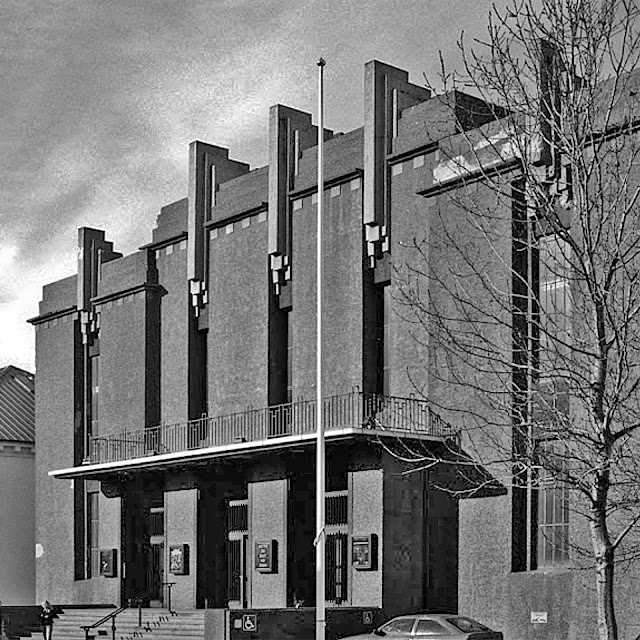
The National Theatre of Iceland is located in a severe, stucco-covered building on Hverfisgata in the old part of Reykjavík. It is not a big tourist destination (it is closed in the summer and the plays are presented in Icelandic.) This is serious theater and is a challenge for even the most open-minded visitor.
Last winter, I had the opportunity to attend a performance of Þetta er allt að koma (“This is all coming”), adapted and directed by Baltasar Kormákur from the satirical Hallgrímur Helgason novel:
In a series of sometimes bizarre vignettes, the story of the aspirations and setbacks of an aspiring performer and her extended Icelandic family is portrayed.
While watching this marvelous production (with a brilliant set design) I felt as if in a waking dream; a dream where I usually couldn’t follow the dialogue; it always seemed as if I was missing a piece of the puzzle:
At the end of the play, with a grand finale in a wedding reception, I was laughing and applauding the triumph of the actors’ skill in portraying the human condition—no translations were needed.
Although Icelandic Theatre is not available here in the US, (that would be a small niche market!) there are several Icelandic movies that can be found if one is diligent. 101 Reykjavík, Noi the Albino, The Laughter of the Seagulls, and Cold Fever are all worthwhile (and have many of these same fine actors in them.)
A Novel by
Auður Ava Ólafsdóttir
Translated by Brian FitzGibbon
Iceland in the 1960s. Hekla always knew she wanted to be a writer. In a nation of poets, where each household proudly displays leatherbound volumes of the Sagas, and there are more writers per capita than anywhere else in the world, there is only one problem: she is a woman. After packing her few belongings, including James Joyces’s Ulysess and a Remington typewriter, Hekla heads for Reykjavik with a manuscript buried in her bags. She moves in with her friend Jon, a gay man who longs to work in the theatre, but can only find dangerous, backbreaking work on fishing trawlers. Hekla’s opportunities are equally limited: marriage and babies, or her job as a waitress, in which harassment from customers is part of the daily grind. The two friends feel completely out of place in a small and conservative world. And yet that world is changing: JFK is shot and hemlines are rising. In Iceland another volcano erupts and Hekla meets a poet who brings to light harsh realities about her art. Hekla realizes she must escape to find freedom abroad, whatever the cost. - from the Amazon review.
The above blurb doesn’t address style. Miss Iceland is tersely written (there seems to be a lot of that going around these days) yet full of dropped names, places and 1960s references. A reader without a background in Icelandic culture and the layout of the City of Reykjavík would quickly find themselves overwhelmed by all the information. I could suss out most of the references and I could appreciate the dramatic arc of the book (Icelandic country girl goes to Reykjavík and discovers herself and a whole new world), which was and is a real-life experience for thousands of young Icelandic women. That part is fine. I found that the relentless references to 60s culture were just a bit too much baggage for a novel this slim to bear. There is also an egregious howler of an anachronism in the middle of the book that shattered my suspension of disbelief. Previously, I really enjoyed Auður’s Hotel Silence and also liked Butterflies in October but Miss Iceland left me cold.
This just might be the last Icelandic book I’ll read for a while, at least until Sixty Kilos of Sunshineby Hallgrímur Helgasonis available in an English translation.
In the broader scope of things, I find that I have pretty well exhausted all my Icelandic cultural pursuits. That fact, coupled with the Covid-19 travel restrictions, makes the prospect of my returning to ‘the rock’ dim. After having said all that, it may well be that by this time next year things will be completely different.
My experiences with 20+ years of Icelandic culture made for a pretty nice ride, however.
Those of you interested in exploring Icelandic culture may find that a visit to one or both of the two major theater companies in Reykjavík to be most rewarding. They aren't usually listed in most tourist guides for a couple of reasons: they are not active in the high tourist season and the plays are all in Icelandic. If you do happen find yourself in town between September and May you would be wise to check them out:
Þjóðleikhúsið, Reykjavík
Þjóðleikhúsið, the National Theater, is located in an intimidating structure on Hverfisgata, with a smaller "box" theater situated on the street behind it—Lindargata. Þjóðleikhúsið produces a mixture of plays every season, including serious drama by foreign playwrights, modern Icelandic drama, several productions for children, and contemporary Icelandic comedy. These are world-class productions with fantastic sets and brilliant direction. They feature many of the fine actors you've probably already seen in Icelandic films. The smaller Kassinn (box) venue features intimate productions and are usually somewhat "edgier". Baltasar Kormákur's 2006 production of Peer Gynt was the most intense theater experience I've ever had. The main stage offers a little more traditional fare (but only a little), Hallgrímur Helgason’s Þetta er allt að koma in 2004 was a wild ride through Icelandic consciousness.
Borgarleikhúsið
Borgarleikhúsið is the City Theater. Located on the south end of Kringland, it usually runs a little lighter in tone, with an emphasis on musicals and family fare (Mary Poppins, for example). The smaller theater offers current playwrights; on a recent visit I saw John Logan's Red (Rautt), a Tony-award winning play about the artist Mark Rothko. The theater complex is newer than the Þjóðleikhúsið and contains a vast lobby (for both venues) well worth a visit on its own.
Don’t let the language barrier prevent you from attending one of these plays. You might want to avoid overly "talky" dramas, but I've found that the expressive acting in most plays usually makes up for my lack of literary comprehension. A play you are familiar with, for example Shakespeare's Macbeth, would lose little in translation. The tickets are reasonable (4400 kronur, about $35 or £24) and while it is possible to order on line, it requires some help from Google translate. You might want to visit the box office a couple of days in advance for the performances often sell out. If you are by yourself, or can't convince your traveling partner to come along, you'll have a better chance of scoring a single ticket to a popular show. Part of any theater experience is people watching during the intermission and the Icelanders do enjoy dressing up for the occasion so dress up yourself—and you'll become part of that show! The matinees are somewhat less formal.
A big part of Iceland's appeal for me is its spoken language. Attending a play there is an opportunity to hear it at a very high level. This form of Icelandic culture, when distilled into a dramatic context, creates memories which you'll never forget.
Note: a slightly different form of this post was originally written for the I’d Rather Be in Iceland Blog.