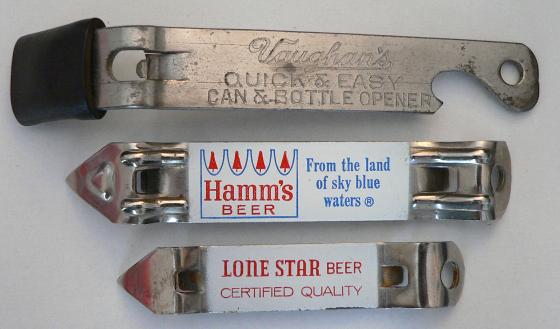
When I was very young, cans of beer were made of steel, with a flat top that needed a "church key" to cut a triangular opening, or with a conical top and a regular crimped cap- also needing an opener. They were sold primarily to fishermen and hunters who needed an unbreakable container for their "wildlife adventures." Most beer was sold in 12 ounce bottles, in cases of 24. There were even 7 ounce bottles- "ponies" as they were called- my mother would drink one every night before going to bed.
In the mid-sixties the "pop-top" tab can openers began to show up. They had a little aluminum ring which, when lifted, would detach from the can and in so doing create a die-cut opening in the top, no tools needed. Can beer sales exploded, especially among under-age drinkers. It was said by some teen-aged quaffers that if you dropped the tab back into the can, you would never get caught by the cops.
Beer manufacturers soon realized that packaging sold more beer than the actual product itself, and began making all sorts of innovations to attract the young drinker, with none more successful than the "Tall Boy." 16 ounces of the most god-awful swill imaginable, and as long as it was strong, it sold. Malt liquor was even stronger. This size race effectively ended when Foster's, in a 25.4 ounce can, became widely available. Beer marketing then turned toward inane slogans and concepts ("tastes great, less filling") and other hoopla.
In recent years, the trend in brewing has returned to making quality beers, beers made with good ingredients from traditional and innovative modern recipes; although in terms of quantity, the swill still wins.
I grew up in what seemed to be Beaver Cleaver's neighborhood. Lot's of kids, Mom at home, Dad working during the day. Divorce happened to other people. One thing that Ward and June Cleaver didn't have was booze. All our folks had their stash. Mine kept a bottle of Windsor under the sink. When he had a beer it was only in the summer- when I was young he favored Hamm's- as he got older he could be caught with a bottle of Cold Spring or Special Export. These were all lagers, but not really the same as a good German beer. We'd sneak a taste now and then but didn't drink much as these local beers were a bit heavy on the hops; the watering down of American beer didn't really take off until the end of the 60's.
Kevin's Dad liked the onomatopoeic "Gluek's" which spoke its name clearly when you poured it from the bottle. Big Bill's Dad had a real liquor cabinet, which got Bill and some of his friends in trouble once - the legendary "Schoch's Booze" incident. Mrs. Lewis, however, had a different strategy for keeping his 6 kids out of trouble. She bought the worst beer- Fox DeLuxe- a brew so foul that he could keep the case right out in the open in the basement where we played, knowing full well that it would remain unmolested.
Still in New Ulm, the day's first stop was the Minnesota Music Hall of Fame.
Pipe Organ under restoration:
Hundreds of ballroom posters from throughout Minnesota, including
many big names from the past, some of whom I had the pleasure to work with:
Just outside of New Ulm is the nation's second oldest brewery,
run by the same family since 1860. The Schell’s beer bus sits at the entrance to the brewery grounds:
A dedicated (and hot) tour guide rests against a 100 year old vat (still used for brewing!) The beer tasting was later (The Porter won my vote, but I really prefer the Stout, only available in the winter):
This fine Peacock graced the brewery’s pleasant grounds:
And the musical heritage of New Ulm is honored
in the brewery's museum as well:
A different sort of band used this kind of drum:
Its legacy, a defining moment in the area's history, has not been forgotten.
… Milwaukee cuisine defined in three words, although “meat cheese” might be a flavor of beer. Across the the street from the Usinger’s famous sausage building was Maden’s, a German restaurant established in 1905. I had the Rheinischer Sauerbraten: Marinated roast beef served with ginger snap sauce, topped with sour cream, toasted almonds, golden raisins, served with spätzle and red cabbage:
Delightful.
Note: the cabbage had been properly fermented, and the spätzle was perfect—not the usual tasteless doughy mass. I’m not big on German, but once in a while it satisfies the cravings of a certain part of my DNA. Mader’s has posted a long list of celebrities who had dined there going back to movie stars of the thirties as well as several presidents. After dinner we stopped in at The Red Elephant, an overpriced truffle and ice cream shop:
It looked better than it was. We ate out at several forgettable places, however I did manage to have the best beer of my life—and it was from San Diego! During the day I happened across this chilly busker:
What she lacked in virtuosity, she made up for in attitude. On Sunday we managed to take in the surprisingly anemic collection of the Milwaukee Art Museum:
Over all, my strongest impressions of Milwaukee came from its architecture which has retained many of its classic 19th century buildings; urban renewal left this gem intact:
I spent the weekend in New Ulm, Minnesota, an old time town settled by German immigrants in the 1850s who loved their beer (it is still home to Schell’s Brewing,the largest brewery in Minnesota.) There were exhibits at the Brown County Historical Society that I wanted to see, one about prohibition and the other about the Gag family (more on that one later):
The brewing heritage of New Ulm continued through prohibition when the breweries were forced to make “near beer”, they had to paint over the word “beer” on the cases:
The town has numerous attractive buildings, many of which are still pretty much intact:
An old hotel has been converted to an art center, complete with cabaret:
It was definitely a place to meet and greet for “right-swipers”:
“No, I took a cab—I wanted to have more than a couple of beers.”
And both of them had certainly downed more than a couple. The summer night air was quite a bit warmer than the air-conditioned pub—Andy liked the way the warmth of it embraced him. By the time they got to his house, Andy was feeling a little woozy.
“I should’ve stopped drinking earlier,” he said, as he opened the door. He wondered if his speech was slurred.
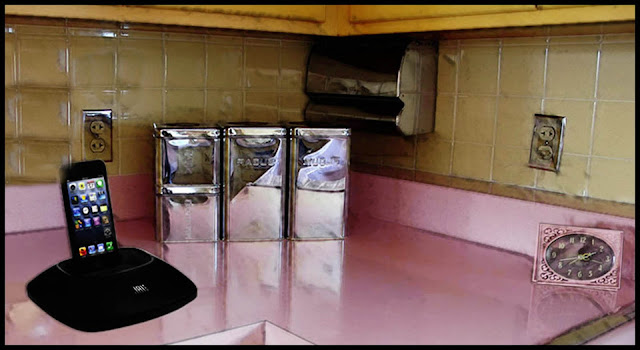
“If one is not enough and two is better, three should be just right right, no?” said Jennifer. They went into the kitchen, “Retro! I love it,” she gasped.
“I think we had five,” said Andy, “Apiece. How ’bout some music?”
“Yes, let’s dance.”
Andy put his phone in the speaker dock that was the only modern appliance on the counter. Everything else had belonged to his parents. When there was no sound at first Andy thought that he might had hit the mute mode. After a second, however, a strange tune began playing in mid-verse, full of minor sevenths and suspended chords. After a few choruses the sound faded away and a relaxed baritone voice purred from the box:
“Now, here’s a blast from the past—In the Summertime—by Mungo Jerry, ” said the DJ, who had an exaggerated epiglottal push. It sounded as if he was puking up the words:
In the summertime, when the weather is hot, Drinking beer, until your mind is shot, In the summertime, you’ve got drinking, You’ve got drinking on your mind, Have a quart, have a pint, Go out and see what you can find.”
“That’s not the way I remembered it,” said Andy. The song continued to its end, each verse more more twisted than the previous.
"Banner Year for Beer!" an ad on the radio proclaimed. A choral group perkily sang the praises of a cheap beer in jazzy four-part harmonies.
“Freedom Radio request hour,” said the DJ, “… with this one going out to Andy and Jennifer on the Northside… ”
“They’re playing our song, com’on, dance with me…” said Jennifer, pulling Andy closer.
Switchin’ in the kitchen, hey mama on a Saturday night, Twitchin’ with a feeling, everything is goin’ alright, She’s dancin’ up on the table, man, this girl is really unstable, Switchin’ and-a twitchin’, on a red-hot Saturday night…
Andy put his hands on Jennifer’s waist but he was too drunk to dance. She put her arms around his neck and they swayed in time to the music. When the song ended, Jennifer put her lips next to Andy’s ear:
“Nice girls don’t stay for breakfast,” she purred.
The DJ’s voice came on the box:
“And now a slow ballad from Julie London—Nice Girls Don’t Stay for Breakfast.”
Andy wondered what was going on.
The Readeris short fiction, published every Friday.
A Natural History of Transformation
By Michael Pollan
The Penguin Press, New York, 2013
“... what was the single most important thing we could do as a family to improve our health and general well being?”
Michael Pollan’s quest for a deeper understanding of the natural world and our role in it was the germ of inspiration for this exploration of the way cooking has changed our species and its role on earth. He breaks the book down into four main sections: Fire, Water, Air and Earth.
Fire takes the reader on a wild search of traditional barbecue, food preparation in its “purest" form—basically roasting meat over burning wood. He gives a historical background and also works with modern barbeque masters—a real trial by fire.
Water is about cooking in a pot, but Pollan also muses about the way our modern processed foods have taken us away from the way traditional cooking brought families together.
Air covers baking, with an emphasis on wheat and breads and also deals with the health issues caused by refined food.
Earth is about the way microbes in fermentation create cheeses, beer and pickling. He shows how the lack of live cultures in our food also harms our health.
While traveling through Kansas we found our food options limited. We were surrounded by agriculture, yet it seemed as if the only food we could find was made by a big multinational corporations in some distant factories. Reading this book during this part of our trip made that disconnect all too clear. The most interesting part of the book is Fire, mostly due the great characters he finds in the world of professional barbeque. Water is probably the most informative and useful—showing the virtues of slow cooking both in gastronomic and in familial aspects. I think that Air is the weakest section, it only reaffirmed what I already knew—that baking is tedious and best left to the pros. Earth starts out well with some interesting cheese makers but Pollan loses momentum when covering beer making. What was a compelling narrative turns into just a routine story about hobbyists.
During a recent visit to my local liquor store, I found a variety pack of beers with this attractive labeling:
Summit is a local brand out of Saint Paul that I have enjoyed in the past. Only after I returned home did I see the small “non-alcoholic” labeling on the front of cans.
So, dear reader, I drank some.
It was actually pretty good, and the flavors of IPA, Amber, and Irish Red were accurate.
Wild in the Kitchen
A Cookbook by Will Jones
Gilbert Publishing, Minneapolis, 1961
With the estate, yard, and garage sale season finally upon us (its been too cold to really enjoy them until now) I've been making the rounds. The most intriguing find so far has been this cookbook. Will Jones wrote After Last Night, an entertainment column for The Minneapolis Tribune, from 1947 until 1984. He was also a self-styled epicure; a bold stance for a time when the concept of Haute Cuisine hadn’t made many inroads in the Midwest. Will was also a bit of a hipster, in the original 50s sense (dig the hat!) and an entertaining writer. He was a pioneer in the campaign to eliminate smoking in public places. All of that biography aside, this book is a hoot.
In it Will not only gives recipes, he also weaves a story about the Twin Cites on the cusp of the “soaring sixties”—a decade which would change everything. Many of the names he drops are of his acquaintances: Cedric Adams, Charles Van Doren, Lauren Bacall, Edgar Bergen, Van Heflin, Dick Cullum, Hugh Hefner, Ancel Keys. Most of the big name Minnesota restaurants of the day and their respective chefs are here as well. The recipes are pretty heavy fare with lots of meat, cream, butter and fat (including “meat waffles” and “minnow pancakes.”) Here's an example from the book describing one of his stranger gastronomic experiences:
The Beefsteak At a remarkable social event in Dania Hall on Cedar Avenue in Minneapolis not long ago, the real beefeaters were separated from those who merely like a good steak every now and then. In the kitchen, some of the finest steaks available—cuts of well-aged prime beef two and a half inches thick—were being made ready for the evening's festivities. Meanwhile a bowl of ground trims and tails of these aged steaks, a stimulatingly fragrant mound of meat really too elegant to be called hamburger, was passed among the beer-drinking early arrivals in the hall to be sniffed and admired. Many did more than admire. They dipped in with their fingers, and enjoyed the beef unsalted, unpeppered and raw: beefsteak for its own sake. They were the real beefeaters, among a crowd who by their very presence had declared their dedication to beef. The occasion was an attempt to recreate, partially in atmosphere, but mostly in sheer purity and unclutteredness of the beefeating, an old pre-prohibition New York social event: the beefsteak... …The menu at a strictly-run (a beefsteak is always thrown or run, never held or given) consists of meat and beer, and some slices of day-old bread upon which the meat is served. There are no napkins and no silverware. Butcher's aprons are supplied to every guest. Slices of meat are placed upon the bread, the juice is poured on the meat, and the drippy open-faced sandwich is eaten with the hands. Fingers and chops are wiped with the aprons... ...One bit of authenticity was carefully preserved that night: All the meat was cooked rare. Those who wanted medium or well done had to seek out the slices from the ends of the steaks. Or two or three traitors sneaked into the kitchen to persuade the cooks to put some rare slices back on the stove. There was another authenticity in another department. Almost nobody in that greasy-eared lot who turned in their aprons and left the hall that night could hold another bite of anything. They had, indeed, been to a beefsteak.
These lurid passages were followed by several pages of raw beef recipes.
The book was printed on quality paper with very 50s-modern illustrations by Rob Roy Kelly:
My needs are few, my desires simple. I enjoy partaking of a full-bodied stout on occasion—only with food of course. There are dozens to chose from, running the gamut from nasty (Rasputin) to the transcendent (Speedway Coffee). My latest discovery is very close to the "godhead" and readily attainable.
Night Tripper is from New Holland Brewing, which also makes the ridiculously over-the-top Dragon's Milk which, when paired with Ice Cream, is the ultimate in dessert beer. Night Tripper is very similar, but not as sweet and doesn't have the liquor overtones of DM. These brews are 11+% alcohol so consume with caution—they are very drinkable but a couple of these is the same as a six pack of regular beer. One is plenty for me, my teeth get 'comfortably numb' but I remain able to carry on a conversation. YMMV.
The deliciously perverse description on the label:
An abundance of roasted malts and flaked barley create a rich roaty stout with deeply intense, lush flavors. Layered, nuanced tones invite intrigue and reward a curious palate. Pairings: dark chocolate, stinky cheese, cayenne.
This is chapter 1 of Window Weather, a serial fiction novel on FITK
July, 2010
The couple in the grimy sedan pulled into a dusty roadhouse–but not for a beer. They had too many miles to go before they could start drinking again. They just needed a break from the heat and the road and the sun and all that monotonous farmland. Stultifying. The only features breaking the horizon line were the rows of other-worldly wind turbines that marched across the terrain.
The roadhouse was a small place decorated with beer signs and worn-out farm implements. There was a stage in the corner for the weekend bands. After the noise of the wind and the tires on the road the tavern seemed profoundly still. The bartender was restocking the bar; Sean Carroll, out of work data analyst and Molly Berenson, currently unemployed MBA, were his only customers.
“Two lemonades, thanks,” said Sean.
“Hey, play something while I hit the john,” Molly said. The nearly empty roadhouse was that quiet. The joint was a throw-back—it still had a jukebox. The Seeburg held mostly Country Music, or what passed for it nowadays, but Sean still managed to find a dollar’s worth of listenable tunes. He sat down at a corner table as the music began to play. The bartender brought their drinks to the table. Molly came out of the restroom. She had washed her face but hadn’t redone her makeup. There was not much point in that—not when you were going back out to a humid ninety degrees in a car without A/C.
It had been too noisy to talk in the car and now, as the couple drank their sours, they continued to exercise their right to remain silent. The last song started; it had an old Fred Rose lyric that Sean liked:
Every night alone I miss her
Her eyes blue as a clear sky after rain
She told me soon she’d be returning
I still see her at the train...
“Shit,” said Molly.
“What?” said Sean.
“You would have to play that song.”
They had met the week before, hitting it off quickly, but with only as much ardor as two people who have been through the routine more than twice are capable of. Love may be wonderful the second time around, but not so much the third. There weren’t many illusions between them, but there were many unread pages in their life stories.
Now I’m fading like the embers
Of a fire left out in the rain
I try so hard to keep my hopes up
When will she be on that train…
“Sorry, it’s just something out of my past. It’s nothing really, there’s no way you could have known," Molly said.
Sean tried not to gulp his lemonade.
She said she’d come back in the winter
When the snow replaced the rain
But now I know I’ll never see her
Blue eyes on that lonesome train…
As the song ended tears began rimming Molly’s eyes.
“Let’s get out of here,” she said, “I’ll drive."
The motel room was dark, only a faint glow from the lights in the parking lot leaked through the window shade. A sliver of light from under the bathroom door was the only other source of illumination. Cool, if somewhat musty, air blew from the air conditioner. Molly was in the shower. After a while, the sound of running water stopped and a few minutes later she came out of the bathroom dressed in a full slip.
“This sure beats those sweaty jeans I was wearing… ”
The previous 12 hours Molly and Sean had spent on the plains in a hot car was just a rapidly fading bad dream now. Tomorrow, they would leave South Dakota behind and head northwest into Montana and then go through the Rockies. It would be cooler there. They would reach Seattle late tomorrow night. Molly had a lead on an office job; her mother lived there in a duplex with a basement apartment that Molly and Sean could rent cheaply enough. Sean had a job lead as well. He was looking for something more stimulating than his last one was: sitting in a cubicle with a monitor and a telephone.
“I don’t have anything nearly as provocative,” he said, “But after I shower I’ll put on a clean tee.”
As Sean stood under the shower he thought about the previous week. How Molly had entered his life. He had been living alone too long. His usual reluctance against starting a new relationship was dissolved by their second bottle of wine. Sean wasn’t worried about what could go wrong. Not like those other times he had fallen in love. Maybe the difference was that now he just didn’t care about ‘passion’ anymore. This time, without any unrealistic expectations, things seemed to be going better.
As Sean stepped out of the shower he realized that his clean clothes were still in his suitcase—on the luggage rack by the bed. He thought about just walking out naked but he and Molly hadn’t quite yet reached the stage of ‘casual’ nudity. He wrapped a towel around his waist and headed out.
“Oooh! You look delicious!” said Molly.
As she grabbed his arms her lips parted—her teeth reflected the light from the open bathroom door. She playfully lunged at Sean with her open mouth but misjudged the distance. As her teeth sank into his chest her jaws clamped shut—hard—forming a pair of red semicircles on the skin—just over his heart. He began to bleed.
“Ohmigod! I’m so sorry—I didn’t mean to hurt you!” Molly said, aghast.
“That’s alright, it was only a reflex action.”
Molly turned Sean around so that the light from the bathroom fell on his chest.
“That’s gonna leave a mark!” they said, laughing simultaneously.
“Just wait and see… you’ll find I can leave all sorts of marks,” said Molly
“A biter. I would never have thought it… ” said Sean, shaking his head.
"Go back and turn off the light," said Molly, “… and leave the towel.”
A red smear of blood began to ooze down Sean’s chest.
“I’ll need a couple of band-aids first,” said Sean, “That bite really might leave a mark.”
My little canoe and I prowled the Rum River last week. The flotsam and jetsam pictured above is left by the 'rats' who dump their non-biodegradables into the stream. It's just the tip of the trash-berg. I spent an hour collecting the worst of it, all in an area of about 400 square feet:
Two full bags as well as a couple of 2-liter pop bottles—one of them full of root beer.
It was only a dent, but where I did do a clean up it looked better already. I might make this a habit.
The most disgusting item was a can of Budweiser Clamato beer.
Why not- a new one every weekend, maybe even two or three. A mix of people: friends, stoners, even a neighbor or two. Hi-Fi phono in the corner, when they played Junior Walker and the All Stars everybody danced. It didn't take much to prime the pump, a case of beer was plenty enough to get things rolling. And when they got out the papers and the baggies things started really "rolling." It could take a turn to the bizarre.
The last party got too weird. Crazy Mike got a furlough from the hospital, he was allowed out as sort of a test. When he saw the beer, he started pounding it down as if there was no tomorrow. A friend took him straight back to treatment. He never came out again. Peter, the dealer, showed up. What was once novel and exciting years ago- all his stories, potions and paraphernalia- was just creepy now, too many people had overdosed on his junk. Gene, Gene, the smokin' machine, would lose everything a few months later, lost in his pursuit of oblivion.
But one was always had a chance to get lucky; there were usually couples in the kitchen, exchanging words and glances, and only with each other. More than one hook-up turned permanent in that party house. And the troubles of the world were gone, if only for a few hours.
There were parties after that, of course, but they were dinner parties, or kids' parties. The Belfast cowboy's Wild Nights were over:
As you brush your shoes And stand before the mirror And you comb your hair Grab your coat and hat And you walk, wet streets Tryin' to remember All the wild nights breezes In your mem'ry ever.
And ev'rything looks so complete When you're walkin' out on the street And the wind catches your feet Sends you flyin', cryin' Ooh-wee! The wild night is calling, alright Ooh-wee! Wild night is calling.
All the girls walk by Dressed up for each other And the boys do the boogie-woogie On the corner of the street And the people passin' by Stare in wild wonder And the inside jukebox Roars out just like thunder.
And everything looks so complete When you're walking out on the street And the wind catches your feet Sends you flying, crying Oooh, oo-ooh wee The wild night is calling, alright Oooh, oo-ooh wee The wild night is calling
The wild night is calling The wild night is calling Come on out and dance Woah! Come on out and make romance Come on out and dance Come on out; make romance
A teen, wearing a school jacket with a "Tennis Team" patch on the sleeve, interrupted out discussion. She was fair, with impossibly smooth skin, and had no reservations about talking to two gray-haired strangers. Old men sporting Saturday stubble, wearing Saturday clothes. When a Grace asks you a direct question, how can you do anything but smile and answer truly and sweetly, all the while basking in her radiance?
The "Moment" ended. She left- I don't know if she took our advice or not, perhaps she was polling all the other patrons as well! The food we had eaten (fajitas and wild rice soup) was standard suburban restaurant fare, forgettable, but palatable enough. Neater than the chicken wings.
Our conversation resumed.
"Have you talked to your cousin lately?"
"I saw him a little while ago, he was involved with some kind of conflict mediation therapy. He wanted me to attend a meeting."
"Conflict mediation?"
"Sure, don't you have conflicts?"
"Well... sometimes, I guess. Most of the conflicts I have usually depend on what I've had to eat. All-Bran usually mediates them."
After paying our bill, we headed out to the street.
This may well be the last picture of the interior of a venerable North Minneapolis watering hole. It was torn down not long thereafter, to make room for a freeway entrance ramp. I was not yet in the habit of hanging out in bars, so although I lived an actual 'stones throw' away, I never went inside. It was for old guys, a twenty-something hippie would have been laughed out of the place. This was an old building, built before prohibition.It was nothing fancy yet the fireplace and the wood paneling made it a pleasant home away from home for those who took their drinking responsibilities seriously. As to the 'cafe' part of the name, I think it may have served sandwiches. An internet search did turn up a picture of the bar's most memorable feature… the 'thirst things first' sign:
Image: Thomas W. Bremer, MHS
The beer was made just across the river, about a mile or so away. Local wags would sometimes call Grain Belt Beer 'Brain Melt', although it wasn't particularly strong.
The band I was working with used the entrance as a backdrop for publicity photos:
“Look who showed up… ” said Scott, nodding towards Tommy.
A tall woman, wearing a designer dress, had walked, no… had sauntered into the room where the band had set up their equipment. Her entrance was too classy for a slink, but her subtle sashay did turn a few heads.
“Irene, the queen of small talk,” thought Tommy, “There will be no lack of conversation tonight.”
Tommy had a warm spot for Irene, they went back a long way together. Irene’s stream-of-consciousness discourse flowed continuously; there was never a drought when it came to the minutiae of her (or her acquaintances) lives. When they were young Tommy used to talk to Irene for hours until he gradually came to realize that with her the “log” was mono, not dia. Irene and her friends had spent a lot of time hanging out with him when they were young—but not making out. There was just enough difference in age between them that it was far easier to fall into the role of siblings; the path to lover’s lane was a much rocker road.
Tommy had always felt that he hadn’t been good enough for Irene. It didn’t help matters any that when he used to get drunk he would do things that he regretted. Nothing major—a single stolen kiss—although in light of #MeToo even that seems bad. But the incident at Woman Lake was definitely one step beyond a stolen kiss. It was a sunny afternoon, warm, everyone was swimming except Irene, who was holding court from her inflatable raft. Tommy had drunk one beer and then thought that it was such a nice day that two would be better, even though he knew that two was his personal line of demarcation. As he gazed at Irene that day he beheld a glorious scene: in a white-on-white linen outfit, backlit, basking in the late afternoon sun, she was a queen surrounded by her subjects. Tommy flipped the raft and Joan went into the lake. When she emerged her outfit clung to her lithe body, leaving nothing to the imagination. “How could I have been so crude?” he thought, thinking back on the incident. Almost simultaneously a devil in him said “But it was so worth it—what good are the glories of life if they are always hidden from view? No regrets, Coyote!”
“Hey,” said Irene to Tommy, breaking his reverie, “Looks as if you’re back in the saddle again with all that sound gear.”
“It’s like riding a bicycle, you don’t forget, here’s hoping I don’t crash, I didn’t bring a helmet,” said Tommy, “You are looking fabulous as always Irene, is that dress vintage?”
“T.J. Maxx,” said Irene, “I’m the expert of all the southern Minnesota outlets. It’s my superior sense of style. Speaking of style, where’s the Blatz?”
Irene always drank the lowest alcohol light beer she could; “I can drink myself sober on Blatz!”, was one of her non-drunken tirades. At 3.4% ABV, she just might have been right. She headed off to the bar. “A definite slink in that walk,” thought Tommy.
Tommy’s romantic reminiscences of Irene were quickly supplanted by the actual history of their parallel lives—his marriage and children; her various affairs and marriages. When they grew older they both moved to small towns and had done alright for themselves, with meaningful lives well lived. Candide.
It was time for the band to begin. Scott was the nominal leader and he nodded to the bass player who laid down the groove for In With the In-crowd. And they were off. There was still no hint of what the “surprise” might be. After the band played a few more songs Scott began to speak:
“There has been a rumor going around that we have a special surprise for you tonight… we have a special guest… you all know him… you all love him… Bob Dylan!”
Groans were heard and Tommy joined in. In the old days of the band Dylan would hang around Minneapolis from time to time so there was always a chance that it could be true—at least it was geographically possible.
“No, really,” began Scott, as Tommy began to sense a rustling in the crowd. People turned around when Scott pointed to the rear of the room, “Direct… from the Beehive State… you all know him… you all love him—Kevin!”
Shouts from the crowd surrounded Kevin as he walked to the stage and put on the guitar. Some people began to cry.
It had been almost forty years since anyone had seen him play. Although he was nominally the lead singer of the old band, as well as being the most prominent guitarist, Kevin was always a reluctant star. But he was never unnoticed. Major record labels, other bands, everyone wanted him. He and his family had moved out west in an attempt to find a better life. Tommy had visited him out there once. Kevin told him then that, musically, he had reached a dead-end in Minnesota. Looking back on it with hindsight, Tommy had to agree. Performing was marginally remunerative in the best of times and, with the advent of the internet and file-sharing, recording was no longer a viable enterprise either. Still, neither man had any regrets, some things have no measure of worth.
But seeing him in the flesh, this was a reality of now. Nothing lasts forever, does the moment of glory compensate for a lifetime of mediocracy? Tommy let this fleeting muse evaporate and returned to the task at hand—mixing sound. The horn players had been told what the next song would be and were arranging their charts as the crowd chanted “Kev-in! Kev-in!”
“Such an appreciative audience!” said Kevin, “We’d like to shake off a little rust with an old Curtis Mayfield number that Major Lance had some success with back in 1963… ” and then he counted off The Monkey Time:
There’s a place right across town Whenever you’re ready
Where people gather ‘round Whenever they’re ready
And then the music begins to play
You feel a groove comin’ on its way
Are you ready (are you ready)
Well, you get yours, cause-a I got mine
For the Monkey Time (Monkey Time)
Now the dance that the people do I don’t know how it started
All I know is that when the beat brings a feel
It’s so hard to get parted
And then the music begins to play
Automatically you’re on your way
Are you ready (are you ready)
Well, you get yours, cause-a I got mine
For the Monkey Time (Monkey Time)
Do the Monkey, yeah (do the Monkey Time)
Do the Monkey, yeah (do the Monkey Time)…
Ah-twist them hips (twist them hips)
Let your backbone slip (let your backbone slip)
Now move your feet (move your feet)
Get on the beat (get on the beat)
Are you ready (are you ready)
Well, you get yours, cause-a I got mine
For the Monkey Time (Monkey Time)
For the Monkey Time (Monkey Time)
The Monkey Time-Time-Time-Time-Time-Time-Time-Time
TIME!
And then it was only percussion for eight bars until Kevin came back in with one of his funky guitar solos for another eight bars and then the saxophones began trading fours and everybody was dancing and all the years of gigs in seedy bars and disappointments faded away into ONE BIG NOW.
And when Kevin came back in and sang the last verse it was Tommy’s turn to cry. No regrets, it was just experiencing something that he had thought he had lost forever.
Just down the street from the apartment I had during my stay in Reykjavík is the Russian Embassy. Being the running-dog lackey of Yankee imperialists that I am, it was my duty to conduct a clandestine surveillance of activity therein. Here is my report:
The facility appears to be a bee-hive of activity. A mysterious pipe extends from the attic, emitting an irregular "brap-brap-brap" disturbing the peace on Garðastræti. A diesel-powered document shredder? Or a cold-war confession-extractor? There were men on the sidewalk throughout the day, once a van pulled up and a swarthy "agent" unloaded black-market items: Cigarettes, beer and packages that could contain secrets, or chocolates, or nylons, perhaps? The yard adjacent to the Embassy was filled with steel I-beams, one day I saw babushka-wearing matrons priming these girders. Another afternoon I saw a man carry some white, square cardboard containers out the rear entrance- microfilm , perhaps? (or maybe just pizza boxes- he placed them in the trash bin...)
One night, as I headed down the hill into the center of town, one of the basement windows (visible in the photo above) was open, and I could hear voices in animated conversation; through the semi-sheer draperies I could see that a dinner party was taking place, with wine, beer and what smelled like delicious food. When I returned, several hours later, the lights had been dimmed and a stereo played emotional Russian music, there may have been dancing...
As was my case, the Embassy staff were also strangers in this strange land, although they probably had fewer options than I did- most Icelanders speak excellent English, I imagine that not so many speak fluent Russian. Coming from one of the poorer countries in the world to one of the most expensive, I'm sure the people who lived there didn't have much in expendable income, a night on the town here is an expensive proposition by any standard. An Embassy and its grounds are considered native soil for its occupants; in it they did have their Russian food and drink, and their Russian music; they were making their few thousand square meters a home away from home.
Here is a list of twenty-five Flippism Is The Key subjects in rank order: 01. Love....85.1 02. Help....73.0 03. Good....66.2 04. Girl....60.2 05. Happy...59.2 06. Sex.....54.2 07. Woman...53.1 08. Men.....49.9 09. Boy.....48.6 10. Mother..45.1 11. Work....40.1 12. Music...40.1 13. Joy.....36.8 14. Evil....36.5 15. Touch...35.1 16. Father..35.0 17. Song....34.8 18. Play....33.8 19. Beer....33.0 20. Jesus...33.0 21. Wine....32.2 22. Weird...30.7 23. Poetry..30.5 24. Cats....30.0 25. Iceland.29.7
Other words that didn't make the list include Satan (18.9), Beatles (9.3), despair (7.6), and walnuts (0.8). So I guess John Lennon was wrong about The Beatles' popularity, Jesus beats Satan (although he tied with Beer), Work beats Play, and Love conquers all.
On the northern border between Wisconsin and Michigan's upper peninsula, lies the small town of Hurley. This was mining country years ago, but the mines have long since closed. The town remains, and with it the abundance of bars, joints and "gentleman’s clubs" that once serviced the hard-drinking miners. A town with a population of 2,000 has over 30 liquor establishments in a eight square block area. The rest of the town is a mixture of old buildings and dilapidated housing, with small businesses making up the mix. I pondered, is this what an alcohol-based utopia (dystopia?) looks like? Perhaps they should package their 12 packs of beer between a pair of shingles, so that the houses without siding could eventually be covered (a new twist on “The House Of Heileman”)? The grocery store I stopped into had an aisle of hard liquor: right next to pet food and paper products.
But it was work, not pleasure, that brought me here in search of a laundromat for my vacation-soiled clothes. I finally found one, nice and modern inside, new machines and a TV. After loading my clothes, I noticed a separate room, with a cooler, perhaps holding a sodas or sandwiches. I went in and then it hit me. The cooler was full of beer.
In a town built on booze, even the laundromat had to have some alcohol.
Back in the professor’s show biz days, some gigs were harder than others. The performance date was to be a benefit, held in a church basement in St. Paul, for a six-year-old with cancer. It was well organized, with activities for kids, a silent auction and lots of door prizes. Our combo was the entertainment.
About a week before the gig, the child died. It was strange, playing a wake. The parents were there, his medical team, relatives, neighbors and schoolmates. His father gave a heart-rending speech, thanking those who helped, but he was really inconsolable. We played the best we could, I think people appreciated it. Afterwards, there was a ton of leftover beer that had been donated by a local brewery. They told us to take as much home as we wanted.
It was really good beer, but drinking it didn’t make me feel any better.