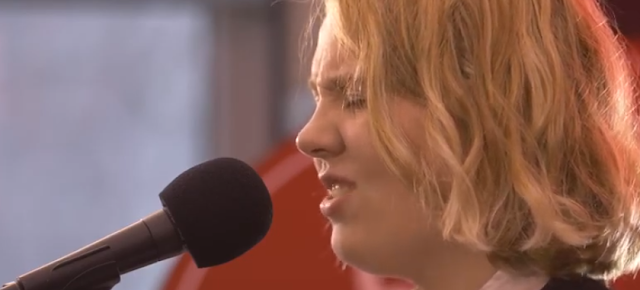
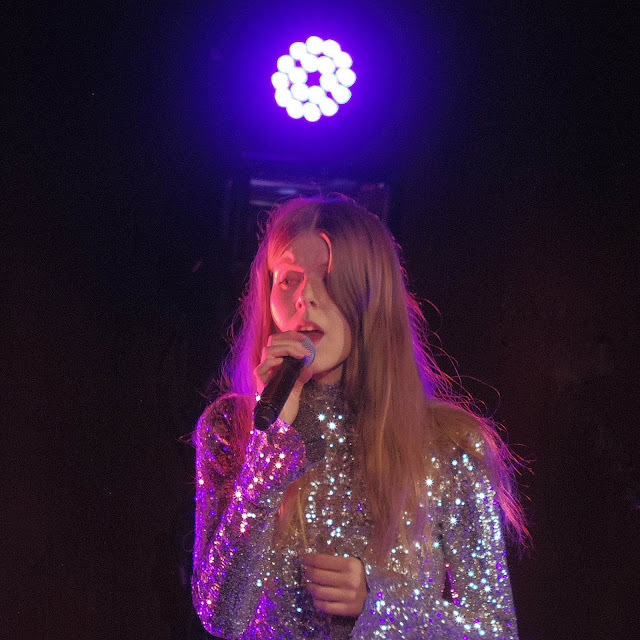
Not a problem though, as I managed to score a pair of tickets for the Borgarleikhúsið’s live production of Rocky Horror Show, the full-fledged musical (upon which the cult movie Rocky Horror Picture Show was based), with Páll in the lead role. Because words fail in trying to describe how perfect the casting of Páll as Dr. Frank N. Furter is, I present this clip of one of show’s numbers from this production:
SPECIAL NOTE: I’m in Reykjavík RIGHT NOW and will be giving updates on new performances including Nýtt eldhús eftir máli (tonight) and Ormstunga (tomorrow afternoon.)
Þjóðleikhúsið (National Theatre)
Over the last two decades a recurring topic of FITK has been Icelandic Theatre. Is it ironically appropriate in that the National Theatre building is the same age as me?
Borgarleihusið (City Theatre)
Like many aspects of Icelandic Culture, the dramatic arts have had an outsized influence in the world. Not the stage productions themselves (although the 2006 production of Pétur Gautur did play in London) but through Icelandic and world cinema and television productions. Notable actors (Ólafur Darri and Ingvar Eggert Sigurðsson, Anita Briem) and stage director Baltazar Kormákur have been part of big-budget films. Film composers Jóhann Jóhannsson and Hildur Guðnadóttir (who both started out in Icelandic theatre) have won numerous awards including: Golden Globes, Baftras, Emmys and even an Oscar. The first woman elected president in the world, Vigdís Finnbogadóttir, was the director of the city theatre when she was elected.
I’ll list the productions I have seen in chronological order.
Þetta er allt að koma by Hallgrímur Helgason, d. Baltazar Kormákur, 2004, Þjóðleikhúsið, Main stage:
My Icelandic theatre crawling started with a bang with this wild satire of a talent-challenged performer who always believes that “Things are going great” as her life falls apart in various picturesque ways. The most inventive set I’ve ever seen in a stage play, much of it is set in a huge furry box with a multi-section floor continuously sliding back and forth. I did manage to speak with the playwright (via Zoom) twenty years later. Alas, there were no new plays from Hallgrímur on the horizon. The next production I saw was also directed by Baltazar and was, in some ways, even wilder.
Pétur Gautur (Peer Gynt) by Henrik Ibsen, 2004, Þjóðleikhúsið, Black Box stage:
One of Ibsen’s most intense plays, and it was doubly so in the intimate confines of the small ‘black box’ theatre on Lindargata. My companion and I were almost within touching distance of the actors! The fish cleaning scene (with real fish) was memorable, and they eliminated the ‘second wall’ when the fire escape double door in the back of the stage was opened and the action went outdoors - with people on the street walking by in the background! The play ended with the stage floor covered in blood, money, and ashes as the lights went out.
Frida, vida la vida… written, directed and starring Brynhildur Guðónsdóttir, 2009, Þjóðleikhúsið, Main stage:
This was a very stylized production, with Frida Kahlo’s paintings becoming a part of the set. Figures from them, most notably Óxlotl, her dog (and also the Aztec dog of the underworld), and La Catrina, the Mexican goddess of death, came alive on stage. Frida’s life, including her disfiguring accident and her stormy relationship with Diego Rivera, was told in a grim, nightmarish fashion that became frightening at times. Ólafur Darri Ólafsson was Rivera with a commensurate stature appropriately larger than life. Frida’s politics were also covered, even Leon Trotsky made a memorable appearance. That a regional Icelandic theatre would produce an original play about Frida shows what an influence her art and life has had worldwide. The Selma Hayek movie version was visually stronger, as would be expected from a Hollywood movie, but this production brought out the internal struggles of Frida in a more compelling way. The cognitive dissonance in this production was pretty high, which added to the play’s surreal quality.
Jónsmessunótt, by Hávar Sigurjónsson, 2012, Þjóðleikhúsið, Black box stage:
Kristbjörg Kjeld and Arnar Jónsson are the parents of an unruly clan meeting for a reunion on midsummer’s day. The father, who has numerous affairs over the years, is deluded in thinking that his family respects him but in reality they all know he is a philandering fraud. The set featured clever intersecting boardwalks used in numerous ways:
As the audience filed in the actors mimed as if they were a continuous loop in a DVD menu.
Rautt (Red), by John Logan, Borgarleihusið 2012, small stage:
THE Icelandic drama reviewer Silja Aðalsteinsdóttir personally recommended this play to me. Although the play was quite wordy, the context (late fifties New York art scene) and numerous instances of name-dropping in the script helped me follow the gist of the story. Mark Rothko (Jóhann Sigurðarson) and his fictional assistant (Hilmar Gudjonsson) have heated conversations about the meaning of modern art vs. pop culture:
The play’s major conceit is the real-time creation of Rothko’s art on 2x2 meter canvases. As Silja had mentioned to me earlier, Jóhann was exceptional as Rothko.
Heimkoman by Harold Pinter, 2015, Þjóðleikhúsið, Main stage:
The Homecoming is a strange two-act play which explores the dynamics of sexual power in an English family. Teddy, the eldest son, brings his “wife” Ruth home from America to the seedy house where his father, an uncle, and two other brothers live. In the version I saw, in preview, the stage had morphed into a service garage complete with operating plumbing. This sleazy psychodrama unfolded in this hyper-realistic yet surreal set. I could understand few of the words, but the emotional language of the actors was quite clear, as was the full male nudity added to the mix. In a short conversation with the woman sitting next to me (who goes to ALL the plays), I mentioned some of the more memorable plays I had seen there and her appraisals more or less matched mine. In this play, she was put off by Pinter’s 1960s sensibilities.
The Rocky Horror Show By Richard O’Brien, Borgarleihusið 2018, Main stage (lobby shown below):
This was a blockbuster hit in Iceland, with its first run selling out almost instantly. Iceland music legend Páll Óskar reprised his role as Frank-N-Furter which he had performed as a college student twenty-eight year earlier. A true extravaganza, with an intricate set design and first-rate singing actors in all the major roles. My companion and I had never seen the play (nor the film) and were blown away by the excess of it all. Special note must be made of Minnesota’s own Surfin’ Bird by the Trashmen being played during intermission—twice! Rather than have me blather on about the production anymore, here is a video of the Páll’s opening number, you can judge for yourself:
Vertu Ulfur (Be a Wolf) directed by Unni Ösp Stefánsdóttir, 2022, Þjóðleikhúsið, Main stage:
I can’t even begin to explain it, much less justify it.
The one-man stage play is based on Héðin Unnsteinsson's autobiographical narrative of the same name. It was described as a crazy journey through the “… dangerous places of the mind into a world of anarchy and despair and back again, the struggle of a man who manages to break out of the vicious cycle and manages to turn his most terrifying experience into the strength needed to change.”
This production really pushed me out of my comfort zone with its 100+ minutes of Björn Thors’ nearly nonstop monologues in Icelandic, imaginative stagecraft and his masterful emoting. I was enthralled throughout.
Why would anyone go to see a play in a foreign country, performed in an incomprehensible language? I’ve done stranger things, but not many. This production had been a rousing success, with over 100 performances seen by tens of thousands of people, including many middle-school students who were there in abundance that night:
Between trigger warnings and censorship, I can’t see that a performance as intense as this one would be allowed to have an audience of older children and young teens in the U.S.A.
The play opened with a closed curtain. A man in a suit (actor Björn Thors) stepped out in front of it with a pocket full of sand. He used the sand and a piece of chalk to draw a circular diagram of his family and its history. Out of this simple introduction came the story of his struggle with manic-depression, two hours of intense acting that enthralled me with its vivid portrayal of a man struggling with his inner demons. His body language became a sublime dance, choreography of the human spirit. The stagecraft was just as brilliant—the minimal sets were transformed again and again with its archetypal imagery: A rain shower! A forty-foot-long duvet! A vanishing road to nowhere! Evocative lighting made it visual magic.
An aside: A typical tourist, unless they happened to walk into the theatre’s box office out of curiosity about the theatre’s imposing facade, would be unaware of the miracles this venue performs on a regular basis. And if that wasn’t enough culture for one town, the city boasts of another live theatre complex of equal stature, plus several smaller companies.
Before this play started I was sitting on a bench in the outer lobby when woman came in and sat down next to me. We started talking about Icelandic theatre, she was a regular and I mentioned Hallgrímur Helgason’s Þetta er allt að koma. She had known Hallgrímur since he was three years old! She also mentioned what a great man he was—the second time I heard someone say that about him that day!
When the woman for whom my bench-mate was waiting came in she saw us sitting side by side she said to us: “Ah! Brúðkaupsbekkurinn!”
Here is the play, in its entirety, with an additional prologue:
Sjö ævintýri um skömm (Seven Fairy Tales of Shame) a play by Tyrfing Tyrfingsson, 2022, Þjóðleikhúsið, Main stage:
One recurring aim of my trips to Reykjavík is to experience experimental and off-beat Icelandic Theatre.
This production hit the target in the bulls-eye.
This play had been expanded from an earlier one-act which had been a hit in a festival setting.
Several of Iceland’s most celebrated stage and screen actors were in it, including the lead Ilmur Kristjánsdóttir (seen in the TV series Trapped!) as Ölga, Ólafía Hrönn Jónsdóttir (White Night Wedding) as Ölga’s mother Amma, the venerable Kristbjörg Kjeld as her grandmother Fanney, and Hilmir Snær (101 Reykjavík) playing against his usual leading-man-type, as an alcoholic psychiatrist who takes on a troubled client: Öğla.
The psychiatrist abhors cognitive behavioral therapy, and believes that the cure for Ögla's distress lies in finding its roots—which is shame. We follow the two of them throughout the play as she tells the doctor about seven adventures that are crucial to her dilemma, and were caused by the people who were closest to her.
The key dynamic of the work is the uneasy relationships between Ölga and her grandmother and her mother—it shows us how ‘wounds’ are inherited between generations. Playwright Tyrfing used a lot of his childhood memories for the set pieces with the grandmother. Ólafína and Kristbjörg tear into their roles with gusto, it was really a special pairing:
In Ilmar’s performance as Ögla she draws the audience in, as her character falls apart as the play progresses. She is not easy to love—on edge and confrontational, Olga is married to Hanna (Kristín Þora Haroldsdóttir), the two women have the most outrageous artificial insemination scene-gone-wrong I had ever seen:
A crucial scene of the play revolves around the relationship between Ögla and Hanna, about the paradox of the fantasy of love with love in everyday life.
Seven Fairy Tales of Shame celebrates the magic of the theater, queerness and everything that is strange, oblique and excessive in life. This was not your standard dinner theatre fare:
Sem Á Himni, 2022, Þjóðleikhúsið, Main stage:
This musical originally was a Swedish stage production and then a film. It is the story of a conductor who has a heart attack (at the podium!) and then returns to his home town to recover. There he helps out with a struggling choir and in the process everyone grows, learns, and is fulfilled. It was written as a crowd-pleaser with character stereotypes aplenty. The drama is supplied by themes of spousal abuse and small-town politics presented in almost in a check-list fashion:
Overall I found it to be well sung, but with stilted staging, especially compared to the two previous plays I had seen. I had heard from more than one person that the casting of the play was controversial in that one of the characters was a special needs man who was portrayed on stage by a ‘norm’, with no other actors even considered for the role. I could see both sides of the argument; his part was pivotal and needed an accomplished singer and actor to fill it or, conversely, they could have reached out for someone with that background. I imagine there was someone in the tight-knit Icelandic theatre community that should have been given a chance—otherwise there might not have been such a fuss. I had read in a review that the big production number (at the end of the first act) was so good that the remainder of the play suffered in comparison. If that was the play’s high point (and it was impressive) I didn’t want to see any more. I left at the intermission.
Look at the Music! 2023, Tjarnarbíó theatre:
I had never been in Tjarnarbíó before, it was an old cinema restored, seating about 250, a little gem of a venue:
A powerful set of choral music set to complement Sign Language, Look at the Music! was part of a year-long international project involving both hearing and deaf artists with poetry in Icelandic Sign Language (ITM).
The 45 minute show was excellent; the music complemented the signing perfectly. There was even a “sing-along/sign-along” at the end. And there were balloons (Yay!) Beforehand I hob-nobbed with the cultural elite over a bottle of Apelsin, a uniquely Icelandic orangey beverage that I have every time I’m here. It’s awful (shown on the table in the foreground) but I’m weak—I need it.
Ibuð 10B, written by Olaf Olafsson and directed by Baltazar Kormákur, 2025, Þjóðleikhúsið, Main Stage. The set was static, with minimal changes in the background and lighting:
This was a talky play, set in a modern apartment (Ibuð) where a group of residents gathered to forge a covenant for potential incoming refugees who might be living in their building. What started out as an exchange of pleasantries (and wine tasting) turns sour as everyone gets more drunk. When a mixed-race resident comes in with his spouse unacknowledged feelings of bigotry simmer and boil over. I’ll let an Icelandic reviewer give a deeper explanation:
There are big issues here and some are very hot, and Ólafur Jóhann skillfully weaves them together so that from the first quiet minutes, the tension in the living room grows more and more, the characters reveal themselves better and better until we have a clear understanding of how they are put together, where they come from and where they are going. The conversations are fast-paced and often very funny, you have to keep your eyes peeled when it is at its most intense. This is a dense and substantial text, brilliantly thought out and written. ~ Silja Aðalsteinsdóttir, TMM Forlagið
The near-capacity audience gave the cast multiple ovations at the end.
On an unrelated note: I did snap this pic of the old retired lighting board at rest in the upper lobby of the theatre:
Kjallarakabarett, Kjallarinn, 2022, 2025:
What better place to celebrate Halloween than in the ‘cellar’ of the National Theatre. A most welcoming and congenial atmosphere of Pulchritude and Perversion greeted this timid visitor who otherwise wouldn't dream of attending such a spectacle. The MC greeted us with the invitation/admonition “You can take photographs but no flash, please. We’ll do the flashing!” A series of bawdy skits followed and were interspersed with singing and some very titillating amusing stripteases.
40.000 Fet, Tjarnarbíó 2025:
It is always nice to see so many young people at the theatre:
In the lobby a man greeted me thinking I was someone he knew from 30 years ago. I was sorry to have disappointed him, he seemed like a nice guy.
The play was the stylized comedy about two female flight attendants and their flight crew. It was quite bawdy at times, with a serious ending addressing mortality. A nice twist was that when you entered the theatre space the actors portraying the flight attendants greeted you in character, as if you were the passengers:
Dead Air by Álfrún Rose (in English): Tjarnarbíó, 2025
Since Alfie’s dad died, he’s visited everyone’s dreams but hers. Rude. Desperate to talk to him, she uses AiR, an AI chatbot for the dead. A heartfelt, funny, and glitchy deep dive into grief, ghosts, and digital obsession.~ from the Airwaves guide
A good premise, somewhat defeated by an unintelligible voice-shifting device that Álfrún used when she was ‘streaming’ her dead father.
The hour+ performance became a litany of dysfunctional family tropes, even more disturbing because I suspect they were all true. I find it ironic that the only real dud I saw in 21 years of Icelandic theatre was in English!
Performance images by the respective theatre groups.
Four troubled young teen-aged boys in a suburb of Reykjavík struggle to find themselves in this gripping drama. This is not an easy film to watch; the pointless violence of the teens is reflected in the wreckage of the broken lives of their parents. This movie won’t bring any tourists into Iceland, but much of it rings true to me, especially with the very limited experiences I’ve had with young males and single mothers in Reykjavík, and with my own experiences growing up in the 60s.
Set in the late 90s/early 00s (computers but no smart phones) the film plays out over the span of a couple of weeks, following the boys in turns as they bluster, smoke, drink and do drugs on their way through one self-generated crisis after another. There is a bit of supernatural nonsense thrown in but the narrative is generally straightforward and reaches a conclusion that I found satisfactory. The entire cast is excellent, especially the boys who will probably become the next generation of Icelandic film stars. Anita Briem appears as a mother of one of the youths and, in an horrific cameo, Ólafur Darri Olafsson makes an appearance (and manages to get naked as usual). I saw both Páll Óskar and Samaris listed in the musical credits.
A limited recommendation. It is thought-provoking but difficult to watch. The Icelandic title translates as "nightmare."
This is the fifth in a series of informative posts on FITK offered with the intent of giving those who are house-bound some intelligent diversions during their period of isolation.
This one might be a bit of a stretch for many: a performer who is nearly unknown in the United States, who usually sings in Icelandic, whose biggest hits have been in disco/EDM/techno styles, who is an outspoken advocate of human rights and, who is flamboyantly and unapologetically gay.
Are you still with me? Good.
I’ve mentioned him here on FITK, I’ve seen him in person (thrice!) and even had an email from him once concerning a post I wrote for I Heart Reykjavík! Here are some various videos that feature this wonderful human being:
I attended an art opening last week where one of my favorite artists had some of her work up in a gallery in Northeast Minneapolis. A late-summer humid warm spell gave the non air-conditioned space a sultry vibe, perfectly suited to her atmospheric paintings. When I caught the artist’s attention, she came over and we had a short chat about her art and the neighborhood.
While I’m not as good at small talk as I used to be, and I really did enjoy talking with the artist, I don’t want to be a creepy old man who follows her around. I’ve bought some of her work in the past, I hope she judges my taste by those things I have purchased. Any struggling artist leads a hard life and I’m happy to support her in my small way.
I always feel like an imposter at these soirees. I hardly ever see anyone I know and I’m usually the oldest person there. My days of trendy dress and hipster-ish behavior are in the distant past. This event was better though, it always helps to have children around:
I had spent many an evening in the neighborhood and the memories of them were benign. Non-threatening ghosts were swirling all around me: a dance where I had played 45 years ago was held in the ballroom directly above the gallery, the theater where I had seen a memorable play was on the same block, a record release party held on the next block. Many memories, all within a stone’s throw. After I got in my car and began to drive away, the Páll Óskar song Betra Líf came on my car’s MP3 player. It was the poignant concert version; a bittersweet musing on desire and fulfillment:
I just look around and see
All of this beauty that is near to me
I had put that aside, it was only a stalemate
Now I'm at the right time and in the right place
Who can I thank for that?
I opened my eyes and my heart…
At the end of the block I drove past the bar where I had worked in the early aughts. Across the street from that place was another bar, a place where I attended a mini-reunion with some of my high-school classmates. Swinging over a block, to the county road, I soon came across a restaurant where I once had a dinner with my late brother-in-law and his mother. All gone now. A block beyond that was the funeral home where I had been last year, paying my respects to an old classmate.
I found a better life
Because I finally had to believe it
Another life would be something else
Something bigger and bigger
Life is all that is…
Ghosts everywhere. A few blocks further on there was the club where I last saw Frankie Paradise play thirty years ago. Beyond that was a whole block of houses—surrounded by a tall chain-link fence—that had been condemned. It was where my niece and her now-divorced husband used to live. Nothing like urban renewal to completely erase the memory of a relationship gone bad.
Whether it's a big or little thing
I perceive some major power
I need no proof
I feel and know and see
Even with all knowledge and wealth
You could never create a tree
I opened my eyes and heart…
When I got to the parkway exit I left the county road. To the left of the exit the bridge over the railroad switching yard was still closed, has it really been under repair for 10 years? Going to the right, the parkway skirted the golf course and when I finally got back on a through street, I was only a block away from where Dan used to live. Dan had aspirations of art too, even going so far as to have his place be a stop on the Art-A-Whirl one year. Dan is gone now too, another ghost.
I found a better life Because I finally had to believe it Another would be something else Something bigger and bigger Life is all that is…
Betra Líf was written by Örlygur Smári, Niclas Kings and Daniela Vecchia, very loosely translated from the Icelandic.
Morning in Reykjavík. It's the blue gray light from which Esja emerges from the kitchen window in my new flat, the thunk of the heavy outside door with its counter-intuitive lock (turn towards the door to unlock, not away).
It's the scraping of tires getting out of the parking space, onto the narrow road that's never plowed, two tracks of glassy ice with a hump of solid snow in the center. Right, then left then right at the Salvation Army guesthouse, then it's to the roundabout and down Hringbraut. Páll Óskar's dance club tunes on Bylgjan, a string of neon lights past Mjödd, then out into the countryside where my office now is located.
It smells of coffee and new there. Puddles on the floor from snowy feet, glass doors unable to withstand the rousing winds are still boarded over, and my gray tweed skirt matches the nubbed carpet on the stairs. In office, it's the sound of yet more construction behind the meetings, work, meetings, pondering, conversation, the punctuation of saltjkjöt og baunir, since today's sprengidagur again.
After work, pool. I do my kilometer, sharing the lane with a guy in flippers who's slower than I expect. Each time I somersault, I look for the bubbles trailing from his leading hand, and they're not there. Arms, arms, arms, breathe, arms, arms, arms, breathe, and repeat until the next flip. I always lose count but does it really matter that much after all? My only competition is myself and flippers-man who takes long breaks after each length.
Salt pot, then steam, then salt again, and it's time's-up. Shower, spin the suit in the dryer, and then on with the boots and along the dark sea route home. There's only time to check email before I'm out again, to eat blueberry-vodka marinated lamb topped with papadum, and talk economics and the intricacies of the English language with H, my erstwhile flatmate.
Home now, a whisper of breeze swirls through the crack in the window, and the rooftops I see from my new home are edged with snow. A few lights remain on, extinguished one by one as the neighborhood goes to sleep, and a solitary car grinds up the hill nearby.
What's in this day that might justify the reports that this is one of the happiest nations in the world? It does seem odd that a time spent so much in the dark can seem so cozy and lovable. Is it the food traditions that I am so happy to see for my third year, the level of constant intellectual stimulation, the socializing of such variety, the freshness of wind and the water in my glass close at hand? Of course, there are plenty of other, more practical arguments that one could make for why things are nice here, like healthcare, work conditions, short commute times, and general tidiness. I think these those are more the features of life that help you have the space to be happy about other things, rather than the reasons for happiness themselves. There's time for music, for thinking about interesting ideas, for drinking lots and lots of coffee (perhaps another reason for the happiness?), for swimming and for just dreaming in a pool of hot sea water. These are what makes it great for me here.
The good news is that there are now over twenty off-venues. More good news is that Harpa is not a venue. The not-so-good news is that Þjóðleikhúsið (The National Theater) is not a venue this year—they are staging a musical version of Shakespeare in Love Wednesday the 6th and Sunday the 10th and Halldór Laxness’ Atómstöðin the 7th and 8th (both highly recommended!)
That won’t help you get your Airwaves fix, however. This post might.
Wednesday is usually a good day to find undiscovered acts. With the exceptions of Gróa at the KEX hostel (16:30), Between Mountains (below) and JFDR at Slippbarinn (17:30, 18:30) and Svavar Knútur (everywhere!) I’m not familiar with them but here is a good guide for the new Icelandic acts (with videos.)
Between Mountains, The Current
Thursday’s off-venue schedule is good again at Slippbarinn with Sóley (above) at 16:30.A revamped Between Mountains is at Fríkirkjan (19:50) and Hjaltalín commands the stage at the Reykjavík Art Museum (21:50). If Páll Óskar shows up for a cameo in their set there will be complete pandemonium.
The ever-evolving JFDR will perform in Gamla Bio (22:20):
Friday’s best bets are the line-up at Fríkirkjan in the early evening and Iðno later.
On Saturday afternoon you can catch Ateria (above) at Lóa Bar-Bistro (16:00), not the best venue for three moody teenagers, but they are well worth it (you can also see them at Hard Rock Café at 20:10 followed by Between Mountains at 22:00). Fríkirkjan’s Saturday night has another solid line-up. The big show is at Vashöllin, a stadium about a kilometer from the city center, where you can catch Of Monsters and Men (23:45), both of whom do great shows. Sólstafir at Iðno (00:00) may be the best metal show of the festival (bring earplugs!):
Notes:
One off-venue that is listed but not yet scheduled is the senior home Grund. They have had a 10 a.m. show on Wednesday the last couple of years; last year Sóley gave a heroic performance with her dad (and had an introduction by the President of Iceland!) It was the emotional highlight of the festival:
The Minnesota radio station The Current will have live video from Hresso on Friday and Saturday starting at 12:30 GMT (06:30 CST).
Dillon has music for seven days, starting tonight (Monday) and going through Sunday.
Most shows are open but some (Wednesday—Saturday evenings) need a wristband/or admission.
If you have a hankering for Icelandic rockabilly, you can’t do any better than Langi og Skuggarnír, Lucky Records, Thursday, 17:00
KEX Hostel has radio broadcasts by Seattle station KEXP—they are consistently great (and crowded) and start in the afternoon on Tuesday. This year you will need a wristband to attend (come early!)
The Nordic House (south of the pond, across Ringbraut) also has consistently exceptional performances in what is arguably the most intimate venue (Notables: Bláskjár, Thursday, 18:15, Nising, Friday, 15:00.)
Ólöf Arnalds is at Iðno Saturday, 21:00, I saw her there in 2004(!) and in Seattle in 2011. She is a knockout—a triple threat of singing, playing and songwriting. Perhaps she’ll be one of the “special guests” at KEXP, Friday, 21:30?