Thursday, April 24, 2008

My Weekend With Baltasar

                          "No! No more cruddy digital projection!"

I'm not really as upset as the fellow in the picture seems to be. Actually, I'm looking forward to spending some quality time with him tonight. we've met before, via a mutual acquaintance: Baltasar Kormákur, the Icelandic director of such films as 101 Reykjavík, Hafið, A Little Trip to Heaven, Devil's Island, and a film that I'm going to see again tonight, Jar City, based on the book Mýrin by the noted crime writer Arnaldur Indriðason. I've seen 101 and a couple of Kormákur's stage productions. Furthermore, I was almost run over by him the last time I was in Rekjavík as I was leaving the National Theatre's box office!

One thing Baltasar does well is create stunning images, both on stage and in movies; the first time saw Mýrin, without subtitles, I was left with quite an impressionistic view of modern Icelandic forensics. Tonight's viewing (after having read the book) should be a little more coherent, but just as rewarding. He just won a "best picture" award for Jar City at the Prague Film Festival. It's worth a look, it will also play Monday night in Minneapolis, you might be able to catch it at other festivals this spring as well.

UPDATE: Just got back from the festival showing, the movie is as good (or better) than I remembered it (yay!), but it had been transferred to digital (boo, hiss!) with a BIG degradation of image quality. The theater was packed, the film received a good response, with a lot of Icelandic-oriented discussions going on in the lobby both before and after the showing. One viewer at a time, Rose.

If this is the only "print" in the country, it might be better to wait for the DVD or pay-for-view. Some kind of "truth in advertising" law must have been broken here, film is film and digital is digital. High quality digital is possible, but this wasn't it.

By Professor Batty


Comments: 4 


Friday, December 27, 2024

Touch


A film by Baltasar Kormákur

A late Christmas present, as it were.

This charming and heartfelt movie spans generations and cultures in a flowing yet restrained style. Kristófer is a newly-retired Icelandic restaurant owner who, during the start of the Covid epidemic, seeks out a lost love from his youthful days in London where he worked in a Japanese restaurant and fell in love with the owner’s daughter, Miko. This film could have been a treacly disaster, but Kormakúr’s steady hand and measured pace elevate it into something really special. This is a true cross-cultural affair; all of the Japanese actors are excellent, especially Kôki as the young Miko, and Masahiro Motoki as her father. Egill Ólafsson as the old Kristófer and Pálmi Kormákur as the younger Kristofer inhabit their roles with a natural ease. The story is from the novel of the same name by Ólafur Jóhann Ólafsson who co-wrote the screenplay with Baltasar. The subtle score was by Högni Egilsson, who is no stranger to FITK.

This film is a can’t-miss for fans of the romance genre: timeless and engaging. It is available to rent or buy from Amazon, as is the book, both are highly recommended.

By Professor Batty


Comments: 1 


Sunday, October 07, 2012

Kolaportið, Kaffi, and Kormákur

After yesterday's adventures, I decided to take it a little easier today, sticking close to my apartment. I did go to Kolaportið, a combination flea market/grocery with a wide variety of seafood, meats, pastries and even a few vegetables:


I spent the afternoon in the company of an old blog-pal, her husband and their absolutely charming toddler:


In the evening I went to see Baltasar Kormakur's newest film Djupið, (The Deep), a true story of a fisherman who swam seven miles in the frigid sea after his ship sank. Brutally realistic: they filmed in the ship as it was sinking!


By Professor Batty


Comments: 5 


Friday, January 02, 2009

The Sea

Part of my "Icelandic Culture" Christmas gift this year was the 2002 film The Sea, or Hafið, as it was titled in its original Icelandic. A modern family saga, full of dysfunctional relationships, with quite a few laughs for such a bleak film. This is a film that you should be in the mood for, there is quite a lot of bitterness which threatens to turn horrific. The plot revolves around a fish business run by a patriarch who is out of sync with the times. He brings his family together in an attempt to force his will on them- he wants them to continue the fishery in the community, but he finds them all lacking. He is also writing his "memoirs" to set things straight, but all of the family knows only too well of his sordid past. The feelings of disgust are mutual and hilarity does not ensue.

The dynamics of fishing in Iceland is actually covered pretty well, as are xenophobia, small town mentality, and generational divisions. The acting and direction are all first-rate, but the story seems a bit forced. Director Baltasar Kormakúr has had better material. On a scale of one to four (Puffins?), I'd give it a two and a half.

By Professor Batty


Comments: 5 


Monday, October 30, 2017

Þjóðleikhúsið Revisited

NOTE: This is an expanded version of a FITK post from 2004

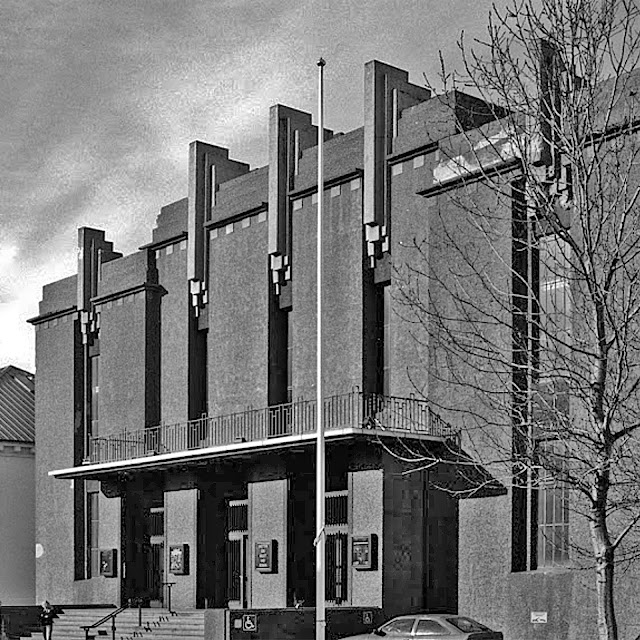
The National Theatre of Iceland is located in a severe, stucco-covered building on Hverfisgata in the old part of Reykjavík. It is not a big tourist destination (it is closed in the summer and the plays are presented in Icelandic.) This is serious theater and is a challenge for even the most open-minded visitor.


Last winter, I had the opportunity to attend a performance of Þetta er allt að koma (“This is all coming”), adapted and directed by Baltasar Kormákur from the satirical Hallgrímur Helgason novel:


In a series of sometimes bizarre vignettes, the story of the aspirations and setbacks of an aspiring performer and her extended Icelandic family is portrayed.


While watching this marvelous production (with a brilliant set design) I felt as if in a waking dream; a dream where I usually couldn’t follow the dialogue; it always seemed as if I was missing a piece of the puzzle:


At the end of the play, with a grand finale in a wedding reception, I was laughing and applauding the triumph of the actors’ skill in portraying the human condition—no translations were needed.


Although Icelandic Theatre is not available here in the US, (that would be a small niche market!) there are several Icelandic movies that can be found if one is diligent. 101 Reykjavík, Noi the Albino, The Laughter of the Seagulls, and Cold Fever are all worthwhile (and have many of these same fine actors in them.)


Production stills: Þjóðleikhúsið

By Professor Batty


Comments: 1 


Monday, February 18, 2008

Peer Gynt


or: The Onion, Revisited

When last I tangled with the amoral hero of Henrik Ibsen's dramatic poem, it was in Baltasar Kormákur's incendiary 2006 production at the Þjóðleikhúsið- Iceland's National Theatre. Sunday we met again, this time at the Tyrone Guthrie Theater in downtown Minneapolis. Ibsen's work has been newly translated and adapted by Robert Bly, the noted poet and "Men's Movement" figure. Because Peer wasn't originally intended for the stage, some adaptation is usually needed; a previous Guthrie production that was unabridged ran over 5 hours in length. This version is framed with a modern opening and ending- a surprise 50th birthday party for "Peter" who collapses and while unconscious "imagines" the play.

Bly does the language justice, he cleverly waits until Act II to introduce the rhyming couplets, which worked a lot better than had I expected. Mark Rylance, a British actor, plays Peer with more of an oafish aspect, rather than the rakish style which is often associated with the role. The austere set (above) is minimal, this is more a play of ideas, rather than spectacle. Rylance gives a good interpretation of the famous "Onion Speech", one of the few times where he rises above buffoonery.

It is perhaps unfair to compare the intense production I saw in Reykjavík with this somewhat tepid affair. There is a tradition at the Guthrie of introducing a special "effect" into their big shows- this time it was undulating floorboards simulating a desert and an ocean- I only wish they had come up with a few more dramatic "show stoppers" instead of that gimmickry.

The play itself remains pretty relevant, touching on the evils of unbridled capitalism (including slave and arms trading), human nature and its failings (the trolls are a satiric device exploring baser urges), and of course the failure of Peer to grow into adulthood and establish meaningful relationships, and, ultimately, discover his own humanity.

By Professor Batty


Comments: 0 


Tuesday, April 21, 2009

On the Town - Part II


It was a dark and stormy night. Well, it was blustery and cold, perfect weather to attend a screening of the film White Night Wedding (Brúðguminn), directed by Baltasar Kormakur. We were on the east side of the river for the Minneapolis-Saint Paul International Film Fest- now in its 27th year, still hopelessly disorganized, but a great way to see films from around the world. White Night Wedding is a loose adaptation of Anton Chekhov's Ivanov.


This tale of a miserable professor and his marriage woes has been turned into a dark tragicomedy set mostly on Flatey, a small island off the Icelandic coast. The mixed time line of the film, which could be a bit confusing for some viewers, unfolds slowly then gradually comes to a climax in a riotous wedding scene. Of course, any dramatic production which includes the sublime Laufey Elíasdóttir and a nearly-naked Ólafur Darri Ólafsson (I've seen three of them now!) is OK in my book. There is even has a cameo from my favorite girl group. It should be on IFC in the future, it is also Iceland's 2009 submission to the Oscars. Highly recommended.


The showing we went to was oversold, they may reprise it in May...

By Professor Batty


Comments: 5 


Monday, February 18, 2019

Ófærð!


Part of my recent Tucson mini-vacation was spent in Iceland. Not content to spend my days in the sun while basking in mid-70s temperatures, I had to get some blizzard action so I wouldn’t feel too guilty about missing the polar vortex.

The place where we stayed had the Icelandic series Ófærð (Trapped!) on Amazon Prime.

This is a crime drama that takes place in a remote port in Northern Iceland. A ferry comes into port at the same time a human torso is fished out of the bay. The town’s skeletal police force is pressed into service and things are further complicated when a major storm cuts off air and road access. The ferry is impounded but a fugitive manages to escape from it in a delivery truck, setting off a cascading stream of events that threatens the townfolk, already under a storm alert. The locations are all real, it is as an Icelandic experience as you are going to going to get without boarding an Icelandair jet.

Created by Baltasar Kormákur, Trapped! is full of notable Icelandic actors, all of them great, but this situation caused some problems on my part. I've seen them before in films, some of them many times, and many of them in person as well. While we only watched a couple of episodes, I had seen my fill, it really was kind of depressing (and we had to fly home before we could finish watching.) I’m sure that someone just discovering Icelandic drama would be enthralled—me, not so much. There are eight more episodes in season 1 and another ten in season 2. If you are up to to binge-watching a creepy and chilly crime drama, you could do worse.


Ingvar Eggert Sigurðsson, Ólafur Darri Ólafsson, Ilmur Kristjánsdóttir

By Professor Batty


Comments: 4 


Monday, April 19, 2010

Reykjavík-Rotterdam

So the Minneapolis - Saint Paul Film Fest is finally here, and over the weekend I did manage to catch three films. One was French (35 Rhums), one was Chinese (Dixia De Tiankong- The Shaft), and one was Icelandic- the aforementioned Reykjavík-Rotterdam. The French and Chinese films were both slice-of-family-life dramas, very minimal action, and not a whole lot of character interaction either. They both had some redeeming qualities, but entertainment was not one of them.

Óskar Jónasson's film was, in contrast, a vivid and at times sordid crime drama. Co-written by the director and Arnaldur Indriðason, it is a "last caper" movie, with Baltasar Kormákur in the lead role as a reluctant bootlegger. An excellent cast includes many regulars from the Icelandic scene including Ingvar Sigurdsson, Ólafur Darri Ólafsson, and Jörundur Ragnarsson. Although it does feature some good local color, it is more of a Hollywood style movie. Indeed, it is being remade with Mark Wahlberg in the lead! Lots of hoods, creeps and lowlifes, with some disturbing beatings and bloody violence. Realistic footage on a freighter and a wild heist scene in Rotterdam filled out the well-plotted story. Not much of Icelandic culture, but as I said, it is a Hollywood style movie, and a successful entertainment.

By Professor Batty


Comments: 0 


Friday, March 31, 2023

Touch

Touch
A Novel by
Olaf Olafsson
Published by Ecco, 2022

Leaving New Mexico behind, my literary pursuits took me back to Iceland (and then to Japan) in this elegant, bittersweet book. This is also a Covid novel, a genre that I’ve explored my own writing. Touch is a story of love found and lost and found again. Kristófer, a widower, is a successful chef in Reykjavík who has decided to retire after the onset of Covid-19 pandemic destroys his business. At the same time a long-lost lover, Miko, (who had abruptly left him years ago) had gotten in touch with him and seemed interested in reconciling. Kristófer undertakes a trip to Japan to see her just as Covid restrictions are starting to be enforced. On the way he relives his memories of the time they spent together as he tries to come to grips with the meaning of his life and of his personal sense of failure. He had met Miko in London in the late 1960s, where she worked in her father’s restaurant. He began working there in order to see more of her and incidentally found a vocation. A set of circumstances beyond his understanding caused their separation—he had lived more than fifty years not knowing why.

The story is told with a light and tender touch. Olaf’s prose suits the narrative; other work by this author is equally refined and shares a common theme of thwarted desire.

Recommended.

UPDATE: In 2024 it has been made into a movie by Baltasar Kormákur:

By Professor Batty


Comments: 2 


Tuesday, January 04, 2011

Devil's Island


A film by Friðrik Þór Friðriksson, written by Einar Kárason (Icelandic title: Djöflaeyjan), 1996.

This DVD was part of my Christmas "haul" and is an off-beat film concerned with the lives of lower class people living in abandoned U.S. military barracks in Reykjavik in the late 1950's. It stars Baltasar Kormákur as Baddi, a rebel without a cause who lived briefly in the U.S. and returned with a pompadour and an attitude. His shiftless hedonism, based upon American pop culture, clashed with these impoverished families, in a unique, short-lived environment.

The film veers close to stereotype at times (with the usual quirky Icelandic tropes), but the high level of acting and the basic humanity of the characters kept it from veering into parody. There are sub-themes of alcoholism and despair, but ultimately the film is not depressing. A worthwhile effort about a unique historical situation which manages to embrace some universal truths.

Readily available through Amazon.

UPDATE: A newly published analysis of Devil's Island at Senses of Cinema...

By Professor Batty


Comments: 4 


Wednesday, October 15, 2014

Dramatic Reykjavík

Those of you interested in exploring Icelandic culture may find that a visit to one or both of the two major theater companies in Reykjavík to be most rewarding. They aren't usually listed in most tourist guides for a couple of reasons: they are not active in the high tourist season and the plays are all in Icelandic. If you do happen find yourself in town between September and May you would be wise to check them out:


Þjóðleikhúsið, Reykjavík

Þjóðleikhúsið, the National Theater, is located in an intimidating structure on Hverfisgata, with a smaller "box" theater situated on the street behind it—Lindargata. Þjóðleikhúsið produces a mixture of plays every season, including serious drama by foreign playwrights, modern Icelandic drama, several productions for children, and contemporary Icelandic comedy. These are world-class productions with fantastic sets and brilliant direction. They feature many of the fine actors you've probably already seen in Icelandic films. The smaller Kassinn (box) venue features intimate productions and are usually somewhat "edgier". Baltasar Kormákur's 2006 production of Peer Gynt was the most intense theater experience I've ever had. The main stage offers a little more traditional fare (but only a little), Hallgrímur Helgason’s Þetta er allt að koma in 2004 was a wild ride through Icelandic consciousness.


Borgarleikhúsið

Borgarleikhúsið is the City Theater. Located on the south end of Kringland, it usually runs a little lighter in tone, with an emphasis on musicals and family fare (Mary Poppins, for example). The smaller theater offers current playwrights; on a recent visit I saw John Logan's Red (Rautt), a Tony-award winning play about the artist Mark Rothko. The theater complex is newer than the Þjóðleikhúsið and contains a vast lobby (for both venues) well worth a visit on its own.

Don’t let the language barrier prevent you from attending one of these plays. You might want to avoid overly "talky" dramas, but I've found that the expressive acting in most plays usually makes up for my lack of literary comprehension. A play you are familiar with, for example Shakespeare's Macbeth, would lose little in translation. The tickets are reasonable (4400 kronur, about $35 or £24) and while it is possible to order on line, it requires some help from Google translate. You might want to visit the box office a couple of days in advance for the performances often sell out. If you are by yourself, or can't convince your traveling partner to come along, you'll have a better chance of scoring a single ticket to a popular show. Part of any theater experience is people watching during the intermission and the Icelanders do enjoy dressing up for the occasion so dress up yourself—and you'll become part of that show! The matinees are somewhat less formal.

A big part of Iceland's appeal for me is its spoken language. Attending a play there is an opportunity to hear it at a very high level. This form of Icelandic culture, when distilled into a dramatic context, creates memories which you'll never forget.

Note: a slightly different form of this post was originally written for the I’d Rather Be in Iceland Blog.

By Professor Batty


Comments: 0 


Sunday, October 29, 2006

Intermission


In the lobby, we were discussing the first half of Pétur Gautur, a modern production of Ibsen's Peer Gynt, directed by Baltasar Kormákur, and performed by the Icelandic National Theatre company. My companion asked if I was getting much out of it without understanding the Icelandic. I told her that the emotional impact was there for me in many scenes, the actors' body language was very expressive. I had been most affected by a scene with Pétur and his dying mother:


Our conversation continued about the different stages of life that were now in. My companion spoke of a television interview she had seen with the oldest person in Iceland. In it, the 109-year old woman had simply stated that: "God has forgotten me."

In one critical scene, Pétur declares: "I am an onion", and as he peels one he only finds more layers, with nothing at the core. His quandary, existential in nature, is the modern dilemma. Has God forgotten us? And if so, how shall we behave?

We returned to the theater for the second half, even more dramatic in its nature. The play ended with the stage floor covered in blood, money, and ashes as the lights went out:


Images ~ Þjóðleikhúsið

By Professor Batty


Comments: 0 


. . . . . . . . . . . . . . . . . . . . . . . . . . . . ©Stephen Charles Cowdery, 2004-2025 . . . . . . . . . . . . . . . . . . . . . . . . . . .