Monday, October 18, 2010

Mysteries of the North Country

Hypothermia

An Inspector Erlendur Mystery
By Arnaldur Indriðason
Minotaur Books, 2010

I spent last week not in the North Atlantic, as my posts would appear to indicate, but rather halfway up northern Minnesota's Gunflint Trail, in a cabin a stone's throw away from the icy cold waters of Little Ollie Lake. The days were gorgeous for this time of year—unseasonably warm and generally sunny. The evenings did cool off enough to allow the building of a cozy fire in the stove. The nights have already gotten longer, making a perfect setting for this chilly Icelandic murder-mystery.

So I read this one—aloud—to the Weaver while she knitted. Reading the place-names of dozens of Icelandic locales really tested my concentration, and I found that I actually could suss out most of them, in my fashion, after awhile I had even started to unconsciously trill my "r's"!

Arnaldur Indriðason's latest novel (latest novel to be translated into English, that is) continues with the existential struggles of Inspector Erlendur as he tries to deal with his inner demons while struggling with some decades-old missing-person cases as well as a recent suicide. The twist in this book is the introduction of a theme of supernatural events: seances, visitations, and dreams. Erlendur steadfastly refuses to believe in any of it, but is also aware that something is going on; more than one coincidence usually means it isn't a coincidence at all. This a talky book, with lots of circular conversations, often repeated with several different people. The mystery isn't too hard to figure out, the story's strength lies more in watching Erlendur come to an understanding of the chain of events and how the suicide case spurs new insight into the older case. Erlendur is, as usual, haunted by the childhood death of his brother, a death he feels responsible for, and a feeling which was shared by the suicide victim. He is also haunted by his failed marriage and his dealings with his ex-wife and children. There are a lot of dysfunctional family dynamics going on here—Indriðason incorporates them brilliantly in the plot, giving this mystery a definite sense of depth.

A note on the translation: Bernard Scudder, his original translator, passed away a few years ago, being replaced by Victoria Cribb. The dialog seems less fluid; I think Scudder may have had a better touch for this kind of writing. In addition, the book was riddled with typos! They may have rushed the production a bit, I can't recall reading a book that had been so poorly proofread! You might want to opt for the UK softcover edition, hopefully these mistakes have been corrected in them.

By Professor Batty


Comments: 7 


Wednesday, June 24, 2015

Reykjavík Nights


An Inspector Erlendur Mystery
By Arnaldur Indriðason
Minotaur Books, US edition 2015

   Hooray! Erlendur is back, this time in sort of a prequel to the other books in the series. Set in 1976, Erlendur is a young traffic officer who works the night shift in Reykjavík. To the usual mix of accidents, drunks and domestics is added the the case of two missing women and the apparent death by drowning of an alcoholic who Erlendur had gotten to know. As is usually the case in this series, apparently unrelated events have hidden connections. Erlendur’s stubbornness leads him through the city in a quest to find the answers to his questions, questions the police had given up on.

   If you are familiar with Reykjavík be sure to have a map of the city handy when reading, Indriðason provides street names to all the locations. The book features the city’s new building projects, giving a sense of the era between its World War II-era past and its modern incarnation. I found it fascinating, those readers without a special interest in the city may find it less so. Indriðason is exploring some aspects of his own coming-of-age in this book, with numerous seventies cultural references.

By Professor Batty


Comments: 4 


Saturday, November 02, 2013

Strange Shores


An Inspector Erlendur Mystery
by Arnaldur Indriðason

Fortunately, I received my copy of this, the last book in the series, only a few hours before leaving our my recent trip.  I read it in one sitting while cozily ensconced in an antique bed in my room at the Calumet Inn in Pipestone, Minnesota. In a way it was fitting, for the hotel is said to be haunted, Arnaldur’s book is also filled with ghosts from the past. The previous two books in the series centered around his colleagues in Reykjavík while Erlendur was on leave, revisiting his childhood haunts in the East Fjörds. This book tells the story of his absence.  While still a child, Erlendur had been caught in a snowstorm with his younger brother and father. The younger brother was lost in the storm and never found.

It so happens that other people had also turned up missing in another, earlier, storm in the area—a group of British soldiers and a local woman. The soldiers were ultimately all accounted for (some died) but the woman's body never turned up. Erlendur starts asking questions out of curiosity, perhaps spurred on by the similarity with his brother’s disappearance, but soon finds himself reliving the event through the memories of aged pensioners. This is not a book for fans of action. Most of it is in the form of dialogs, many of those who Erlendur interacts with are in nursing homes. The book has an exceptionally dreary mood: it is overcast, cold, damp and dark, filled with lives of regret and suspicion.

The book has two endings: the ending of the story and the ending of the series. The story’s end is melancholy. The series end is fitting and, in a strange way, spiritual and uplifting. I wouldn’t recommend reading this entry first; the reader should have at least a few others read in order for this volume to make its maximum impact. My other reviews of the series are here.

By Professor Batty


Comments: 2 


Monday, August 22, 2011

Summer Reading, Continued...

Outrage

A novel by Arnaldur Indriðason
Random House, Canada, 2011
Originally published in Icelandic as Myrká, 2008
Translated by Anna Yates
281 pp.

The latest detective novel by Iceland's most successful living author is the ninth Inspector Erlendur book and the seventh to be translated into English, and although it is part of the series, it really isn't an Erlendur book at all. Throughout the story, Erlendur is off in the trackless Eastfjords; the main character becomes Erlendur's co-worker Elínborg, a middle-aged detective and mother of three who also writes cookbooks as a sideline. A good deal Elínborg's domestic life comes through in the novel. Some critics have faulted the book for this, however I think that it gives a proper grounding to the story; I can never get enough of Icelandic culture in any of these Icelandic mysteries- the culture is part of the mystery. It may well be that I have been putting myself into the narrative a little too closely but it's easy to do when there is so much in the story with which I can identify.

The twist this time is that the murder victim is actually a perpetrator, until Elínborg realizes this the investigation goes nowhere. Arnaldur may have turned to a different investigator in order to breathe new life into the series, his writing seems a touch formulaic, although the translation may have had a part in that. It isn't a bad book by any means, but the series may have reached a peak in the previous book, Hypothermia. I haven't seen this title in a US edition yet, perhaps Minotaur, the US publisher, has passed on it.

By Professor Batty


Comments: 2 


Monday, April 18, 2016

Mondays in Iceland - #58

Into Oblivion

An Icelandic Thriller
By Arnaldur Indriðason
Minotaur Books

This is the eleventh in the Inspector Erlendur series, although it would be the second in a chronological order.

Taking place in the late-seventies, Erlendur has been recently promoted to Inspector and works with his mentor, the gender-unspecified "Marion" to investigate a battered corpse that has turned up in the waste pool (which would later become the Blue Lagoon) from the geothermal plant on the Midnesheidi moor. An old missing-persons case from the early 1950s also captures Erlendur's attention.

The sub-theme behind both of these incidents is the US military base in Keflavík and how it distorted the values of the Icelandic citizens who dealt with it. There is a fair amount of history of a temporary housing project built upon old US facilities, a history which I found to be very interesting. Camp Knox, featured in the book, was where the Vesturbæjarlaug pool was later built and was also a subject of the excellent film Devil's Island.

The formula of this series is beginning to ossify, that's not necessarily a bad thing, but it does tend to make all the books blur together after a while. Still, I found it to be  worthwhile and it is a must for those who like their mysteries seasoned with an Icelandic flavor.

By Professor Batty


Comments: 0 


Monday, January 31, 2011

Convergence

“It’s all one great big bloody mire.”


Nordurmýri, Reykjavík, 2004

Jar City, A Reykjavík Thriller, by Arnaldur Indriðason, Thomas Dunne Books, 2005

Promising Genomics, Iceland and deCODE Genetics in a World of Speculation, by Mike Fortun, University of California Press, 2008

Under the Glacier, by Halldór Laxness, Vintage International, 2005

These three books have converged on my consciousness this winter; I've referred to Jar City, (Original Icelandic title: Mýrin) several times before, but never given the book a proper review (as if I've ever given a "proper" review!) I had received it for Christmas (to replace a lost copy) from a blog-pal, and I recently got a glowing recommendation about it from another blog-pal. In the four years since my first reading of the book, I’ve read read four other Inspector Erlendur mysteries and was eager to revisit “the scene of the crime.” I’ve spent some time (not nearly enough!) prowling the streets of Reykjavík, including a stay in the Nordurmýri area (the foreground of the area pictured above) where the murder takes place. Arnaldur’s series seems authentic, indeed, the atmosphere of the settings and the psychology of Erlendur are more important than an actual crime. The plot-wrinkle in this book concerns genetic profiling, with references to a fictional “Genetics Research Centre.

Promising Genomics is a non-fiction book about deCODE Genetics, a start-up company which raised millions on the promise of using the genetic data-base of the Icelandic population to decode inherited illnesses; the results could create new therapies and treatments. I was made aware of this book by yet another blog-pal and I was pleasantly surprised to find it an in-depth treatment of the actual institution which Arnaldur used so effectively in fiction. Mike Fortun does a good job explaining the irrational exuberance displayed by venture capitalists before, during and after the "internet bust" of 2002, when millions of dollars were raised and lost by deCODE on "promises" of scientific breakthroughs. The subject can be overwhelming at times, but Fortun cleverly models himself as a participant/observer, acknowledging and assuming the persona of “Embi”, a character from the Halldór Laxness novel Under the Glacier. The promoters of deCODE are portrayed as playing a con-game, but one in which there is just (barely) enough potential to keep it going. The book was published in 2008, so fallout from the failure of the Icelandic banking system was not covered.

Halldór Laxness’ great novel of ideas, Under the Glacier (Icelandic title: Kristnihald undir Jökli) seems (to me, at least) be getting better and better, the more I read it, and read of it. This book (published in 1968) is an examination of the modern dilemma, in all of its messy glory. Religion, technology, sex, morality and just plain everyday existence is hashed over in a uniquely Icelandic stew (Plokkfiskur?) Fortun’s book uses Glacier as a template, as well as references from Halldor’s other social satire The Atom Station. Glacier is a hard book to dive into—many of a Western reader’s cultural landmarks have gone missing or are deconstructed with a ‘ironic fatalism’, for the lack of a better word. There are implied promises in Glacier as well: the promise that Embi's report will have meaning and that Úa's anima can save Embi. Like deCODE, the promise is there, but never quite fulfilled.

There is always a place, a place beyond the “focus” where converging lines diverge again. I appear to be at that place now with the overlapping of three such diverse books. Still, I’ve found that Erlendur’s search for the meaning of a murder, Fortun’s search for meaning in a business model, as well as Embi’s search for the meaning of life itself, share similarities. When overlapped on my mental map of Icelandic culture patterns emerge, still beyond my understanding, but tantalizingly close.

Rose, Niranjana, and Mary: thanks again for the inspiration!

More on Halldor Laxness at Laxness in Translation

By Professor Batty


Comments: 6 


Monday, November 12, 2007

Voices


The third Inspector Erlendur book, Voices, by Arnaldur Indriðason, is billed as a thriller, but is really a subtle, layered psychological novel. This is the third in a series (the other English titles: Jar City, Silence of the Grave) of Icelandic mysteries, Erlendur is called to investigate a murder in a posh Reykjavík hotel, he decides to stay there for the investigation, not wanting to go home to his "empty hole" of an apartment during the Christmas season. By restricting his main character to one location, Arnauldur forces us to go inward with Erlendur, as he confronts his own past, as he explores the motivations of the murder, and reveals the background of the victim.

Arnaldur Indriðason is getting better with each book in the series, this book lacks the broader Icelandic settings of the others, but probes the Inspector's internal landscape deeper. This is a great series, and I am looking forward to many more.

By Professor Batty


Comments: 9 


Thursday, January 21, 2010

Arctic Chill

A Thriller. By Arnaldur Indriðason, Minotaur Books, New York, 2009

This latest* installment in the Inspector Erlendur series is another bleak visit to the world of Icelandic murder and intrigue. One problem in this continuing series is that there is always a chapter or two devoted to exposition, but once things get rolling the action picks up considerably. These stories always have a sub-context concerning Icelandic society and conflicts caused by change. This time the questions of immigration and prejudice are at the forefront of the narrative, with a nasty murder of a Icelandic-Thai child sending Erlendur off on a search for the murderer and, as is always the case, his own demons.

Fans of the series should enjoy this book thoroughly, newcomers might want to start with Jar City AKA Tainted Blood (Mýrin, in Icelandic.) There is just enough continuity in these stories to warrant reading them in order.

*The latest book in the US market. We are about 3 years behind the Icelandic publication, and a couple of years behind the UK, perhaps because Arnaldur's long-time translator, Bernard Scudder, died recently.

By Professor Batty


Comments: 3 


Monday, October 04, 2021

Mondays in Iceland -#123

The Darkness Knows

A novel by Arnaldur Indriðason
Translated by Victoria Cribb

It has been a few years since there have been any new English translations of novels by Arnaldur Indriðason. Arnaldur is best known for his 14 Detective Inspector Erlendur novels, he has been writing and publishing in Icelandic regularly but I suspect that the recent explosion of translated Icelandic novels has caused a backlog (this book was first published in 2017 and is just now available in English.) When Arnaldur started his career (in the late 1990s), he was one of only a handful of Icelandic writers being translated into English. Now there are dozens of quality books by Icelandic authors making the ‘leap across the pond’ every year—truly an embarrassment of riches. The golden age of Icelandic literature is NOW.

The Darkness Knows is the first novel in a series featuring Konráð, a retired Reykjavík police detective. The story begins when a tour group discovers a body frozen in a glacier. The body belonged to a man who went missing thirty years previously and the chief suspect in his disappearance (who had never been charged) had become close to Konráð, uncomfortably so, and so asks to see Konráð after he is re-arrested. Konráð meets with the man, who protests his innocence but in such a way that there remains doubt about his story. There are also sub-plots concerning a victim of a hit-and-run accident and Konráð’s relationship with his father (who was a minor criminal and conman) who had died when Konráð was a teen. I suspect that relationship will be more fully developed in the later books (there are already three more that have yet to be translated.) Konráð, a widower, is a melancholy figure (but not nearly as cranky as the Erlendur character was in that previous series) but has a much darker backstory,  which I also assume will also be explored in future books. The writing, as is usually the case with Indriðason, is terse and direct, making the somewhat complex story line easier to follow and, if you are familiar with Reykjavík, the description of the story’s settings add color to the story. The plot is logical, but still manages to take a sharp turn or two. I found the ending to be surprisingly touching. One of the joys of following Indriðason’s novels is the ‘slow burn’ of character development over the series. This augurs well for the remaining titles—or it just might be that I find a perverse pleasure (self-identification?) in reading about idle pensioners. Konráð is the antithesis of a television action-detective.

Victoria Cribb’s translations, after a shaky beginning, have become faultless—she is now one of the best in doing Icelandic to English.

Recommended.

By Professor Batty


Comments: 0 


Monday, June 11, 2012

Summer Reading - II

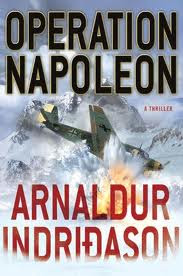
Operation Napoleon
A Thriller
By Arnaldur Indriðason, Minotaur, 2010
Translated by Victoria Cribb

One way to beat the heat is to spend time being engrossed in chilly Icelandic crime fiction. Although this book isn't part of Arnaldur Indriðason's immensely successful Inspector Erlendur series (Erlendur does make an uncredited "cameo" appearance), it is a one-off mystery/thriller with a plot centered around a German plane which had crashed on an Icelandic glacier during the last days of World War II. Most of the action takes place in the year 2000 as the United States military is engaged in a clandestine recovery operation. The plane holds a terrible secret which still has the power to disrupt international relations. Kristín, a lawyer for the Icelandic Foreign Ministry, unwittingly becomes entangled with with this affair setting off a wild sequence of events to uncover the mystery.

This novel came out in Iceland in 1999; it was only recently translated. It is much less introspective than Arnaldur's other titles (it would make a dandy action flick), but it still retains a strong sense of setting and a few quirky Icelandic idioms. The plot is complex but well handled. The chain of events, while a bit far-fetched, never becomes ridiculous. Because it was written before the US closed its base at Keflavík in 2006, its sub-theme about the US military presence in Iceland adds an interesting historical perspective to the book. The Americans in it are, for the most part, villains and nasty ones at that. Exciting, fast-paced, not too challenging (I read it in one sitting) Operation Napoleon I found it to be perfect summer reading, especially compared to:


Available Dark
A Crime Novel
By Elizabeth Hand
Minotaur, 2012

This turgid mess of drug, death-metal music and Icelandic references masquerading as a book comes across as a lightweight parody of the Stieg Larsson thrillers. Told from the point of view of a 40-something female photographer and drug addict, it comes across as a quickie made in order to cash in on the Nordic crime craze. Gives a new meaning to the phrase "speed-read."

Yuck.

By Professor Batty


Comments: 4 


Friday, December 01, 2017

Another Arnaldur

The Shadow District
A Thriller
By Arnaldur Indriðason
Translated by Victoria Cribb
Minotaur Books, 2017

Indriðason’s back with this stylish “thriller” set in both past and current Iceland. The death of an old pensioner in modern Reykjavík re-ignites interest in a pair of old murder cases from the forties. Konrad, a retired police detective who is still consulted by the overworked police investigator Marta, who gives him some enigmatic clues about the dead man, starting the action. In a parallel narrative set in 1944, Flóvent, a Rekjavík detective, and Thorson, a Canadian military policeman, try to come to grips with the body of a murdered woman found behind the National Theatre building. Indriðason does a good job of intertwining the stories, each iteration of the story reveals more details yet somehow remains opaque until the very end.

This is evidently the start of a new series, there is no “Inspector Erlendur” in this book. The fact that there are four detectives (in two different eras) dilutes its dramatic center. Indriðason is trying to take his writing in a different direction, although many of the tropes are similar to the Erlendur books. Anyone familiar with Rekjavík will get a kick out of seeing familiar neighborhoods come to life on the page. The translation is good, one of the better efforts by Victoria Cribb.


By Professor Batty


Comments: 1 


Monday, January 12, 2009

Bad Girls and Wild Women


Blame it all on the full moon.

This weekend was spent wallowing in pop culture, with a focus on the darker side of femininity. Two films, two books, with some unusual parallels and some striking contrasts between them.

First up: Black Snake Moan. This 2007 film is a morality play of sorts, with Christina Ricci and Samuel L. Jackson both seeking some sort of redemption. Set in the modern south, it would be a mistake to watch this as a "realistic" drama. Almost every scene is charged with symbolism and layered with centuries of meaning. Ricci's character, Rae, is a sexual addict with a bad family history. Jackson's Lazarus is a blues man turned farmer whose wife has just left him for his brother. They meet through fate and the rest of the film has them struggling with each other and the voids in their lives. Despite having Ricci's character clad only in underwear and a 40 pound chain for the middle third of the movie, this is a serious examination of race, gender and relational abuse. It ends with some hope of redemption for its characters, but no promises. The whole cast (even Justin Timberlake!) is excellent. The DVD has a feature about the making of the movie which really adds a lot to understanding some of the themes. A big surprise for me and well worth renting.

Next was In This Our Life, a 1942 melodrama starring Bette Davis and Olivia de Havilland. Set in Richmond Virginia, it was based on the Pulitzer-prize winning novel by Ellen Glasgow and was directed by John Huston. Davis' character Stanley Timberlake (how about that coincidence?) steals her sister Roy's fiance in her frenzied pursuit of attention. The implied incest with her rich uncle suggests the cause of the sexual hysteria present in Stanley's behavior. There is also a racial theme, quite progressive for its era, with a grim, moralistic outcome. This movie is quite "stagey", but Davis really tears into her role.

Turning from the screen to the page, I was thrilled to discover that Lise Erdrich (Louise Erdrich's sister) is also an exciting author in her own right. Night Train is a collection of 31 short (some very short) pieces of "flash fiction" full of wild imagery and uncensored expression. There is a strong undercurrent of American Indian experience. Perhaps best taken in small doses. Were this a blog I'd definitely link to it. Strong stuff, a real trip.

Finally, Last Rituals is a mystery novel by the Icelandic author and civil engineer Yrsa Sigurdardóttir. In it, Þora Gudmunsdóttir, a struggling lawyer and single mother in Reykjavík, is asked to assist a wealthy German family investigate the bizarre, ritualistic murder of their son. This book was a bit of a let-down for me, the writing, while competent, was a bit mundane, thin on psychology; the story's Icelandic backdrops were not very atmospheric. As a mystery there were a few too many quirky plot details resulting in a bit of a messy, improbable ending. It's worth a look- I thought it better than most mysteries I've read lately- but my perception may have been tainted by Arnaldur Indriðasson's superior Inspector Erlendur series.

By Professor Batty


Comments: 6 


Monday, April 02, 2012

Fish Leather and Dreams of Iceland


Fashion, Skólavörðurstígur, 2004

For all you dreamers out there...

It's been a while since I've done an overview of the Icelandic sites I've been visiting recently. There seems to be a resurgence of interest in Iceland, at least in the blogosphere. I've found several new sites and some of my old faves have been especially inspired lately. So, without further ado and in no particular order, respectfully submitted for your consideration:

UPDATE: All of the below links are now (2020) defunct except for the Pascal Pinon ones.

The Saga-Steads of Iceland: A 21st-Century Pilgrimage< by Emily Lethbridge, a 31-year-old Cambridge-based academic researcher. She is really into Iceland, past and present- a true fanatic.

Rósir og hraunbreiður (Roses and Lava) by Unnur Birna Karlsdóttir (Google translated) offers an intriguing look at Iceland and modern life.

Nancy Campbell is a writer and printmaker currently living in Siglufjörður.

I've mentioned I Heart Reykjavík before. This site keeps on getting better, an absolute must for anyone traveling to Reykjavík for the first time (or returning- things are changing rapidly.) Auður has the scoop on food, fashions and fun.

Maria Roff's Iceland Eyes has been especially fine lately with insightful essays complementing her eclectic photography. An honest portrayal of Iceland and also full of ideas of things to see and do.

Jono's Otto's son blog is from another Iceland-dreamer, he lives in Northern Minnesota, but has a genetic connection.

I'd Rather Be In Iceland by "Eva Lind" (no, she isn't Inspector Erlendur's daughter) says it all in the title. Hopelessly infatuated.

wdvalgardson's kaffihus is the blog of another "Western Icelander", the author is a true author, and his posts are exceptional- not for short-attention spans. His posts on Halldór Laxness' The Fish Can Sing and Paradise Regained are featured in the Laxness in Translation site.

Finally, that teen-age girl-group Pascal Pinon is touring Japan (What were you doing when you were 17?) in support of their album, with a new "Japan-only" EP. The link takes you to an index of sites related to PP. Don't forget to check out Ásthildur's home-made video including clips from their younger sisters- very dream-like!

By Professor Batty


Comments: 5 


Sunday, April 18, 2004

Arnaldur Indriðason

FITK reviews of novels by the noted Icelandic mystery/thriller writer:

In English publication order:

Jar City (aka Tainted Blood) (2004)
Silence of the Grave (2005)
Arctic Chill (2005)
Voices (2006)
The Draining Lake (2007)
Hypothermia (2009)
Operation Napoleon (2010)
Outrage (2011)
Black Skies (2012)
Strange Shores (2013)
Reykjavík Nights (2014)
Into Oblivion (2015)
The Shadow District (2016)
The Shadow Killer (2018)

A guide to the Inspector Erlendur Series in continutity order here.

By Professor Batty


Wednesday, October 08, 2008

Spheres of Influence

The Draining Lake
Arnaldur Indriðason

It isn't often that a mystery novel illuminates current affairs. In this, the fourth Inspector Erlendur book, the action shifts between the cold war in mid 1950's Leipzig and a present-day investigation of a body found in Lake Kleifarvatn in Iceland. This is more of a why-done-it than a who-done-it. As with any good mystery, you don't want it to end, but when it does it reaches a satisfactory conclusion.

But it was the context of the story which really caught my interest. In it, Russian and East German spies, Icelandic and East German Socialists, youthful idealism and utter political depravity clash, with a backdrop of Stalinist totalitarianism. This book presents the idea of Icelandic students and the country of Iceland itself as unwitting pawns in a massive, covert struggle for influence and domination by the Soviet Union for the hearts and minds of the the Iceland populace- helped along by a few hard-line, if somewhat naive Icelanders.

This context made today's news concerning a Russian bailout of the Icelandic banking system even more sinister. Since the departure of the U.S Navy Base in 2006, Iceland and the US government have drifted apart, while reports of Russian bombers violating or approaching Icelandic airspace have become more frequent. The Russians would love to have a base in the North Atlantic, and with the US in no position to reestablish economic or military ties, they may have a "golden" opportunity. Check out Alda's most excellent blog, The Iceland Weather Report for a look from the inside of this developing situation.

Of course, any group wanting to dominate this nation of "Independent People" will need a lot more than a bail-out to turn that fantasy into a reality.

By Professor Batty


Comments: 1 


Thursday, May 31, 2018

The Shadow Killer

A thriller
By Arnaldur Indriðason
Minotaur, 2018

This is the second book in Indriðason’s wartime Flóvent/Thorson series, although it takes place a couple of years before the previous one, The Shadow District Set in Reykjavík during World War II and the change from British to American occupation, this atmospheric novel captures that brief time vividly—in both its place descriptions and characters. The plot revolves an execution-style murder of a hapless traveling salesman, a man who is slowly revealed to have been an unwitting part of a much larger scheme involving Nazi sympathizers, German spies, and a secret “scientific” project that took place in his childhood. The story is realistic, the characters are believable, and the story comes to a satisfactory conclusion, and, after my recent diet of modern mysteries, it was refreshing to read a story where the only personal electronic device is a hard-wired telephone.

This is a very good mystery, although Flóvent and Thorson, the two detectives, are not as fully developed as Erlendur was in Indriðason’s other series. Written in a restrained style, with realistic characters and situations, it is a solid entry and worthy of a look.

A qualified recommendation.

By Professor Batty


Comments: 0 


Wednesday, November 19, 2014

Sugar Mountain


Pascal Pinon press conference, Reykjavík, 2009

Oh, to live on sugar mountain
With the barkers and the colored balloons
You can’t be twenty on sugar mountain
Though you’re thinking that you're leaving there too soon
You’re leaving there too soon…

                     ~ Neil Young
Childhood’s end is the end of a dream.

In Neil Young’s Canada the end was turning twenty, when ‘kids’ were no longer allowed into a certain amusement park intended for youngsters. I’ve been nurturing my own dream these last fifteen years; a dream abetted by many fine people on both sides of the Atlantic. For me, Iceland’s allure was always more than its considerable natural wonders. Right from that first windy March day when I stepped out of the Keflavík terminal the whole of Iceland—its nature, people, and culture—has held me in its thrall. As I became further immersed in its cultural aspects: literature, cinema, music and theater, I was overwhelmed.

Recently, however, I’ve been losing the spark.

Icelandic pop music, always quirky, is an acquired taste, but a taste that needs to be nourished for it to thrive. If it weren’t for a few reliable sources I’d be starving. My limited impressions of the recent Iceland Airwaves music festival (from what I was able to see on line) wasn’t encouraging: in the span of four years since I last attended it appears to have morphed from a mix of unique, artistic, and very musical acts to a uniform parade of post-punk screamers. Of course, I wasn’t there, and subtlety never goes over very well in video clips. Still, it was a marked change: music made with an emphasis on shock value, more of a unpleasant burlesque than an expression of the human spirit. In other words, a freak show. Looking back, I was spoiled and/or lucky in my Airwaves experiences (2006 and 2009). In 2012 I did attend some good shows in Iceland (not in Airwaves) but some of the acts, although polished, were exercises in cognitive dissonance, i.e., Icelandic bands playing in a faux American style. I won’t despair of Icelandic musicians yet: there seems to be a trend of them becoming astute social commentators and political activists.

Iceland is a literary beacon, and it that area it continues its appeal. The problem here is dilution. The market demands more Icelandic mystery fiction following in the vein of Arnaldur Indriðason’s successful Inspector Erlendur series. What the market demands, the market gets. I’m guilty of it myself. But after reading the third or fourth work of mediocre Icelandic fiction in a row (generally by non-Icelanders) I find the whole genre to be losing its appeal. The more esoteric works still captivate me. I won’t give up on Ice-Lit quite yet.

Icelandic films, when I can see them, are still excellent, but the economic hardships imposed on the industry since the Kreppa has reduced their amount and distribution. Again, the world cinema market in films is over-saturated. I find it hard to choose anything to watch.

Nothing lasts forever. The most poignant example of this is the musical group Pascal Pinon (pictured above, at the age of fifteen) who created a body of work which perfectly expressed the dilemmas inherent in a girl’s coming of age. Of course, now that they have matured, they can’t continue to play ingenues. The idea of adult women performing songs of their adolescence is mortifying. I’m grateful for that which they have accomplished.

The medium of “blogging” (does that mean anything anymore?) has changed as well; it’s hard to keep a fresh approach to something with a limited audience, and sometimes life just gets in the way. That said, I’m still amazed at Alda and Auður’s contributions over the past ten years: establishing world class portals that are the entry points into their wonderful, strange and troubled island. Auður, in particular, is going above and beyond what anyone expects of a blogger. In contrast, I’ve noticed that my Icelandic posts here have dwindled recently and, unfortunately, a return trip to recharge my batteries, seems unlikely. The continuing economic hardships in Iceland haven’t helped diminish my sense of pessimism either.

I’m now twenty three times over, and then some, but Iceland still casts its spell.

And I’m thinking that I’m leaving there too soon.

By Professor Batty


Comments: 3 


Monday, January 14, 2013

The Gathering Storm

Black Skies

A novel by Arnaldur Indriðason
Harvill Secker, London, 2012

Originally published in Icelandic in 2009 as Svörtuloft (The Black Fort), Arnaldur Indriðason's second crime novel without Inspector Erlendur is set in Reykjavík in 2008 during the run-up to Iceland's financial meltdown. This time the main character is Sigurdur Óli, an investigator in the homicide division of Iceland's CID.

A convoluted plot involving sex, blackmailing and murder is set into motion when Sigurdur tries to help an old school chum who is being shaken down for his involvement with a "swingers" group a couple of years earlier. The list of persons of interest expands rapidly, taking the detective into the dazzling world of the newly-rich banking class. The author further explores this class stratification in a parallel story about a pathetic young alcoholic whose demise is not completely unrelated to the corruption that Sigurdur uncovers at the top.

This may be the most unrelentingly bleak of Arnaldur's crime novels since Voices. Sigurdur Óli's distaste for much of Icelandic culture (he prefers American Baseball and Football) is fully justified by the actions of the novel's characters. Arnaldur does use the City of Reykjavík as a vivid backdrop to the story; there is a lot of background here for those bitten with the "Iceland bug."

By Professor Batty


Comments: 2 


. . . . . . . . . . . . . . . . . . . . . . . . . . . . ©Stephen Charles Cowdery, 2004-2025 . . . . . . . . . . . . . . . . . . . . . . . . . . .