Wednesday, May 10, 2017

Icelandic Invasion at the ASI


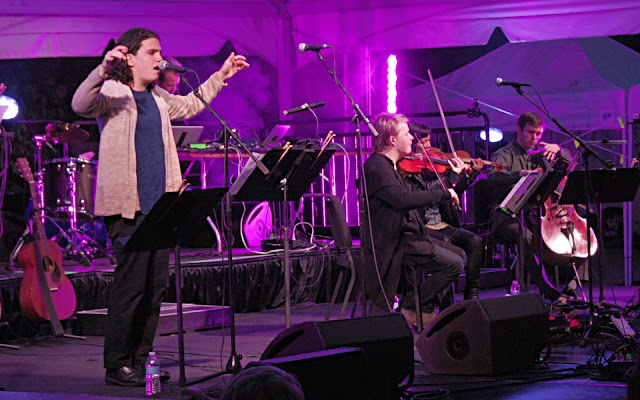
Last night found the Weaver and me at a most unusual concert featuring some fairly obscure musicians: the Icelandic musical collective Bedroom Community. I have seen versions of them perform in Iceland a couple of times but this was a rare opportunity to see these performers in the Midwest, fresh from their triumphant residency with the Los Angeles Philharmonic. Not every artist could make it: The U.S. Immigration Services denied the visa application for Swedish vocalist Mariam Wallentin, I fear that this may be a harbinger of things to come. Set in the gorgeous courtyard of The American Swedish Institute, it was an evening of musical highs and plateaus. It has been over ten years since I’ve last seen the melancholy Valgeir Sigurðsson perform. He’s since been busy, as a composer and as an all-around audio producer and engineer for Björk, Sigur Rós and numerous other acts. He was in Minneapolis last night, although oddly subdued, seeming content to stay in the background while violinist Pekka Kuusisto led a string quartet from the Saint Paul Chamber Orchestra:


The Bedroom Community is a loosely-knit group of musicians, it includes Jodie Landau, a singer and multi-instrumentalist out of Los Angeles who was effective with his art songs:


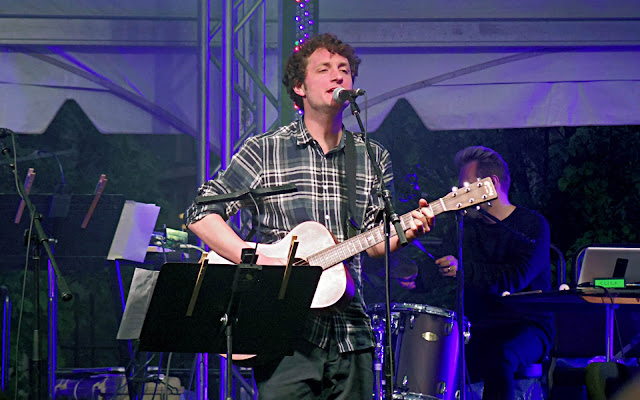
The neo-folkie Sam Amidon is a bit of the odd man out here, he is not a very dynamic performer and his musical sensibilities re: American Folk Music is about 60 years out of sync with the times. He would have been great in the pre-Bob Dylan folk era, I couldn’t fathom why he was on stage with this group of musicians:


Daníel Bjarnason was also low-key tonight, his piano was lost in the mix at times:


The wild card in this deck was Kuusisto, a virtuoso violinist from Finland who performed an excellent cover of Prince’s Something in the Water with Poliça's Channy Leaneagh:


There was more than just music: delicious small plates from Fika, the ASI restaurant, were available, along with a choice of beverages and a yummy strawberry custard dessert cup.

The ticket also included an admission to the institute’s current show, featuring Scandinavian textile designers.

One hazard of an outdoor show in South Minneapolis is the nearly constant sound of jets leaving the nearby MSP airport. Sometimes the roar of the engines was in tune with the composition, not what was intended, but making for memorable performances.

All in all, not too bad for a Tuesday evening!

By Professor Batty


Comments: 2 


Monday, April 19, 2004

Tónlist

Here is the list of the various Icelandic and other Nordic/Arctic musical groups I’ve mentioned in FITK over the years:

Áki Ásgeirsson
Amiina
Andy Schauf
Apparat Organ Quartet
Árný
Árný Margrét
Atli
Ásthildur Ákadóttir
Ateria
Áuslaug Magnusdóttir
Æla

Baggalútur
Bára Gísladóttir
Bárujárn
Bedroom Community
Benni Hemm Hemm
Between Mountains
Biggi Hilmars
Björk
Björt
BKPM
Bláskjár
Borko
Bríet
Brimheim
Buff

Cosmic Call
Cyber
Daníel Bjarnarson
Ditka
DJ Margeir
Dr. Spock
Egill Sæbjörnsson
Eivør
Elin Hall
Elisapie
Evil Madness
Flesh Machine
Fókus
Frid Fufanu

Gabriel Ólafs
Geðbrigði
Ghostigital
GKR
GDRN
Greyskies
Gróa
Grúska Babúska
Guðmundur Óskar Guðmundsson
Guðni Thorlacius Jóhannesson
Guðrið Hansdóttir
GusGus
Gyða

Hafdís Huld
Halla Tómasdóttir
Halli Guðmundsson
Ham
Hekla
Hekla Magnúsdóttir
Hellvar/Heiða
Hildur Gunðadóttir
Hildur
Hilmar Örn Hilmarsson
Hjaltalín
Hjörvar
Högni
Hraun
Hudson Wayne
Hugar
Iðunn Einars

Jakobínarína
Jana
JFDR
Jófríður Ákadóttir
Jóhann Jóhannsson
Jóhanna Elísa
Jóhanna Rakel
Jonathan
Jonfri
Joshua Wilkinson
Júniús Meyvant
K.Óla
Kaktus Einarsson
Kalli
Kevin Cole
Kimono
Kira Kira
Kiriyama Family
Kitchen Motors
Kjallarakabarett Kónguló
Kristín Sessala
Kvikindi

Langi Seli Og Skuggarnir
Larus Halldór Grimsson
Liva Mo
Ljáðu Okkur Eyra
Lupina
Mag og Tómas
Magnús Jóhann
Marius DC
Markús & The Diversion Sessions
Marta Ákadóttir
Mikado
Mezzoforté
Mr. Silla
Mugison
Múgsefjun
Mukka
Múm
My Summer as a Salvation Soldier
Mysterious Marta
Neonme
Nini Julia Bang
Nóra

Oculus
Ojba Rasta
Ólafur Arnalds
Ólöf Arnalds
Orphix Oxtra
Osmé
Óttarr Proppé
Pale Moon
Páll Óskar
Pellegrina
Pascal Pinon
Pellegrina
Peter Evans
Petúr Ben
Rakel
Red Barnett
Retro Stefson
Reykjavíkurdætur
Róshildur
Rokkurró

Salka Valsdóttir
Samaris
Screaming Masterpiece
Shadow Parade
Shahzad Ismaily
Sigrún
Sigrún Stella
Sin Fang Bous
Sindrí
Siggi Ármann
Sigur Rós
Ske
Skúli Severrisson
Sóley
Sólstafir
Sprengjuhöllin
Stórsveit Nix Noltes
Sunna Margrét
Svavar Knútur
Sycamore Tree
Systur

Tappi Tíkarrass
Team Dreams
Tilbury
Toggi
Úlfur Eldjárn
Ultra Mega Technobandið Stefán
Una Torfa
Uni
Unun
Útidúr
Valgeir Sigurðsson
Vicky
Wim Van Hooste

† = Fellow Travelers

By Professor Batty


Sunday, December 03, 2006

Collectively Speaking...Icelandic Style

Hildur Gudnadóttir with Evil Madness

The musical explosion which was the recent Iceland Airwaves Music Festival is only now starting to settle in my impressionable brain.

What keeps floating to the surface is the work of two musical/art collectives, Kitchen Motors and Bedroom Community. Each had memorable individual performers, and each had equally worthwhile collaborative efforts. The solo artists; Egill Sæbjörnsson, Ólöf Arnalds, and Siggi Ármann, each projected a very personal musical impression, refreshing in this era of "wanna-bes". Siggi, in particular, created an intense emotional field, captivating in its purity and simplicity. Ólöf and her armadillo-shell lute brought out some kind of primal response in me, her music was new and a thousand years old at the same time. Egill, with his persona (video Elvis?) was quite unlike anything else I've experienced.

The larger ensembles, Kira Kira, Stórsveit Nix Noltes, the formidable Jóhann Jóhannsson and the exquisite Valgeir Sigurðursson all fronted large groups with unique, experimental or newly imagined music, all at a very high levels of musicianship and composition. Two of the "odd men out" in these organizations are actually American, old-time folkie Sam Amidon and the Julliard grad Nico Muhly. In some respects, theirs' is the more traditional music, but still tempered by their Icelandic cohorts' contributions. Muhly is a serious composer, already with an impressive cv.

All of this music is fully realized, incredible and enjoyable. You may have noticed that I haven't yet mentioned the two 500-pound gorillas of the Icelandic music scene, Björk and Sigur Rós. Something great has been emerging from that rock in the North Atlantic, a cultural magma whose effects have yet to be fully measured.

By Professor Batty


Comments: 2 


Friday, October 20, 2006

Iceland Airwaves Update - Day Two

Art is the keyword for the day. I thought I would try a more highbrow approach to my music venues. After a morning of delightful conversation with a completely charming Icelandic blogger, and yet another glorious afternoon at the pool, I was ready for anything...

1900 hrs - The Reykjavik Art Museum. This venue is in the canvas domed courtyard of an old industrial building. A full stage with all the rock show features, light shows, massive subwoofers etc., the band Ske hit the stage, an experienced outfit, with everything you could want from an arena rock band. Good arrangements, a confident lead singer with some evocative lyrics:
...she doesn't drink wine, but if she's asked she'll take a glass... now she is wasted...
A good start:

Ske

2000 hrs - Over to Iðno, the old Craftsmen hall. A beautifully restored auditorium, the Bedroom Community (group of artists) presented Egill Sæbjörnsson who started things off with some clever performance/video pieces including a most amusing animation. Very arty:

Egill Sæbjörnsson

2100 hrs - Sam Amidon, from the US, who did an old folk-music type act, supplmented with odd dance interludes. He began with a strange, dirge-like version of O Death. His voice could be described as fragile, or, perhaps more accurately, weak. He was joined by some Icelandic performers that filled out the sound nicely:

Sam Amidon

2200 hrs - Nico Muhly from New York- came on with his original piano compositions. He shared the stage with an Icelandic violinist for one tune. Stunning.

2300 hrs - Valgeir Sigurðsson performed with a guitar, Echoplex and computer. He was joined by six other musicians, and with them (and his samplers) he created a wall of sound. If Sigur Rós didn't already exist, he would be quite the deal. Still, most impressive:

Valgeir Sigurdsson

0015 hrs - and over to the National Theatre's basement. A little gem of a room (think 50's nightclub) the Icelandic rockabilly group Langi Seli Og Skuggarnir held forth with a great take on the rockabilly style. The dancing was fervered and the mood was more roadhouse than art house. They were a lot of fun:


Best music of the day… Nico Muhly, Sonata for piano, violin and computer, no contest.

I can't wait for tonight.

By Professor Batty


Comments: 0 


Thursday, February 17, 2011

In the Midnight Hour


Adolescence is a time of discovery.

One such discovery was that the day had twenty-four hours—it didn't end at 10:30 PM. There was another world which sprang into existence in the middle of the night. Almost everyone’s parents worked in the morning so if one was discreet one could leave the house at midnight, meet up with a friend or two, and prowl the streets, looking for adventure.

My childhood friend Kevin had a special knowledge of secret places. One of these places was the roof of Our Lady of Victory, the local catholic K-8 school. There was a certain section of the roof which overhung a railing next to the playground. There was only a 5 foot gap between the railing and the gutter, anyone who had the nerve (and could do a pull-up) could hoist themselves up. From there it was any easy job to attain the roof of the classroom building, a good forty feet above the ground.

We lived on the northern edge of North Minneapolis in a housing development on what only a generation prior had been a potato field. The land was table-flat, any elevation was an anomaly. When we stood on that roof we could see for miles, taking in a vista of treetops, only broken by distant grain elevators. We could see the boundaries of our world: banal and small—a bedroom community with no attractions. There were no bars, no pubs, we lived in a "dry" ward. As we raced around on that roof-top, going from one side to the other, we felt excited by our double transgression: trespassing, and on the Church's property!

We managed to get down without killing ourselves, but there would be other midnight excursions, which gradually morphed into our late teen years, when booze, girls and other worldly temptations (in other parts of the city) replaced these childish games. We never found a bigger thrill, though.

By Professor Batty


Comments: 5 


Thursday, March 26, 2009

JC


Junior College, that is. In the late 60's a side effect of the baby boom was the proliferation of numerous 2-year "Junior Colleges." There were so many kids coming of age that the established universities had no place to put them all. In the middle of corn fields or nestled in the periphery of downtown areas, all sorts of community colleges sprang up almost overnight, or so it seemed. I had already attended the U for a year and while my grades were decent, I was miserable. Metropolitan Junior College, on the western side of downtown Minneapolis right across the street from Loring Park, was housed in a funky amalgam of buildings purchased from a small bible college/radio station (Jim and Tammy Faye Baker were notable alums.) The classes were small, taught by mostly by part-timers and other academic misfits, and were, on the most part, pretty good. The politics of tenure was absent (or at least minimized), the jock culture was small (I was on a badminton squad!) and most of the instructors actually had some practical experience in their fields.

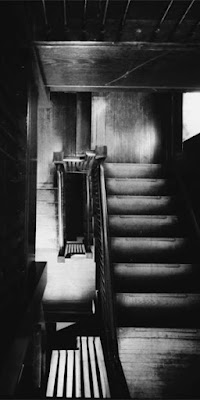
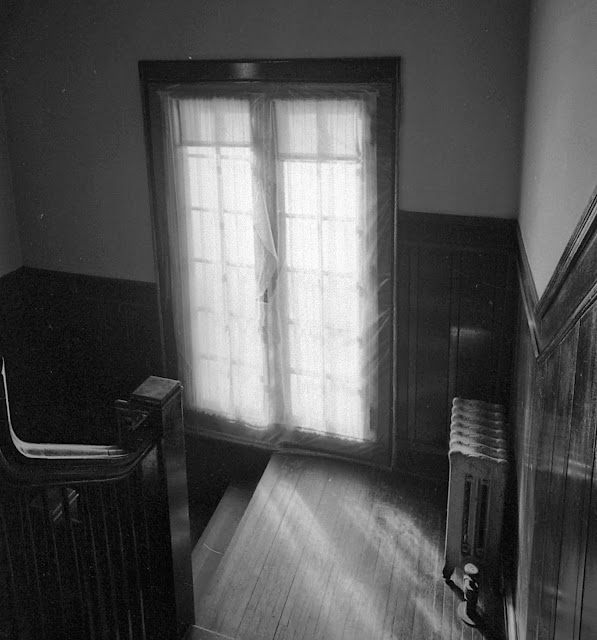
All of the college buildings were connected by underground tunnels. The older buildings possessed sort of a horror-flick vibe (Roman Polanski's The Tenant comes to mind) with long dark corridors, crumbling plaster, dark wood trim and hissing radiators. I had gotten a part time job attending to the photo lab; it was located on the second floor of what had previously been an old apartment building. The darkrooms were in a bedroom and in its adjacent bath- which still retained toilet, tub and sink. The other apartments in that building were used as offices and small classrooms, some complete with functional fireplaces! There was an elderly caretaker who had an office in the basement full of tools and supplies. I think he came with the building. There was even a small room with a piano- if a practice time hadn't been scheduled you could go in and play, no questions asked.

I'll stop the reminiscence now; I'm starting to realize what a good thing I had there. And it would never do to the have this ersatz prof start wallowing in blubbering sentimentality, would it?

By Professor Batty


Comments: 9 


Monday, May 16, 2011

Interview

In 2009 a group of four young Icelandic women began performing what they called “Friendly Concerts” in Reykjavík under the name Pascal Pinon. In October they appeared at the Iceland Airwaves Festival where I was most impressed by their performance. Although I didn’t know it at the time, they had already recorded an entire concept album which they later released independently; it was picked up by Morr Music in Berlin and re-released worldwide. Last October my blog-pal DJ Cousin Mary (from radio station KFJC in Los Altos Hills, California) went to the 2010 Iceland Airwaves where she saw them perform. Recently Mary did a three-hour special on Icelandic music and during the show interviewed Jófríður Ákadóttir, the primary songwriter for the group. A transcript of that interview follows:

MARY MACDONALD: I’m talking to Jófríður from Pascal Pinon… Now tell us about your band, it’s you and your sister right?

JÓFRÍÐUR ÁKADÓTTIR: Yes, it’s called Pascal Pinon and we mostly just play indie-acoustic pop music. It’s always written in my bedroom so I think you can sort of hear it, because it has a lot of shyness in it because we’re both very shy… when I’m writing I always do it in my bedroom and I always play very low so I hope that nobody can hear…

MARY: (laughs)

JÓFRÍÐUR: … I think that maybe I can hear that in the music because it always colors it, how it comes into the world, I think, and that’s sort of where my music is born.

MARY: Is there anyone other than your sister and you in the band?

JÓFRÍÐUR: We always play four girls when we play concerts, but we just get session players for the shows because we used to be four in the band, two other girls with us, but then after a year of working together they decided to quit because it was getting a bit hard, and me and Ásthildur were doing everything, mostly, so we all just agreed, they just stopped being in the band… sometimes playing with us, sometimes doing other things… it actually works out a lot better this way.

MARY: You began playing when you were very young, isn’t that true? How old were you when you started?

JÓFRÍÐUR: Well, this band we started when we were fourteen, and today we are sixteen, almost seventeen.

MARY: Oh, I see, so you’re still in school…

JÓFRÍÐUR: Yes, and it’s actually Easter break now and we're using the Easter break to make the second album.

MARY: Oh, how exciting…

JÓFRÍÐUR: It’s very exciting!

MARY: You and your sister are twins, isn’t that true?

JÓFRÍÐUR: Yes, we’re twins.

MARY: You say you’re shy, yet you get up and perform… Do you enjoy performing?

JÓFRÍÐUR: Yeah, I think it‘s really, really fun to perform. The first concert—it was terrifying! My feet were shaking and we couldn’t stand because I was so nervous and we had to sit down and my feet were both shaking really, really fast. It was awful because I was so nervous and afraid and shy—and that was the first concert. And then you just sort of learn that people aren’t really that mean, they always kind of seemed to be really positive, and after playing many, many concerts, and people seem to be very happy, it’s not that frightening anymore, it really gets kind of fun and you start to enjoy it a lot because its really really fun to play your own songs in front of an audience.

MARY: There's a sweetness and a warmth to your music, at least that’s why I enjoy your music, so I would think that would appeal to a lot of people.

JÓFRÍÐUR: I think our music, because its been called very cute, and I think that it is very cute, and it’s very warm and it’s very happy, in a way. It’s kind of if you would imagine something very soft. I have nothing against being soft, but I also think that it cannot be too soft, and it cannot be too cute and it cannot be too much of anything. I think it’s very important that all of the things that you write, all this cuteness, and the shyness, that it doesn’t get too much of anything.

MARY: Now, have you written new songs for your new CD that you’re mixing?

JÓFRÍÐUR: Yes we have fifteen songs that we’re going to choose from, and we have recorded fourteen.

MARY: The songs that you’ve composed, have they changed over time, from the first songs?

JÓFRÍÐUR: Well, um, we’re experimenting a bit, on the second album, with shakers and a bit of drums, because if you heard the whole album you notice that there are no drums, or shaker, or anything at all, on the whole entire album, we’re experimenting a bit with that. I think that maybe the compositions, in general, haven’t changed that much. I mostly noticed that the sound is improving and we’re exploring a bit of kind of different sound world on the second album. There’s one song that is very different from all the other songs. I think the most, the biggest difference with this album and the other is that the first album is a really, really whole unit. It’s a really whole album—it has a very similar sound to all the songs and it kind of forms a very special wholeness—if that makes sense (laughs) because it was recorded in five days and we had been practicing these songs for a long time and we knew exactly what we were going to record and we just did it. This album is recorded in three different places. It was recorded first of all in the summer, the summer of 2010, when we had a recording session, and again, when we had the next break from school—it was the Christmas break—and then we did some recordings now, in the Easter break. So we’re using all our breaks to record. And the songs we’ve been adding, more and more songs to the album with time. There’s not much similarity in all the songs as it was in the first album, so the sound is kind of different from each song. But in a way, I think that’s also interesting, to make an album that has a very mixed diversity, or at least more diversity than the first album.

MARY: What kind of musical education do you and your sister have?

JÓFRÍÐUR: We have both studied classical music, and we are studying now. Ásthildur is a really good piano player, a classical piano player, and I play the clarinet, I have been playing the clarinet since I was eight years old and we are very much busy at the music school all the time, except for the breaks, then when we have time to be in a band. I also play piano too, but very little. Ásthildur plays the bassoon.

MARY: Are you attending a music school right now?

JÓFRÍÐUR: Yes we are, we are in the Music School of Reykjavík.

MARY: Is that at the high school level?

JÓFRÍÐUR: Yeah.

MARY: When will you be going to university?

JÓFRÍÐUR: In three years from now, it's a different system…

MARY: Well, that’s a long time.

JÓFRÍÐUR: We’re also very young… so it kind of adds up.

MARY: You’ll have plenty of time to do what you're doing right now.

JÓFRÍÐUR: Um-hmm. I think we just don’t really realize how young we are. We have all this time to do so many things. Sometimes we kind of get lost in always comparing ourselves to some people who are older and have been doing this thing for a lot longer time. I thinks that’s one sort of mistake that you make and you have to be very careful sometimes because we are very young and we have to sometimes be careful not to compare ourselves too much.

MARY: Well, not to compare you to other people, but to compare Iceland to other countries, it seems to me that there are a lot of musicians in Iceland, given the small population, do you agree?

JÓFRÍÐUR: I agree, and I think that there are strangely many good musicians here. I really like this whole indie community that had been formed here, and this whole music scene. I really like it and there are a lot of people in it, and it’s really lucky to be a part of it.

MARY: I agree. Do think there's anything particular about Iceland that has made this happen?

JÓFRÍÐUR: No, I really cannot tell because it’s so hard to spot something that you’re a part of. It’s really hard to look at it as an outsider. I don’t really know why it has become the way it is. I really always think it is a huge misunderstanding that it has anything to do with nature. I think that’s just something that Björk created. Sometimes, when we do interviews, and there are people from other countries, they ask: “Has the nature affected your music in any way?” and we always say “No!” (laughs) because I cannot see how nature can possibly be connected with music, at least not the type of music that we make. But I understand maybe Björk always talks about how she's hiking in the mountains and looking at the wilderness… I think maybe this somehow works for her, but I don’t think it has anything to do with the rest of the Icelandic music scene. I haven’t really thought about this very much. I like the way it is and I haven’t been wondering why everything is the way it is. I’m kind of just thankful for it.

MARY: Are there other Icelandic Musicians that you particularly like, or that you feel influenced you?

JÓFRÍÐUR: Yes. I really like Sóley, who is also with Morr Music, and I also really like Sin Fang, who is also with Morr Music and Sóley is playing with him, and I also like Nolo a lot. They’re not very famous, but they are really, really good.

MARY: OK, I’ll have to look for them.

JÓFRÍÐUR: Yes. I would look for Nolo on gogoyoko- have you been visiting gogoyoko.com?

MARY: No, that sounds like a good idea.

JÓFRÍÐUR: Yeah, that’s a really good site… it’s a music webshop…

MARY: What about other musicians that have influenced you, in the whole world? Is there anyone in particular?

JÓFRÍÐUR: Yes, we were quite obviously interested in Tegan and Sara when we were beginning the band, when I was 14 the only thing I could listen to was Tegan and Sara and I think that without realizing it I was becoming very influenced by their music in my own compositions, maybe I Wrote a Song, which was one of the first songs we played together. Tegan and Sara, they’re Canadian twins—but they’re identical twins. Maybe it’s different.

MARY: Could be. Did you study composition or did you just start writing songs?

JÓFRÍÐUR: No, I’ve been doing this for a long time, it started when I first got my guitar… it was a Christmas present from my parents when I was eleven. I got an electric guitar and I got a book to learn how to play the guitar. I learned the chords and one of the first things I did was to write very, very awful songs on it and they were all very, very bad. Then later I started writing better songs (laughs). Then we got the idea of maybe starting a band and I was the only who could stand up and say “I have written a song—maybe we can play it?”

MARY: Is there anything else you’d like to tell our listeners about your music or Iceland?

JÓFRÍÐUR: I think its really really fun to be in concert in Iceland, I think it’s really a special atmosphere in concerts in Iceland. I think because everybody seems to know each other… all the musicians are watching the other musicians, this whole scene is really connected. It’s sort of like it is a family.

MARY: I could sense that, even being an outsider. I could definitely sense that. Thank you so much for talking with me and with my listeners, and I wish you all the best of luck.

JÓFRÍÐUR: Thank you.


And thanks again to DJ Cousin Mary and radio station KFJC for supporting Icelandic music and airing this interview.

Photo: Lilja Birgisdóttir


Interview Copyright KFJC, 2011. USED BY PERMISSION

By Professor Batty


Comments: 3 


Friday, January 30, 2015

Honeymoon Suite

This is chapter 35 of The Matriarchy, a serial fiction novel on FITK
“Today’s goal: total bliss, or a suitable facsimile of same.”

Mary’s comment came out of the blue as Mary and Sean were heading Southeast on Iowa 76. Sean was driving.

“Our mission impossible?” said Sean.

“When expressed as a postulate, it sounds kind of insane. What constitutes unmitigated pleasure?” said Mary, “Is it a state achievable to a discerning mind, or does bliss require the loss of mind, i.e., the loss of self?”

“Some people think of love as a state of having lost their mind,” replied Sean, “Which begs the question: if ‘love’ was ruled by the head and not the ‘heart’, how long would it take humanity to become extinct?”

“Some cultures already are headed that way. But there is no shortage of new people. Animal instincts can only be overcome by intense civilization,” Mary said, “My animal instincts are insisting that we stop: I have to pee.”

“There’s a National Monument ahead; it has a visitor center. Can civilization dominate your animal instincts for a few more minutes?” Sean said, “The place has the evocative name of Effigy Mounds.”

“That would be fine. I could use a little stroll among the effigies.”

The visitor headquarters was nearly empty. While Mary used the facilities, Sean browsed the exhibits. When Mary returned, they paid the fee and began to walk the path up a large hill to where the mounds had been constructed over a thousand years ago.  It was a challenging hike, taking almost a half an hour to reach the top. The mounds themselves were low and not very large. They were formed in stylized shapes of animals and birds.

“Sensing anything here?” asked Sean.

“Only echoes,” said Mary, “This is an old place. I am picking up on a sense of community, of people working together—as if this was the setting for an ancient mystery play.  Perhaps, when I’ve finished my ‘initiation’, I’ll be able to fully comprehend the experience. It is a peaceful place, though. I don’t sense any underlying sadness.” After a few minutes of wandering between the mounds Mary said: “I’ve seen enough, let’s go back to the car.”

Once they entered Wisconsin the land opened up and the scenery was, at times, spectacular. Mary was quiet—enthralled—during the rest of the trip. It was after five by the time they entered the town of Mineral Point. Sean had pulled up in front of The Brewery Creek Inn.

“We’ve arrived. Our secret honeymoon destination,” said Sean.

“A brewpub?” Mary said, giving Sean a quizzical look. “I’m not doing much drinking these days.”

“This is where we check in, not where we’re staying," said Sean, “Are you ready to begin your lifetime of marital bliss?”

“The premarital bliss has worked out OK so far, so I guess that I’m in,” said Mary, “Put your ring on.”

Inside, the Pub was filling up, but the bartender took a break from serving to sign them in. He exchanged the usual pleasantries with the couple:

“First time in Mineral Point?”

“I'm picking up a weird vibe from this guy,” thought Mary, “Keep it formal.”

“Yes,” said Sean.

“You’ve booked The Miner’s Cabin: Continental Breakfast, the fridge is stocked, just let me know if there’s anything you’ll be needing.” The bartender eyed Mary surreptitiously.  You’ll be here Thursday, Friday and Saturday nights, right?”

“Yes. That’s right,” Sean said.

“Checkout is at 11. There is a parking spot on the north side of the cabin. The cabin is unlocked. The keys are on the kitchen counter.”

Back in the car, Sean exchanged thoughts with Mary.

“Did you figure out where that guy was coming from?” thought Sean.

“It might have been some repressed racism,” thought Mary.

“Or he was jealous of me. You don’t need a ring to see your ‘aura.’ Pregnancy suits you,” thought Sean.

“Tell me about my aura when I’m puking,” thought Mary. “But thanks for the compliment.”

“The cabin is a couple of blocks away,“ thought Sean, “I’m taking off the ring. Distracted driving, y’know. Worse than texting.”

What kind of place is this?” said Mary, as she gazed at the stone facades of the old buildings which lining the street.


“This was a mining ‘boom town’ in the 1830s,” said Sean, “We’ll be staying in one of the oldest houses.”

The Miner’s cabin was deceptively large. From the street, it appeared to be the size of a single car garage. The front room was comfortably furnished with overstuffed chairs and a sofa. A pair of filled bookshelves flanked a fireplace; the walls were tastefully decorated with what appeared to be original art.  An open doorway led to a series of additions: a kitchen, a bedroom, and a small bath. The kitchen had a fireplace as well. On one of its walls was a mysterious black door, flanked by two carved kitchen chairs.

“That door, with those chairs, looks like a metaphor for our marriage: one chair is you, one is me, and the black door symbolizes what lies ahead for us,” said Mary.

“I can see that,” said Sean, “Shall I open it?”

“Do you think it wise?” said Mary, smiling, “I think the bedroom door holds the key to our immediate future.”

“Of course,” said Sean, “Rings on or off?”

Mary stared deeply into Sean’s eyes.

“On,” she said.


Fiction

By Professor Batty


Monday, May 17, 2021

Mondays in Iceland - #115

This is a re-post from FITK, May 16, 2011

Interview

In 2009 a group of four young Icelandic women began performing what they called “Friendly Concerts” in Reykjavík under the name Pascal Pinon. In October they appeared at the Iceland Airwaves Festival where I was most impressed by their performance. Although I didn’t know it at the time, they had already recorded an entire concept album which they later released independently; it was picked up by Morr Music in Berlin and re-released worldwide. Last October my blog-pal DJ Cousin Mary (from radio station KFJC in Los Altos Hills, California) went to the 2010 Iceland Airwaves where she saw them perform. Recently Mary did a three-hour special on Icelandic music and during the show interviewed Jófríður Ákadóttir, the primary songwriter for the group. A transcript of that interview follows:

MARY MACDONALD: I’m talking to Jófríður from Pascal Pinon… Now tell us about your band, it’s you and your sister right?

JÓFRÍÐUR ÁKADÓTTIR: Yes, it’s called Pascal Pinon and we mostly just play indie-acoustic pop music. It’s always written in my bedroom so I think you can sort of hear it, because it has a lot of shyness in it because we’re both very shy… when I’m writing I always do it in my bedroom and I always play very low so I hope that nobody can hear…

MARY: (laughs)

JÓFRÍÐUR: … I think that maybe I can hear that in the music because it always colors it, how it comes into the world, I think, and that’s sort of where my music is born.

MARY: Is there anyone other than your sister and you in the band?

JÓFRÍÐUR: We always play four girls when we play concerts, but we just get session players for the shows because we used to be four in the band, two other girls with us, but then after a year of working together they decided to quit because it was getting a bit hard, and me and Ásthildur were doing everything, mostly, so we all just agreed, they just stopped being in the band… sometimes playing with us, sometimes doing other things… it actually works out a lot better this way.

MARY: You began playing when you were very young, isn’t that true? How old were you when you started?

JÓFRÍÐUR: Well, this band we started when we were fourteen, and today we are sixteen, almost seventeen.

MARY: Oh, I see, so you’re still in school…

JÓFRÍÐUR: Yes, and it’s actually Easter break now and we’re using the Easter break to make the second album.

MARY: Oh, how exciting…

JÓFRÍÐUR: It’s very exciting!

MARY: You and your sister are twins, isn’t that true?

JÓFRÍÐUR: Yes, we’re twins.

MARY: You say you’re shy, yet you get up and perform… Do you enjoy performing?

JÓFRÍÐUR: Yeah, I think it‘s really, really fun to perform. The first concert—it was terrifying! My feet were shaking and we couldn’t stand because I was so nervous and we had to sit down and my feet were both shaking really, really fast. It was awful because I was so nervous and afraid and shy—and that was the first concert. And then you just sort of learn that people aren’t really that mean, they always kind of seemed to be really positive, and after playing many, many concerts, and people seem to be very happy, it’s not that frightening anymore, it really gets kind of fun and you start to enjoy it a lot because its really really fun to play your own songs in front of an audience.

MARY: There's a sweetness and a warmth to your music, at least that’s why I enjoy your music, so I would think that would appeal to a lot of people.

JÓFRÍÐUR: I think our music, because its been called very cute, and I think that it is very cute, and it’s very warm and it’s very happy, in a way. It’s kind of if you would imagine something very soft. I have nothing against being soft, but I also think that it cannot be too soft, and it cannot be too cute and it cannot be too much of anything. I think it’s very important that all of the things that you write, all this cuteness, and the shyness, that it doesn’t get too much of anything.

MARY: Now, have you written new songs for your new CD that you’re mixing?

JÓFRÍÐUR: Yes we have fifteen songs that we’re going to choose from, and we have recorded fourteen.

MARY: The songs that you’ve composed, have they changed over time, from the first songs?

JÓFRÍÐUR: Well, um, we’re experimenting a bit, on the second album, with shakers and a bit of drums, because if you heard the whole album you notice that there are no drums, or shaker, or anything at all, on the whole entire album, we’re experimenting a bit with that. I think that maybe the compositions, in general, haven’t changed that much. I mostly noticed that the sound is improving and we’re exploring a bit of kind of different sound world on the second album. There’s one song that is very different from all the other songs. I think the most, the biggest difference with this album and the other is that the first album is a really, really whole unit. It’s a really whole album—it has a very similar sound to all the songs and it kind of forms a very special wholeness—if that makes sense (laughs) because it was recorded in five days and we had been practicing these songs for a long time and we knew exactly what we were going to record and we just did it. This album is recorded in three different places. It was recorded first of all in the summer, the summer of 2010, when we had a recording session, and again, when we had the next break from school—it was the Christmas break—and then we did some recordings now, in the Easter break. So we’re using all our breaks to record. And the songs we’ve been adding, more and more songs to the album with time. There’s not much similarity in all the songs as it was in the first album, so the sound is kind of different from each song. But in a way, I think that’s also interesting, to make an album that has a very mixed diversity, or at least more diversity than the first album.

MARY: What kind of musical education do you and your sister have?

JÓFRÍÐUR: We have both studied classical music, and we are studying now. Ásthildur is a really good piano player, a classical piano player, and I play the clarinet, I have been playing the clarinet since I was eight years old and we are very much busy at the music school all the time, except for the breaks, then when we have time to be in a band. I also play piano too, but very little. Ásthildur plays the bassoon.

MARY: Are you attending a music school right now?

JÓFRÍÐUR: Yes we are, we are in the Music School of Reykjavík.

MARY: Is that at the high school level?

JÓFRÍÐUR: Yeah.

MARY: When will you be going to university?

JÓFRÍÐUR: In three years from now, it's a different system…

MARY: Well, that’s a long time.

JÓFRÍÐUR: We’re also very young… so it kind of adds up.

MARY: You’ll have plenty of time to do what you're doing right now.

JÓFRÍÐUR: Um-hmm. I think we just don’t really realize how young we are. We have all this time to do so many things. Sometimes we kind of get lost in always comparing ourselves to some people who are older and have been doing this thing for a lot longer time. I thinks that’s one sort of mistake that you make and you have to be very careful sometimes because we are very young and we have to sometimes be careful not to compare ourselves too much.

MARY: Well, not to compare you to other people, but to compare Iceland to other countries, it seems to me that there are a lot of musicians in Iceland, given the small population, do you agree?

JÓFRÍÐUR: I agree, and I think that there are strangely many good musicians here. I really like this whole indie community that had been formed here, and this whole music scene. I really like it and there are a lot of people in it, and it’s really lucky to be a part of it.

MARY: I agree. Do think there's anything particular about Iceland that has made this happen?

JÓFRÍÐUR: No, I really cannot tell because it’s so hard to spot something that you’re a part of. It’s really hard to look at it as an outsider. I don’t really know why it has become the way it is. I really always think it is a huge misunderstanding that it has anything to do with nature. I think that’s just something that Björk created. Sometimes, when we do interviews, and there are people from other countries, they ask: “Has the nature affected your music in any way?” and we always say “No!” (laughs) because I cannot see how nature can possibly be connected with music, at least not the type of music that we make. But I understand maybe Björk always talks about how she's hiking in the mountains and looking at the wilderness… I think maybe this somehow works for her, but I don’t think it has anything to do with the rest of the Icelandic music scene. I haven’t really thought about this very much. I like the way it is and I haven’t been wondering why everything is the way it is. I’m kind of just thankful for it.

MARY: Are there other Icelandic Musicians that you particularly like, or that you feel influenced you?

JÓFRÍÐUR: Yes. I really like Sóley, who is also with Morr Music, and I also really like Sin Fang, who is also with Morr Music and Sóley is playing with him, and I also like Nolo a lot. They’re not very famous, but they are really, really good.

MARY: OK, I’ll have to look for them.

JÓFRÍÐUR: Yes. I would look for Nolo on gogoyoko- have you been visiting gogoyoko.com?

MARY: No, that sounds like a good idea.

JÓFRÍÐUR: Yeah, that’s a really good site… it’s a music webshop…

MARY: What about other musicians that have influenced you, in the whole world? Is there anyone in particular?

JÓFRÍÐUR: Yes, we were quite obviously interested in Tegan and Sara when we were beginning the band, when I was 14 the only thing I could listen to was Tegan and Sara and I think that without realizing it I was becoming very influenced by their music in my own compositions, maybe I Wrote a Song, which was one of the first songs we played together. Tegan and Sara, they’re Canadian twins—but they’re identical twins. Maybe it’s different.

MARY: Could be. Did you study composition or did you just start writing songs?

JÓFRÍÐUR: No, I’ve been doing this for a long time, it started when I first got my guitar… it was a Christmas present from my parents when I was eleven. I got an electric guitar and I got a book to learn how to play the guitar. I learned the chords and one of the first things I did was to write very, very awful songs on it and they were all very, very bad. Then later I started writing better songs (laughs). Then we got the idea of maybe starting a band and I was the only who could stand up and say “I have written a song—maybe we can play it?”

MARY: Is there anything else you’d like to tell our listeners about your music or Iceland?

JÓFRÍÐUR: I think its really really fun to be in concert in Iceland, I think it’s really a special atmosphere in concerts in Iceland. I think because everybody seems to know each other… all the musicians are watching the other musicians, this whole scene is really connected. It’s sort of like it is a family.

MARY: I could sense that, even being an outsider. I could definitely sense that. Thank you so much for talking with me and with my listeners, and I wish you all the best of luck.

JÓFRÍÐUR: Thank you.


And thanks again to DJ Cousin Mary and radio station KFJC for supporting Icelandic music and airing this interview.

Photo: Lilja Birgisdóttir


Interview Copyright KFJC, 2011. USED BY PERMISSION

By Professor Batty


Comments: 2 


Friday, March 29, 2019

JC Revisited

A re-post from 10 years ago (with reworked pics):


Junior College, that is.

In the late 60’s a side effect of the baby boom was the proliferation of numerous 2-year “Junior Colleges.” There were so many kids coming of age that the established universities had no place to put them all. In the middle of corn fields or nestled in the periphery of downtown areas community colleges sprang up, almost overnight, or so it seemed. I had already attended the U for a year and while my grades were decent, I was miserable. Metropolitan Junior College, on the western side of downtown Minneapolis right across the street from Loring Park, was housed in a funky amalgam of buildings purchased from a small bible college/radio station (Jim and Tammy Faye Baker were notable alums.) The classes were small, taught by mostly by part-timers and other academic misfits, and were, on the most part, pretty good. The politics of tenure was absent (or at least minimized), the jock culture was small (I was on the badminton squad!) and most of the instructors actually had some practical experience in their fields.

All of the college buildings were connected by underground tunnels. The older buildings possessed sort of a horror-flick vibe (Roman Polanski’s The Tenant comes to mind) with long dark corridors, crumbling plaster, dark wood trim and hissing radiators. I had gotten a part time job attending to the photo lab located on the second floor of what had previously been an old apartment building. The darkrooms were in what had been a bedroom and its adjacent bath—which still retained toilet, tub and sink. The other apartments in that building were used as offices and small classrooms, some complete with functional fireplaces. There was an elderly caretaker who had an office in a basement room full of tools and supplies. I think he came with the building. There was even a small room with a piano—if practice time hadn’t been scheduled you could go in and play, no questions asked.

I’ll stop the reminiscence now as I’m starting to realize what a good thing I had there. And it would never do to the have this ersatz prof start wallowing in blubbering sentimentality, would it?

By Professor Batty


Comments: 1 


Friday, November 27, 2020

Wrap Up

This is chapter 52 of The Inheritance, a serial fiction novel on FITK

Early Friday Evening, November 27, 2020, Seattle

FBI Special Agent Marchal had requested a meeting with Sean, Mary, Jo, and Mareka for a follow-up to the events of the previous weekend. Sean suggested that he come to their place, specifically the garage which had been retro-fitted to minimize Covid exposure for the home school. Jo’s home school had taken the week off for the Thanksgiving Holiday, a fact which Jo was grateful for—her ribs were still sore and the bruises on her face from where she had been slugged was still visible. Agent Marchal was only too happy to oblige, he liked Mary and Sean, and looked forward to meeting their daughter. The five of them masked-up and went into the garage/school.

“Well I don’t have to tell you how glad I am to see all of you again,” began Marchal, “And how glad I am to meet you Mareka.”

“Hi,” said the girl, ”Pleased to meet you.”

“This is where you go to school, Mareka?” said Marchal.

“We have a lot of fun here,” said Mareka.

“And you are learning a lot, too,” said Sean, “Thanks to Jo.”

“Jo’s the best!” said Mareka, “Even the school people that give us our tests think so.”

“Jo has done a lot for us over the last eight years,” said Mary, “It would have been terrible to have lost her.”

“Thank you all,” said Jo, “You’ve helped me over and over again. I don’t have to say how much I appreciate what Mareka did for me last weekend. That was a very bad scene, I wouldn’t wish that kind of experience on anyone.”

“I came here to tell you what was the result of your bravery, Mareka,” said Marchal, “Mr. Stroud was a very bad man who happened to get caught up with group of other bad men. He had been recruited by a small gang of men who were trying to infiltrate the homeless community in a plot to control the distribution and sale of drugs as well as other illegal activities. They had found out that Mr. Sroud was Jo’s ex-husband and used this knowledge to get him to committ murder in exchange for telling him where Jo was staying. We broke up the gang, most of whom were here illegally. Because you are a minor, Mareka, the story of Mr. Stroud and his accomplices will not be released to the public. The murder of Barbara Merrit and her friend Marcel DuPage, will be told; Mr. Stroud’s death will be tied to it as a drug deal gone wrong. I understand that you Sean, and Mary have had dealings with those two in the past… ”

“As did I,” said Jo, “With Merrit about her ridiculous ‘exposé’ and I did speak with Mr. DuPage on one occasion as well. It’s horrible that they were murdered like that, evidently Stroud was going to kill me in the same way.”

“Yes, the syringe contained a lethal dose of Fentanyl, he planted the syringes that killed DuPage and Merrit to make it look like they had overdosed,“ said Marchal, “He would have probably gotten away with that if he hadn’t been stopped by Mareka here. How are you doing, Mareka?”

“I’m OK, ” said the girl, “It had to be done. Now Jo is safe, and a very bad man is gone.“

“Mareka has been questioned by a child psychologist,” said Mary, “She was very impressed with Mareka’s self-control. There will be a follow-up in a couple of weeks. We’ll keep an eye on her, of course.”

“Good.” Agent Marchal paused for a moment, ”In addition to the wrap-up, this is probably my good-bye to you as well. I’ll be retiring in a couple of months, once the new administration is in place. I won’t bore you with the details of how bad the last four years have been but I will say this: Most of this would have never happened if we never had the shabby political influence on the FBI that has happened on this case. That story may never be told.”


Later that evening Jo and Mary were talking with Mareka in her bedroom.

“It was nice that Agent Marchal visited us today,“ said Mary, “He’s one of the ‘good ones’.”

“I didn’t know that you guys knew each other,” said Mareka from her bed, “What does he know about our ‘family secrets?’”

“We’ve told him that Emily has channeled me, we told him not to take it too literally, that it might just be wishful thinking on my part, ” said Mary, ”He was cool with that, he didn’t want to explore anything that couldn’t be used in court.”

“And he certainly knew about me killing that intruder,” said Jo, In fact, I think he knows a lot more about that intruder than he’s telling.”

“He also knows about the other one, the man that was struck by lightning at Sean’s Aunt Tina,” said Mary, ”What he doesn’t know that I was responsible for that lightning bolt.”

Mareka thought about this for a while.

“So… the three of us, we’re all killers?” said Mareka.

“Yes, I guess that’s true,” said Jo, “Lord help the fool that tangles with us, sho.”

“All that is important now is that we are alive and together,” said Mary, “Here’s to The Sisterhood of Killers—bound to each other forever.”

“Amen to that sister!” said Jo.

“Amen,” said Mareka.

“Amen and good night,” said Mary, and she turned off the light.


Next Chapter: Yearning to Fly

By Professor Batty


. . . . . . . . . . . . . . . . . . . . . . . . . . . . ©Stephen Charles Cowdery, 2004-2025 . . . . . . . . . . . . . . . . . . . . . . . . . . .