Thursday, October 13, 2011

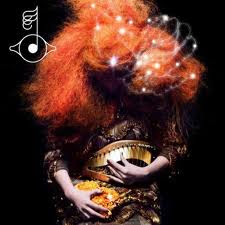
Biophilia

It has been 4 years since Björk's last album, the often derided Volta. That effort found Björk paired with some questionable collaborators; it was probably her least successful major release. There has been a lot of talk about Biophilia: its merging of science and technology with music, its iPad app, its newly invented instruments. I've heard snatches of it on the radio, but have yet to hear it in one sitting, in its entirety. I've got the candles and incense lit around my Björk shrine, the lights are dimmed, and I've copied and pasted the list of tracks with each track's subtitle and writer(s).

It's time.

I'll post my initial reactions as I listen to it for the first time:

Moon (Lunar cycles, sequences)..............Björk, Damian Taylor

Delicate intro with halting sprechgesang lyrics turning ominous, then flowing smoother reminiscent of a Verspertine song, very natural voice.

Thunderbolt (Lightning, arpeggios)........Björk, Oddný Eir Ævarsdóttir

Majestic church organ morphs into science-fiction soundtrack behind B's impassioned lyric- turn up your subwoofers on this one.

Crystalline (Structure).........................Björk

Music-box "gameleste", Joga-esque rhythm- effective lyrics reflect an impression of patterns.

Cosmogony (Music of Spheres, equilibrium)...Björk, Sjón

The creation story as seen through Bjork's and Sjón's sensibilities, beautiful ensemble brass and choir, wonderful refrain.

Dark Matter (Scales)........................Björk, Mark Bell

Bizarre wordless vocalizations over funeral organ, nightmare soundtrack, very evocative of its subject.

Hollow(DNA, rhythm)........................Björk

Pipe organ madness through the space-time of DNA.

Virus (Generative music)....................Björk, Sjón

B takes on the role of an invading virus over "gamelest" background.
Infect me! Infect me!

Sacrifice (Man and Nature, notation)........Björk

Wiggy "sharpsichord" plays behind heavy lyrics.

Mutual Core (Tectonic plates, chords).......Björk

Volcanic eruptions punctuate the irresistible forces of plate tectonics.
Wild, wild stuff!

Solstice (Gravity, counterpoint)............Björk, Sjón

Organic, oriental approach to daily cycles.

BONUS TRACKS:
Hollow (original 7-minute version)..........Björk

More intense than short version, actually works better in a longer form.

Dark Matter (with Choir & Organ)............Björk, Mark Bell

Lighter, not as scary as first version.

Náttúra....................................Björk

Originally a single released to benefit Icelandic conservation efforts, with a real drummer and spooky choir, sung in Icelandic, somewhat different than the rest of the album.


Whew! What can I say? It would be a great mistake to think of this as an album of pop music. The "new" instruments sound great, although traditional organ voices are used even more. I never thought anyone would make such an experimental album with so much pipe organ in it! Musically and sonically challenging, yet her voice retains its natural sonority and it is as compelling as anything she's ever done. The sprechgesang delivery of the lyrics verge on becoming a bit stilted at times, but on the whole it is quite listenable. It is a n audiophile's delight- test your sound system with this disc! The Biophilia Wikipedia article covers the concepts behind each track far better than I ever could. Even if you aren't interested in Björk or her music it's well worth reading to see how her creative genius works.

While I was listening and writing this post, the Reykjavík Grapevine put up a review of Björk's Wednesday night concert at Harpa.

By Professor Batty


Comments: 2 


Friday, November 02, 2007

Top Ten List: Björk

Presented strictly from the criteria of my own personal enjoyment. These are for the performances, not necessarily for the songs themselves. They are in a rough chronological order, earliest to latest, with no particular ranking:

Alfur Út Úr Hól- Recorded when she was 11 years old. Björk has disowned the album this is on, but there remains an eerie charm in hearing her child-voice sing "Fool on the Hill" in Icelandic, with her multi-tracked recorder parts dancing in the background. Joanna Newsom's voice is a twin to the young Björk's.

Motorcrash- with the Sugarcubes. This must be the craziest pop-music psychodrama ever, Björk sounds as if she's singing this while actually riding her bicycle, with sinister comments from Einar...

Bella Símamær- from Gling Gló, Björk is a gossiping telephone operator, hilarious delivery, in Icelandic...

...I'll pass over Debut, if only because there's so much else to choose from and there are at least six I could put on the list from Post...

Hyper-ballad- I've written about this song before, she just nails the concept on this, as perfect a combination of lyric, arrangement and presentation as I've ever heard in a pop song...

I Miss You- is Björk with a Latin beat and a Dadaist lyric. She's done this live on her last tour, until that is available I'll settle for the CD version...

Isobel/Bachelorette- two songs that are virtually inseparable, Björk becoming Nature personified. "I'm a fountain of blood in the shape of a girl."
Really. Sjón and Björk make quite the songwriting team...

The Boho Dance- on A Tribute to Joni Mitchell, a stunning, challenging arrangement (Guy Sigsworth and Damien Taylor) showcases Björks nuanced, passionate interpretation. She really displays a deep understanding of Joni's lyric (and her own experiences) about "The Boho Dance."

Pagan Poetry- Just about as far into someone else's id as I dare go...

Völkuró

Who Is It?- The mix of this on the video (with bells) is the better version of this testament to joy.


Of course, it really is quite impossible to condense her career into ten songs, (what no Hunter?, no Venus as a Boy?, no Stigdu Mig?), but that's the fun of it. I'd love to hear what your favorites are, and why...

By Professor Batty


Comments: 7 


Wednesday, May 09, 2007

Volta

Got the new Björk album today. Impressions written while listening for the very first time-


Earth Intruders:

The current military madness has not escaped Björk's consideration- her assumption of the role of a leader of a ruthless army makes its point with marching cadences and an overlay of pulsing rhythm...


Wanderlust:

The flowing melody and brass choir fight against programmed beats, the beats win...


The Dull Flame Of Desire:

Andrei Tarkovsky's love poetry set to B's music. The massed brass chords again are magnificent, but have to struggle against nervous, mechanical beats. "Antony's" contrapuntal vocalization is meant to be emotional, but merely shows his lack of sensitivity to the phrasing of his partner's superior technique. This would be a stunning track without him and no drums...


Innocence:

Basically a funkier reworking of Alarm Call, the drums make sense in this arrangement, however...


I See Who You Are:

The Japanese song, a celebration of the flesh "before we become corpses", benefits from the ample space in the arrangement. It would fit right in with Vespertine...


Vertebrae By Vertebrae:

Soundtrack music from some parallel dimension Alfred Hitchcock movie? (Actually the brass was sampled from Drawing Restraint 9) Not exactly a sing-a-long...


Pneumonia:

Stunning brass arrangement by Nico Muhly, an emotional vocal performance by Björk. Beautiful...


Hope:
B's internal dialog about the nature of evil and suicide bombers, over a Indian-style background...


Declare Independence

Hard core Techno-Industrial. Not for the timid. While it was playing sirens went by my window. I dug that...


My Juvenile

What should have been a poignant farewell falls apart with another awkward duet between Björk and "Antony"...


Overall impression: This is a deeply flawed album. There is some good stuff there, but it is usually buried under self-conscious programming and arrangements. Buyer beware.

By Professor Batty


Comments: 3 


Monday, September 05, 2016

Mondays in Iceland - #75

Pascal Pinon, Sundur and the circle…


Magnus Andersen

I’ve been listening to the latest Pascal Pinon album a lot. What follows is not exactly a commercial review; in light of the sensitive nature of this project that would be crass. This is more of a rumination—on the music of course, but also on my circular quest for a fuller understanding of life via Icelandic culture.

By the mid-80s, when I had pretty much hung up my musical “career”, I was trying to make the home and family thing work. One escape from my domestic duties that I did have was a subscription to Andy Warhol's Interview magazine, one of the few periodicals that retained a large format. The articles and photography were mostly about New York art and music scenes, but they also showcased up-and-comers from around the world. One of these blurbs featured the Icelandic band The Sugarcubes: Björk’s breakout vehicle. It was the beginning of a circle. I made a mental note of her and, in 2000, the Weaver and I did manage a short trip to Iceland. She was impressed but I was overwhelmed, especially with the omnipotence of Björk in the shops. So began a cultural odyssey. After quickly getting up to speed on Icelandic music and literature (and with the advent of blogs), I even began to make personal contacts with some of the natives. Now, five trips to Iceland later, I have come to the realization that I am approaching the end of the circle. Nothing ever stays the same, of course, and my contacts in Iceland have, like me, have moved on in their lives. The classic literature of Iceland remains great (and I adore serious Icelandic theater), its modern practitioners are gifted. Icelandic cinema remains very strong. The Icelandic music scene, however, seems to have reached some kind of peak around 2010. Although there are still some acts with international success (Sigur Rós, Of Monsters and Men), the most challenging new work is coming from Jóhann Jóhannsson, as a film music composer (Prisoners, The Theory of Everything, as well as the new Bladerunner).

All of this rambling is a preface to today’s subject: Sundur, the third album by Ásthildur and Jófríður Ákadóttir, twin sisters who call themselves Pascal Pinon. I first saw them in 2009 at Iceland Airwaves and I have always had an affection for the group. Their first release (Pascal Pinon, 2010), recorded when they were 14 years old, was a honest topography of the heart. Twosomeness, their second release (2013), brought the girls out of their bedroom and into the studio. It was, as to be expected, much more polished, while still retaining an intimate nature. Sundur goes far beyond either of these, presenting Jófríður’s lyrics "up-close-and-personal" accompanied by Ásthildur’s sure-handed production. The songs, as would be expected from the album’s title, are about love: lost, broken, or missed, with a bittersweet tinge. I could run this down track-by-track, but Jófríður has graciously already done so. Two of the stand-out cuts, Orange, and Ást, are available at the link. Ást was inspired by the writing of Halldór Laxness (another cultural circle), and is a powerful lament on love: “… the silent symphony created by stroking the strings of the heart… ”

Speaking of circles, Jófríður is featured in a recent Guardian article as being one of Björk's inspirations! Some reviewers have commented on the similarity of the two singers vocal styles. There is something to it but Jófríður is in full command of her gift; her melodies and phrasings are her own, the similarities in diction are shared by thousands of other Icelanders! She is also blessed with a twin sister who has grown musically as well. Ásthildur’s previous contributions were subtle but she is now an equal partner in this fascinating collaboration. Her assured and dynamic keyboard efforts are the equal of her sister’s vocalizations.  I would even put Sundur in the same class as Joni Mitchell’s Blue, not as mature, of course (after all, they still are only 22), yet it is even more intimate than Joni’s masterwork—if such a thing could be possible. As a jaded, card-carrying curmudgeon, it takes a lot to crack my frozen attitudes. Pascal Pinon, those wyrd sisters from the North Country, not only thawed my resistance, they positively melted me.

Highest recommendation.

By Professor Batty


Comments: 2 


Monday, April 20, 2020

Covid Confinement Companion #4

Five Star Reviews

This is the fourth in a series of informative posts on FITK offered with the intent of giving those who are house-bound some intelligent diversions during their period of isolation.

More musical musings, this time on female performers, each of whom have made a difference in my life. I thought it would be an interesting idea to showcase one from each decade of my existence, but I found that the 1980s were problematic (i.e., Pat Benatar, Paula Abdul, Janet Jackson, Madonna—fine artists all but not in the same category as the rest, IMHO.) Here’s my list, with the some added comments and an essential album for each:

The 1950s saw the emerging of my musical consciousness as well as certain stirrings that were not yet defined. Julie London definitely stirred that pot. In 1956 she had a hit with the ultimate breakup/putdown song Cry Me A River, which remains the definitive version. She wasn’t a songwriter but she was a great musician, accepted as an equal by the best jazz players of the day. Around Midnight, one of her best albums, is a collection of forlorn jazz standards that features sensitive interpretations of the best songwriters of the day. The track In the Wee Small Hours of the Morning is a great example of her intimate style.


Dusty Springfield was actually a precursor to the British Invasion of 1964 with hits with her brother in the folk group The Springfields. Dusty then became a star in her own right and was a true icon in England where she hosted her own variety show. By 1967, however, this bombastic style of orchestrated pop had fallen out of favor so she moved on to a more R&B approach with her later recordings.  
Where Am I Going is her last hurrah in the old-school style, with first-rate orchestrations of well-crafted songs. Her impeccable singing style reached its climax on the album’s title tune Where Am I Going.


Obviously, Joni Mitchell has to be on this list. Her 1971 album Blue is the standard by which all deeply personal songs are measured.

There is nothing meaningful I can add to the praise this album has received so I’ll link to some other voices:
An interview with David Bazan, Seattle singer-songwriter sharing his reactions to hearing Blue for the first time, Nathan Rabin gets Blue, and Christopher Y’s Colour of Melancholy essay. If you need any further proof of Joni’s brilliance in Blue, here is Prince’s cover of River.


If the 80s were a bust, the 90s were a boom time for female artists and none made as a defiant and shattering debut as Liz Phair in her 1993 Exile in Guyville album. Liz examines gender power games with an unflinching gaze. This is hard-edged music, crude at times, but effective. You can’t sit back and have an “easy listen”, you have to work to get it. Here is an excellent extended interview with her that gives good look at the way she deals with the darker side of fame. Take a look at a great 2010 live version of Flower, performed with an audience member. Fiona Apple is carrying the torch that Liz lit.


Björk recorded her first album in the seventies (as a child) and became famous in the 1990s with the Sugarcubes and her own career. In the 2001 album Vespertine, Björk turned inward with an album that was just as introspective as Joni’s Blue. If Liz Phair is somewhat difficult, Björk is exponentially more so. Written in the emotional rush of a new love affair, this album is a defining point in her career,  a apex beyond which her music became really weird.

I have followed her career since then and she hasn’t made as a coherent album since. These songs are on YouTube, some are NSFW.


JFDR, as the youngest of these women—still at the beginning of her career—already has a long discography with many different musicians. She got her start with twee folk-songs in Pascal Pinon, then made poetic electronica with Samaris. Her later releases are more on the art-song side with her new solo album New Dreams the most experimental yet. She certainly has enough exceptional songs for a greatest hits album but her muse is fickle—she wants to do it all—and her output is not always consistent.  When I finally do get her latest release (still in Amazon’s Covid-19 quarantine) I’ll post an update. An artist to watch.

By Professor Batty


Comments: 2 


Thursday, September 09, 2004

Björk's Heart

In Björk’s new album Medúlla musical instruments have been, for the most part, eliminated, and replaced by sounds of human voices. This brings a very strong sense of the organic to these tunes, even when the voices have been sampled, altered and programmed.

I have learned long ago not to judge her work on first listen. These compositions are carefully constructed in accordance with some internal logic, on both musical and spiritual levels. Careful consideration will bring great rewards—for the open-minded.
Innumerable love songs have been written with the heart as a central metaphor. Indeed, the heart as a symbol of life, of being, has been used in the arts since the ancients. Nowhere (that I’m aware of) has a song been written as a paean to the heart as a biological organ. The climax of the album is the track Triumph of a Heart in which Björk’s muse turns literally inward, in a biological sense. Circulation, respiration and elimination are dealt with in a clinical, yet joyful way.

If you haven't yet gotten into this artist’s work, this might not be the place to start. But for those willing to to explore, this is uncharted territory.

By Professor Batty


Comments: 2 


Friday, January 08, 2010

Mount TBR 2010


As promised, here is a brief rundown on my new books (with another look at my ever-expanding Halldór Laxness collection!), bottom row, left to right:

The Encyclopedia of Witchcraft and Demonology, by Rossell Hope Robbins, Crown, 1959. Pretty tedious reading, but full of cool vintage woodcuts.

Stories from The New Yorker, 1950 - 1960, various, Simon and Schuster, 1960. All the big hitters of short fiction in the '50s. Really exceptional.

Buffalo for the Broken Heart, by Dan O'Brien. Random House, 2002. Received as part of a combo gift with 10 pounds of frozen bison. Heartache, buffalo and redemption on a South Dakota ranch.

Icelander, by Dustin Long. Grove/McSweeney's, 2006. Post modern mystery, not about Iceland at all.

Arctic Chill by Arnaldur Indriðason. Minotaur, 2009. I'll be writing a review when I've finished this.

Swedish Folktales & Legends. See last Tuesday's FITK.

The Chain Letter of the Soul, The Heart Can Be Filled Anywhere On Earth,
The Music of Failure
All by Bill Holm. I've been reading Bill a lot lately, These three books span the last thirty years. I may be writing an overview of his essays sometime in the future. The title essay of Music is about as close to perfection as Bill ever got in his writing.

Björk by Nicola Dibben, Indiana University Press, 2009. A scholarly treatment of Björk, her career and her music. Somewhat pedantic, but its section analyzing her music gives a greater understanding of her unique approach to composition.

TOP ROW: 14 Halldór Laxness titles and counting...

By Professor Batty


Comments: 10 


Tuesday, October 31, 2023

A Room With A View

I am safely ensconced in my four room flat overlooking Tjörnin (the pond in the center of Reykjavík). It is situated in the approximate location of the fictional Brekkukot, the setting of Halldór Laxness’ glorious novel The Fish Can Sing (Brekkukotannal in Icelandic). My landlord says it is located a little further north and west from here but, at least in my mind, it’s close enough for me. The place is furnished with original art, and multifarious curios:
I spent some time yesterday getting to know the airbnb host, Björk (not that Bjórk), a delightful person who seemed to appreciate my Icelandic enthusiasms. I went to the pool, soaking in a hot tub with an Icelandic doctor, discussing the country music phase in Icelandic music about 20 years ago (he was impressed that I had seen Baggalútur in their full-country mode.) He was in the first line with Covid in Iceland, but he minimized it, comparing it to pneumonia and said that anyone in Iceland who died and had had Covid was listed as a Covid death, not mattering what the actual cause was. It made wonder how the county I live in in Minnesota, with about the same population as Iceland, had 7 times the deaths.

When I returned to my apartment Björk stopped by and told me there had been an increase in volcanic activity, right around the airport area, and that we had had a +4 magnitude earthquake while I was at the pool. I may be here longer that I expected! I built this little earthquake detector from a glass of water, when the reflected line starts moving, I'll know its time to get outside:
Later, I went out to see a photo show at a gallery by the harbour, helped a delivery worker by holding open the door for her, played a little soccer with a guy in a field by the Catholic cathedral, and then returned home via the old graveyard where I helped a tourist find the gate. She was wondering about when was the cemetery closed for the day. I smiled and told her “it never closes but I wouldn’t want to be in it after dark.” (Especially on Halloween!)
After dinner I went for a stroll downtown to check out the scene. There were numerous gangs of kids prowling for trick-or-treats:
I went up the hill to capture this shot of Hallgrímskirkja, all done up in magenta lights:
Afterwards, I became trapped by a mob of about 100 young people heading for the Hard Rock Cafe!

By Professor Batty


Comments: 0 


Monday, November 06, 2023

Iceland 2023 Recap

After having safely returned to Flippist World Headquarters from my recent trip to Iceland, I’ll offer some reflections on the experience.

Despite the admonition in the graffiti in the above image, I can’t imagine a more hospitable travel destination than this lump of lava in the North Atlantic. Nearly everyone I dealt with was pleasant and friendly, starting with the Passport Control agents in KEF at 06:45. Because I came just before Halloween, my food choices at Kronan were wider than usual:
Halloween is an odd festival, a throw-back to ancient paganism, that manages to maintain its archetypal appeal to children of all ages. To see the decorations and the costumed children around Reykjavík is common ground to me; Flippist World Headquarters is located in The Halloween Capital of the World™. Reykjavík, under a nearly full moon, found its iconic sights to be even more enchanting as shown in this view from my apartment window:
This trip was especially notable for my lodging, part of a house overlooking Tjörnin, the pond in the center of town. My rooms were the opposite of often-sterile travel accomodations: filled with intriguing objet d’art, most of it original, quirky mementos, and even a guitar! Most hosts were warm and welcoming, two adjectives that would come to define this trip. My daily walks, my time spent in the the heated pools of Vesturbæjarlaug, interactions with service personnel and, of course, the Iceland Airwaves Music Festival experience.
The Iceland Airwaves has changed over the years; from an economic viewpoint it has always been marginally successful. This problem is clearly delineated in Jón Trausti Sigurðarson’s Reykjavík Grapevine article “Is Iceland Airwaves Past Its Prime?” which paralleled my Airwaves experiences, and why I had stopped going for nine years. The festivals basic dilemma is that international fans want to see unique Iceland artists while Icelanders want to see foreign acts. The music business has, for a variety of reasons (including Covid) made it hard for up-and-coming acts to tour and, at the same time, mega-stars command a bigger slice of live performance revenues.
Another problem with modern music, and not just with Airwaves, is the dearth of original new acts. As social media has supplanted the older forms of music exposure, those groups that do get traction tend to be corporate-controlled re-hashes of existing styles, with an emphasis on visuals, rather than the music itself. Eurovision anyone? This has always been true to an extent, but the trend has gotten much more pronounced.

Iceland has always had an advantage here in that its educational system is very supportive of musical exploration, even to the point of subsidizing new acts, allowing them to compete on an international stage. Groups such as Retro Stefson (2006), Pascal Pinon (2009) and Samaris (2011) were touring Europe and Asia while their members were still in their teens. Other teen acts such as Ateria and Between Mountains, both of whom I saw in 2018, were fully developed. While I did see a few teen-aged acts this year, they were still a year or two away from being ready for a broader stage. The most vibrant young act that I saw this year was Gróa, who made their Airwaves debut five years ago.
All of this rumination about youth leads to a related phenomenon, the “graying” of the audience. I attended my first airwaves when I was 56 years old. I was usually the oldest person in the room. This year I was 73 and often found myself surrounded by other grey-hairs seniors. This, in itself, is not a bad thing, but the vibrancy of youth is its greatest asset, one that cannot be faked.
There were many subtle moments of joy I had this year while meeting and bonding with several people who were, like me, interested in all aspects of Icelandic culture, other “fellow travelers” in this quixotic adventure. Special mention must be made of Kevin Cole, program director of Seattle radio station KEXP and DJ par excellence. The way we kept running into each other was almost comical. While KEXP hasn’t been able to resume their remote Iceland broadcasts post-Covid, Kevin was here, faithfully connecting with and still supporting Icelandic music (and doing a killer DJ set at Smekkleysa that featured Icelandic artists.) I had first met Kevin in Seattle in 2011 but we were both veterans of the Minneapolis music scene of the 70s. In the 80s his stint at REV-105 introduced me (through my children) to a new generation of music.
Various highlights of this trip:

Look at the Music! — signing poetry with choral compositions to match…

Hallgrímskirkja lit up in purple…

Chatting with Björk (not that Björk), my Airbnb host…

Chatting with numerous folk in the hot-pots at Vesterbæjarlaug…

Living through an earthquake! Twice!

Seeing two great guitarists, Halli Guðmundsson (Jazz) and Langiseli (Rockabilly) in one afternoon, Lucky Records…

Icelandic rapper GKR, extremely intense and musical…

The mini-reunion of Pascal Pinon in Yeoman, a fashion boutique…

Hekla, the thereminist, in her tour-de-force marathon performance in Fríkirkjan…

Cyber, whose teen-aged friendship grew into a delightful pop duo based on love and respect…

Magnús Johánn, an exceptional composer and keyboard performer followed by Gróa, Punk Supreme, in Lucky Records. The crowd stayed for both acts! Tres cool…

All the conversations with many people between shows…

And, of course, JFDR (Jófríður Ákadóttir), her sisters Ásthildur and Marta, and their father Áki Ásgeirsson, all of whom I saw in performance this weekend.

Search for a Dancer is the memior of my 2022 Iceland Airwaves experience.

By Professor Batty


Comments: 0 


Monday, May 14, 2012

A Life Together


I am strong in his hands, I am beyond me
On my own I'm human and I do faults
I do confess I feel you tricklings
Down my shoulders from above

I turn myself in, I give myself up
I volunteer, you own me, I'm yours
You have to trust it, I'm eternally yours
All that I gave them, I gave to you

So needy of comfort but too raw to be embraced
Undo this privacy and put me in my place
Generous palmstroke, the hugest of hugs
Undo this privacy, embrace embrace me

I am strong in his hands I am above me
On my own I am human and I do faults
She is strong in his hands, she is beyond her
On her own she is human and she does faults

She is strong in his hands

~Generous Palmstroke, Björk

By Professor Batty


Comments: 0 


Monday, April 19, 2004

Tónlist

Here is the list of the various Icelandic and other Nordic/Arctic musical groups I’ve mentioned in FITK over the years:

Áki Ásgeirsson
Amiina
Andy Schauf
Apparat Organ Quartet
Árný
Árný Margrét
Atli
Ásthildur Ákadóttir
Ateria
Áuslaug Magnusdóttir
Æla

Baggalútur
Bára Gísladóttir
Bárujárn
Bedroom Community
Benni Hemm Hemm
Between Mountains
Biggi Hilmars
Björk
Björt
BKPM
Bláskjár
Borko
Bríet
Brimheim
Buff

Cosmic Call
Cyber
Daníel Bjarnarson
Ditka
DJ Margeir
Dr. Spock
Egill Sæbjörnsson
Eivør
Elin Hall
Elisapie
Evil Madness
Flesh Machine
Fókus
Frid Fufanu

Gabriel Ólafs
Geðbrigði
Ghostigital
GKR
GDRN
Greyskies
Gróa
Grúska Babúska
Guðmundur Óskar Guðmundsson
Guðni Thorlacius Jóhannesson
Guðrið Hansdóttir
GusGus
Gyða

Hafdís Huld
Halla Tómasdóttir
Halli Guðmundsson
Ham
Hekla
Hekla Magnúsdóttir
Hellvar/Heiða
Hildur Gunðadóttir
Hildur
Hilmar Örn Hilmarsson
Hjaltalín
Hjörvar
Högni
Hraun
Hudson Wayne
Hugar
Iðunn Einars

Jakobínarína
Jana
JFDR
Jófríður Ákadóttir
Jóhann Jóhannsson
Jóhanna Elísa
Jóhanna Rakel
Jonathan
Jonfri
Joshua Wilkinson
Júniús Meyvant
K.Óla
Kaktus Einarsson
Kalli
Kevin Cole
Kimono
Kira Kira
Kiriyama Family
Kitchen Motors
Kjallarakabarett Kónguló
Kristín Sessala
Kvikindi

Langi Seli Og Skuggarnir
Larus Halldór Grimsson
Liva Mo
Ljáðu Okkur Eyra
Lupina
Mag og Tómas
Magnús Jóhann
Marius DC
Markús & The Diversion Sessions
Marta Ákadóttir
Mikado
Mezzoforté
Mr. Silla
Mugison
Múgsefjun
Mukka
Múm
My Summer as a Salvation Soldier
Mysterious Marta
Neonme
Nini Julia Bang
Nóra

Oculus
Ojba Rasta
Ólafur Arnalds
Ólöf Arnalds
Orphix Oxtra
Osmé
Óttarr Proppé
Pale Moon
Páll Óskar
Pellegrina
Pascal Pinon
Pellegrina
Peter Evans
Petúr Ben
Rakel
Red Barnett
Retro Stefson
Reykjavíkurdætur
Róshildur
Rokkurró

Salka Valsdóttir
Samaris
Screaming Masterpiece
Shadow Parade
Shahzad Ismaily
Sigrún
Sigrún Stella
Sin Fang Bous
Sindrí
Siggi Ármann
Sigur Rós
Ske
Skúli Severrisson
Sóley
Sólstafir
Sprengjuhöllin
Stórsveit Nix Noltes
Sunna Margrét
Svavar Knútur
Sycamore Tree
Systur

Tappi Tíkarrass
Team Dreams
Tilbury
Toggi
Úlfur Eldjárn
Ultra Mega Technobandið Stefán
Una Torfa
Uni
Unun
Útidúr
Valgeir Sigurðsson
Vicky
Wim Van Hooste

† = Fellow Travelers

By Professor Batty


Saturday, May 04, 2013

May Media Madness - Icelandic Style


Our frigid May (another 15 inches of snow in parts of Minnesota and Wisconsin yesterday) has been redeemed by a flurry of Iceland-related media. Of Monsters and Men, the double-platinum Icelandic rock group, will perform on SNL tonight. On May 19th, The Simpsons season finale will take place in Iceland—with Sigur Rós supplying the musical soundtrack!


On a less frivolous note, yesterday I received a DVD copy of Anti-American wins ’55 Nobel Prize, a documentary by Halldór Thorgeirsson. It is a fascinating look at the life of Halldór Laxness and the controversies which followed him throughout his career. Many thanks to Chay Lemoine, Laxness scholar and contributor to the Laxness in Translation website, for sending this my way. I'll be posting more about this Doc in the near future.


UPDATE: The electrons weren’t even dry on this post when I learned that Samaris, my favorite teen-age Techno/Goth combo, has been signed to One Little Indian (Björk’s label) with an album due out soon.

By Professor Batty


Comments: 3 


Thursday, November 02, 2023

Iceland Airwaves — Day 1

As I was going out this morning I met my host, Björk, in the stairway. “I’m going to meet the President!” I chirped, “At Grund!”

Each year the kickoff for Iceland Airwaves is held in Grund, a senior home, with Icelandic artists performing to the crowd that consisted of seniors, Airwaves attendees, pre-schoolers, and Guðni Thorlacius Jóhannesson, the president of Iceland. He gave a welcoming speech, honest and genuine, thanking the Airwaves attendees and, in a broader sense, all the visitors to Iceland. His speech was followed by a short set from Una Torfa, singing her songs in Icelandic, who charmed the crowd:
Then came Mugison, troubador par excellence, who wowed the assembly with his songs accompanied by guitar and accordion. At one point he asked the audience if they wanted a song in English or Icelandic, with the response firmly for the latter. He played an old song, a waltz, on accordion, that had the crowd spellbound, even some of the seniors were seen “waltzing” in their seats. The assembled group demanded an encore in which Guðni joined the throng in a singalong on the chorus.
A beautiful start to a beautiful day.

On the way to the pool I helped a woman who had lost control of a box of mandarin oranges, and she gave me one for thanks!

The pool was divine, again. I spoke with some Airwaves attendees from Slovania and then made it back home for a bit of lie-down.

My first off-venue event of the day was at Smekkleysa record store where the noise trio Osmé was grinding out metal machine music, two guitars ans a technician on various noise generators. Mesmerizing, and I had my second Kevin Cole sighting of the festival:
I left to check out a happening on a boat in the harbour with free cocoa!
On the crowded boat there was a small dog on a leash, and attached to the other end of the leash was JFDR, to whom I actually spoke—thanking her for her music and semi-apoligizing for all the Wikipedia pictures I had posted of her. She graciously said that they were alright. After my fill of cocoa I went back to Smekkleysa where the techno duo Pellegrina was playing. Kevin Cole was still there, but also Heiða of Hellvar fame who I met in 2009! Then JFDR and her husband Joshua Wilkinson came in (without a dog this time) and cuddled in a corner while techno duo Pellegrina made the most unromantic music imaginable, although they were much improved over last years Airwaves:
Then the chanteuse Sigrún came on with a series of kenning tunes with prerecorded backgrounds:
She was very affecting but I left before her set was over in order to see the band Kvikindi at the Airwave information center stage (too Many Choices!):
The lead singer appeared to be visibly pregnant (a fact which she happily acknowledged!) and she didn’t let that stop her fun. The show seemed a little packaged (“Hello, Airwaves!”) but the band was good.

I went back to my flat to gather strength for the rest of the night. After a bit of a lie-down I was putting my shoes on in the entry when Unnur, the daughter of my Airbnb hosts, came in. She was honestly delighted that I was enjoying my rooms (I suspect she may have had a hand in their decoration.)

At Fríkirkjan Sunna Margrét was performing in a power trio. Very strong songs with great arrangements made this the best surprise of the day:
Over at Gaukurinn the female-fronted group Fókus was playing hard-nosed hard rock:
I had never seen Cyber put on a full act, so I went to see them again at the IA headquarters stage. They were as fun as ever but seemed to run out of gas toward the end. All that gyrating is hard work!


Best costume award goes to Jonathan who performed at Fríkirkjan with backing tracks, very ethereal:
Konx-Om-Pax is a Glasweigan techno artist with a penchant for spewing obscenities. No picture—he wanted the stage in Iðno to be “F-n black.” When his ‘music’ began I lasted about 20 seconds before I made for the exit.

By Professor Batty


Comments: 0 


Monday, September 09, 2013

Reference

It has been a while since I've posted any bookshelf pictures, so, for you “snoops” out there, here are a couple images showing the “Flippist Reference Library™”:


Top left shelf contains Icelandic music and videos, along with doubles from my Halldór Laxness collection and a few “teach yourself Icelandic” books (I DIDN'T). The shelf below has the bulk of my Icelandic literature, mostly Laxness, but also some Sjón as well as a few Faroese authors. Fun for some, not for all. Moving down to the third shelf are music related books, heavy on Dylan, with Björk and Joni Mitchell. The right side has modern authors writing about Iceland (Indriðason, Nancy Marie Brown, Bill Holm, others).


Lower still are the books on Mythology (Campbell, Graves) folktales and then a mix of old fiction, art, poetry, biography and even a family genealogy. The bottom shelf has mostly art and photography (along with my High School yearbooks!)

The shelves on the right contain my music collection, They seem empty now because I recently thinned them out and also moved my DVDs which had been there to the Flippist Home Theater Media Center™  (subject of a later post.)

I've been going through a house cleaning purge lately; I can see my possessions dwindling in the future. I don't want to leave my heirs with a bunch of meaningless stuff. The Flippist Archives are safe for now; I use them for this blog. The photos and artwork on the walls as well as my modest ceramic collection (also to be featured later) have become a surprising joy to me.

All of this Proustian reflection leads to a deeper issue: as the tenth anniversary of FITK approaches I wonder what will be the ultimate fate of this site?  Discovered by new generations? Not likely. Buried in some forgotten server until a meteor blasts it out of existence? More likely. The old material here is still accessed every day by persons all around the world.  The new posts are read as well by a few dozen people, some of whom I know, some I don't (here's looking at you, Pretoria!). Facebook users also link to pages, although they never leave a comment. That's OK. It's a blog of images and ideas, not a social group. If I can brighten someone's day or offer a new perspective in my blog-posts, that is enough justification for me for me to continue its existence.

Which is more than can be said of television, the subject of Wednesday’s post.

By Professor Batty


Comments: 11 


Wednesday, May 11, 2022

First Lady

Eliza Reid (left), who I first heard of from the Iceland Writers Workshop, was in town at The ASI yesterday, giving a talk on Secrets of the Sprakkar, her new book, (subtitled “Iceland’s Extraordinary Women and How They Are Changing the World”.)

Eliza’s book discusses Sprakkar, an ancient Icelandic word meaning extraordinary or outstanding women, looking at Iceland as a whole and focusing on several individuals.

As I listened to her speak, I realized that her book's subtitle has been a major theme of my life over the last twenty+ years. There are dozens of Icelandic women who have influenced me: directly, indirectly, even at a personal level. It may have started with Björk, but has grown far beyond that.

Eliza’s talk was humorous and  informative, going into many of the quirks and features (both good and bad) of Modern Iceland and its people. She did bring up “pool culture” as the great equalizer; my many hours in the “hot pots” can confirm that.

One unique aspect of Eliza’s life is the fact that she happens to be married to the President of Iceland! She did have some stories about that as well as showing several scenes from her life as “first lady”, a non-official position but one that she enjoys, with some misgivings. Her New York Times opinion piece lays out those paradoxes in some detail.
Here’s the story of her serendipitous rise to prominence:


And here is another version of the lecture:

By Professor Batty


Comments: 0 


Monday, May 03, 2021

Mondays in Iceland - #113

Iceland Writers Retreat - 2021

At long last the IWR happened, albeit virtually on Zoom.

Although the virtual format is almost the exact opposite of the “bodies in a room” experience that I signed up for (way back in 2019!) it was still something, and something about Iceland is usually better than nothing, right? My previous experiences with Zoom had been OK, if somewhat clumsy. This was on a different scale of magnitude, instead of a half-dozen former classmates I was one of a 150 or so fellow-seekers of literary enlightenment, interacting with numerous writers, poets and even an editor! Held over three seven-hour days, there were 27 presentations to peruse in real-time (and to review later at my leisure.)

So, how did it go?

Better than I had hoped.

The three Icelandic authors were the highlights of the retreat for me. Andri Snær Magnason (LoveStar) had a low-key, almost conversational presentation, as did Ragnar Helgi Ólafsson (in green box above). Hallgrimur Helgason (Hitman’s Guide to Housecleaning, Reyjkjavík 101) gave a wonderful history lesson on modern Icelandic writers, I could have listened to him speak for another ninety minutes. There were non-Icelandic notables as well, I was very impressed by Adam Gopnik’s talk on memoir and was pleasantly surprised by The New York Times Book Review editor Pamela Paul’s wide ranging discussion on how to write a book review. I saw the bulk of nine presentations and am looking forward to seeing most of the others when they are available on replay.

I did run across Emily Lethbridge who I “knew” from Laxness in Translation; we had an exchange of private messages. Other chat-room denizens were also entertaining and informative.

The technical side was handled very well except for a few participants whose equipment/connection wasn’t really up to snuff. I found that several participants hid in the shadows; a simple desk lamp would have turned their presence from distant to palpable.

The big question: would I do it again, in person, in Iceland, in 2022?

As Björk once sang: Possibly Maybe

By Professor Batty


Comments: 0 


Tuesday, September 23, 2008

Icelandic Cinema and Me

There have been a number of notable films with strong connections to Iceland in the last few years.
The IMDb lists 302 titles in its Iceland section. I'll be giving a short impression of the ones I've seen, (using English titles) seeing any one of them is definitely the next best thing to being there...

101 Reykjavík, 2000, probably the most well known release of the last ten years, an unflinching look at the wild side of "101"- the central district of Reykjavík. I had a discussion about this film with a native in the Laugardalslaug pool, he was not at all pleased with its depiction of the city.

Beowulf and Grendel, 2005, Not the Angelia Jolie film, but the same story, told pretty well on a striking Icelandic location.

Cold Fever, 1995, Japanese-Icelandic production, very good, quirky, touching at times. Lots of countryside.

Screaming Masterpiece, 2005, The Icelandic music scene, wildly uneven, a must for music fans.

Dís, 2004, Coming of age story written by a woman who was a night clerk at Hotel Borg (Shen was working the night desk the time I stayed there), not the greatest film, but lots of Reykjavik locales, with a cameo from Vigdís Finnbogadóttir and soundtrack by Jóhann Jóhannsson.

Heima, 2007, Sigur Rós concert film, and much, much more. #1 rated documentary at IMDb.

The Juniper Tree, Brothers Grimm-type story concerning witchcraft set amidst Icelandic scenery. Björk's film debut. A bit thin on drama but very good atmosphere.

Cold Light, 2004, a brooding, dark film about a man haunted by a childhood trauma. Extremely well done, not for everyone. Good views of modern life in Reykjavík.

The Seagull's Laughter 2001, great film about an extended family of women whose worthless men meet their demise in various "accidents." Told from the point of view of a girl on the verge of adolescence. A must see.

Jar City, 2006, an Inspector Arnaldur mystery. Taut mystery with good cast, very dark, excellent location shots.

Noi the Albino, 2003, a peculiar young man in an isolated town on the northern coast of Iceland. Very odd, even by Icelandic standards, well worth viewing if you enjoy a Twilight-Zone type story.

There are obviously many more, some titles I've left off because they were not directly concerned with Iceland (notably Niceland, 2004, A Little Trip to Heaven, 2005, Dancer in the Dark, 2001) and there are some I've been wanting to see but haven't yet had the chance (The Sea, Angels of the Universe) to say nothing of the Halldór Laxness books that have been filmed (Salka Valka, 1954, and Atom Station, 1984.) Most of those are in Icelandic only, some aren't available in compatible formats.

I found Noi at my local Hollywood. Netflix should have most of the others...

UPDATE! Check out Rose's reviews of selected Icelandic films!

By Professor Batty


Comments: 2 


. . . . . . . . . . . . . . . . . . . . . . . . . . . . ©Stephen Charles Cowdery, 2004-2026 . . . . . . . . . . . . . . . . . . . . . . . . . . .