Monday, May 16, 2011

Interview

In 2009 a group of four young Icelandic women began performing what they called “Friendly Concerts” in Reykjavík under the name Pascal Pinon. In October they appeared at the Iceland Airwaves Festival where I was most impressed by their performance. Although I didn’t know it at the time, they had already recorded an entire concept album which they later released independently; it was picked up by Morr Music in Berlin and re-released worldwide. Last October my blog-pal DJ Cousin Mary (from radio station KFJC in Los Altos Hills, California) went to the 2010 Iceland Airwaves where she saw them perform. Recently Mary did a three-hour special on Icelandic music and during the show interviewed Jófríður Ákadóttir, the primary songwriter for the group. A transcript of that interview follows:

MARY MACDONALD: I’m talking to Jófríður from Pascal Pinon… Now tell us about your band, it’s you and your sister right?

JÓFRÍÐUR ÁKADÓTTIR: Yes, it’s called Pascal Pinon and we mostly just play indie-acoustic pop music. It’s always written in my bedroom so I think you can sort of hear it, because it has a lot of shyness in it because we’re both very shy… when I’m writing I always do it in my bedroom and I always play very low so I hope that nobody can hear…

MARY: (laughs)

JÓFRÍÐUR: … I think that maybe I can hear that in the music because it always colors it, how it comes into the world, I think, and that’s sort of where my music is born.

MARY: Is there anyone other than your sister and you in the band?

JÓFRÍÐUR: We always play four girls when we play concerts, but we just get session players for the shows because we used to be four in the band, two other girls with us, but then after a year of working together they decided to quit because it was getting a bit hard, and me and Ásthildur were doing everything, mostly, so we all just agreed, they just stopped being in the band… sometimes playing with us, sometimes doing other things… it actually works out a lot better this way.

MARY: You began playing when you were very young, isn’t that true? How old were you when you started?

JÓFRÍÐUR: Well, this band we started when we were fourteen, and today we are sixteen, almost seventeen.

MARY: Oh, I see, so you’re still in school…

JÓFRÍÐUR: Yes, and it’s actually Easter break now and we're using the Easter break to make the second album.

MARY: Oh, how exciting…

JÓFRÍÐUR: It’s very exciting!

MARY: You and your sister are twins, isn’t that true?

JÓFRÍÐUR: Yes, we’re twins.

MARY: You say you’re shy, yet you get up and perform… Do you enjoy performing?

JÓFRÍÐUR: Yeah, I think it‘s really, really fun to perform. The first concert—it was terrifying! My feet were shaking and we couldn’t stand because I was so nervous and we had to sit down and my feet were both shaking really, really fast. It was awful because I was so nervous and afraid and shy—and that was the first concert. And then you just sort of learn that people aren’t really that mean, they always kind of seemed to be really positive, and after playing many, many concerts, and people seem to be very happy, it’s not that frightening anymore, it really gets kind of fun and you start to enjoy it a lot because its really really fun to play your own songs in front of an audience.

MARY: There's a sweetness and a warmth to your music, at least that’s why I enjoy your music, so I would think that would appeal to a lot of people.

JÓFRÍÐUR: I think our music, because its been called very cute, and I think that it is very cute, and it’s very warm and it’s very happy, in a way. It’s kind of if you would imagine something very soft. I have nothing against being soft, but I also think that it cannot be too soft, and it cannot be too cute and it cannot be too much of anything. I think it’s very important that all of the things that you write, all this cuteness, and the shyness, that it doesn’t get too much of anything.

MARY: Now, have you written new songs for your new CD that you’re mixing?

JÓFRÍÐUR: Yes we have fifteen songs that we’re going to choose from, and we have recorded fourteen.

MARY: The songs that you’ve composed, have they changed over time, from the first songs?

JÓFRÍÐUR: Well, um, we’re experimenting a bit, on the second album, with shakers and a bit of drums, because if you heard the whole album you notice that there are no drums, or shaker, or anything at all, on the whole entire album, we’re experimenting a bit with that. I think that maybe the compositions, in general, haven’t changed that much. I mostly noticed that the sound is improving and we’re exploring a bit of kind of different sound world on the second album. There’s one song that is very different from all the other songs. I think the most, the biggest difference with this album and the other is that the first album is a really, really whole unit. It’s a really whole album—it has a very similar sound to all the songs and it kind of forms a very special wholeness—if that makes sense (laughs) because it was recorded in five days and we had been practicing these songs for a long time and we knew exactly what we were going to record and we just did it. This album is recorded in three different places. It was recorded first of all in the summer, the summer of 2010, when we had a recording session, and again, when we had the next break from school—it was the Christmas break—and then we did some recordings now, in the Easter break. So we’re using all our breaks to record. And the songs we’ve been adding, more and more songs to the album with time. There’s not much similarity in all the songs as it was in the first album, so the sound is kind of different from each song. But in a way, I think that’s also interesting, to make an album that has a very mixed diversity, or at least more diversity than the first album.

MARY: What kind of musical education do you and your sister have?

JÓFRÍÐUR: We have both studied classical music, and we are studying now. Ásthildur is a really good piano player, a classical piano player, and I play the clarinet, I have been playing the clarinet since I was eight years old and we are very much busy at the music school all the time, except for the breaks, then when we have time to be in a band. I also play piano too, but very little. Ásthildur plays the bassoon.

MARY: Are you attending a music school right now?

JÓFRÍÐUR: Yes we are, we are in the Music School of Reykjavík.

MARY: Is that at the high school level?

JÓFRÍÐUR: Yeah.

MARY: When will you be going to university?

JÓFRÍÐUR: In three years from now, it's a different system…

MARY: Well, that’s a long time.

JÓFRÍÐUR: We’re also very young… so it kind of adds up.

MARY: You’ll have plenty of time to do what you're doing right now.

JÓFRÍÐUR: Um-hmm. I think we just don’t really realize how young we are. We have all this time to do so many things. Sometimes we kind of get lost in always comparing ourselves to some people who are older and have been doing this thing for a lot longer time. I thinks that’s one sort of mistake that you make and you have to be very careful sometimes because we are very young and we have to sometimes be careful not to compare ourselves too much.

MARY: Well, not to compare you to other people, but to compare Iceland to other countries, it seems to me that there are a lot of musicians in Iceland, given the small population, do you agree?

JÓFRÍÐUR: I agree, and I think that there are strangely many good musicians here. I really like this whole indie community that had been formed here, and this whole music scene. I really like it and there are a lot of people in it, and it’s really lucky to be a part of it.

MARY: I agree. Do think there's anything particular about Iceland that has made this happen?

JÓFRÍÐUR: No, I really cannot tell because it’s so hard to spot something that you’re a part of. It’s really hard to look at it as an outsider. I don’t really know why it has become the way it is. I really always think it is a huge misunderstanding that it has anything to do with nature. I think that’s just something that Björk created. Sometimes, when we do interviews, and there are people from other countries, they ask: “Has the nature affected your music in any way?” and we always say “No!” (laughs) because I cannot see how nature can possibly be connected with music, at least not the type of music that we make. But I understand maybe Björk always talks about how she's hiking in the mountains and looking at the wilderness… I think maybe this somehow works for her, but I don’t think it has anything to do with the rest of the Icelandic music scene. I haven’t really thought about this very much. I like the way it is and I haven’t been wondering why everything is the way it is. I’m kind of just thankful for it.

MARY: Are there other Icelandic Musicians that you particularly like, or that you feel influenced you?

JÓFRÍÐUR: Yes. I really like Sóley, who is also with Morr Music, and I also really like Sin Fang, who is also with Morr Music and Sóley is playing with him, and I also like Nolo a lot. They’re not very famous, but they are really, really good.

MARY: OK, I’ll have to look for them.

JÓFRÍÐUR: Yes. I would look for Nolo on gogoyoko- have you been visiting gogoyoko.com?

MARY: No, that sounds like a good idea.

JÓFRÍÐUR: Yeah, that’s a really good site… it’s a music webshop…

MARY: What about other musicians that have influenced you, in the whole world? Is there anyone in particular?

JÓFRÍÐUR: Yes, we were quite obviously interested in Tegan and Sara when we were beginning the band, when I was 14 the only thing I could listen to was Tegan and Sara and I think that without realizing it I was becoming very influenced by their music in my own compositions, maybe I Wrote a Song, which was one of the first songs we played together. Tegan and Sara, they’re Canadian twins—but they’re identical twins. Maybe it’s different.

MARY: Could be. Did you study composition or did you just start writing songs?

JÓFRÍÐUR: No, I’ve been doing this for a long time, it started when I first got my guitar… it was a Christmas present from my parents when I was eleven. I got an electric guitar and I got a book to learn how to play the guitar. I learned the chords and one of the first things I did was to write very, very awful songs on it and they were all very, very bad. Then later I started writing better songs (laughs). Then we got the idea of maybe starting a band and I was the only who could stand up and say “I have written a song—maybe we can play it?”

MARY: Is there anything else you’d like to tell our listeners about your music or Iceland?

JÓFRÍÐUR: I think its really really fun to be in concert in Iceland, I think it’s really a special atmosphere in concerts in Iceland. I think because everybody seems to know each other… all the musicians are watching the other musicians, this whole scene is really connected. It’s sort of like it is a family.

MARY: I could sense that, even being an outsider. I could definitely sense that. Thank you so much for talking with me and with my listeners, and I wish you all the best of luck.

JÓFRÍÐUR: Thank you.


And thanks again to DJ Cousin Mary and radio station KFJC for supporting Icelandic music and airing this interview.

Photo: Lilja Birgisdóttir


Interview Copyright KFJC, 2011. USED BY PERMISSION

By Professor Batty


Comments: 3 


Monday, May 17, 2021

Mondays in Iceland - #115

This is a re-post from FITK, May 16, 2011

Interview

In 2009 a group of four young Icelandic women began performing what they called “Friendly Concerts” in Reykjavík under the name Pascal Pinon. In October they appeared at the Iceland Airwaves Festival where I was most impressed by their performance. Although I didn’t know it at the time, they had already recorded an entire concept album which they later released independently; it was picked up by Morr Music in Berlin and re-released worldwide. Last October my blog-pal DJ Cousin Mary (from radio station KFJC in Los Altos Hills, California) went to the 2010 Iceland Airwaves where she saw them perform. Recently Mary did a three-hour special on Icelandic music and during the show interviewed Jófríður Ákadóttir, the primary songwriter for the group. A transcript of that interview follows:

MARY MACDONALD: I’m talking to Jófríður from Pascal Pinon… Now tell us about your band, it’s you and your sister right?

JÓFRÍÐUR ÁKADÓTTIR: Yes, it’s called Pascal Pinon and we mostly just play indie-acoustic pop music. It’s always written in my bedroom so I think you can sort of hear it, because it has a lot of shyness in it because we’re both very shy… when I’m writing I always do it in my bedroom and I always play very low so I hope that nobody can hear…

MARY: (laughs)

JÓFRÍÐUR: … I think that maybe I can hear that in the music because it always colors it, how it comes into the world, I think, and that’s sort of where my music is born.

MARY: Is there anyone other than your sister and you in the band?

JÓFRÍÐUR: We always play four girls when we play concerts, but we just get session players for the shows because we used to be four in the band, two other girls with us, but then after a year of working together they decided to quit because it was getting a bit hard, and me and Ásthildur were doing everything, mostly, so we all just agreed, they just stopped being in the band… sometimes playing with us, sometimes doing other things… it actually works out a lot better this way.

MARY: You began playing when you were very young, isn’t that true? How old were you when you started?

JÓFRÍÐUR: Well, this band we started when we were fourteen, and today we are sixteen, almost seventeen.

MARY: Oh, I see, so you’re still in school…

JÓFRÍÐUR: Yes, and it’s actually Easter break now and we’re using the Easter break to make the second album.

MARY: Oh, how exciting…

JÓFRÍÐUR: It’s very exciting!

MARY: You and your sister are twins, isn’t that true?

JÓFRÍÐUR: Yes, we’re twins.

MARY: You say you’re shy, yet you get up and perform… Do you enjoy performing?

JÓFRÍÐUR: Yeah, I think it‘s really, really fun to perform. The first concert—it was terrifying! My feet were shaking and we couldn’t stand because I was so nervous and we had to sit down and my feet were both shaking really, really fast. It was awful because I was so nervous and afraid and shy—and that was the first concert. And then you just sort of learn that people aren’t really that mean, they always kind of seemed to be really positive, and after playing many, many concerts, and people seem to be very happy, it’s not that frightening anymore, it really gets kind of fun and you start to enjoy it a lot because its really really fun to play your own songs in front of an audience.

MARY: There's a sweetness and a warmth to your music, at least that’s why I enjoy your music, so I would think that would appeal to a lot of people.

JÓFRÍÐUR: I think our music, because its been called very cute, and I think that it is very cute, and it’s very warm and it’s very happy, in a way. It’s kind of if you would imagine something very soft. I have nothing against being soft, but I also think that it cannot be too soft, and it cannot be too cute and it cannot be too much of anything. I think it’s very important that all of the things that you write, all this cuteness, and the shyness, that it doesn’t get too much of anything.

MARY: Now, have you written new songs for your new CD that you’re mixing?

JÓFRÍÐUR: Yes we have fifteen songs that we’re going to choose from, and we have recorded fourteen.

MARY: The songs that you’ve composed, have they changed over time, from the first songs?

JÓFRÍÐUR: Well, um, we’re experimenting a bit, on the second album, with shakers and a bit of drums, because if you heard the whole album you notice that there are no drums, or shaker, or anything at all, on the whole entire album, we’re experimenting a bit with that. I think that maybe the compositions, in general, haven’t changed that much. I mostly noticed that the sound is improving and we’re exploring a bit of kind of different sound world on the second album. There’s one song that is very different from all the other songs. I think the most, the biggest difference with this album and the other is that the first album is a really, really whole unit. It’s a really whole album—it has a very similar sound to all the songs and it kind of forms a very special wholeness—if that makes sense (laughs) because it was recorded in five days and we had been practicing these songs for a long time and we knew exactly what we were going to record and we just did it. This album is recorded in three different places. It was recorded first of all in the summer, the summer of 2010, when we had a recording session, and again, when we had the next break from school—it was the Christmas break—and then we did some recordings now, in the Easter break. So we’re using all our breaks to record. And the songs we’ve been adding, more and more songs to the album with time. There’s not much similarity in all the songs as it was in the first album, so the sound is kind of different from each song. But in a way, I think that’s also interesting, to make an album that has a very mixed diversity, or at least more diversity than the first album.

MARY: What kind of musical education do you and your sister have?

JÓFRÍÐUR: We have both studied classical music, and we are studying now. Ásthildur is a really good piano player, a classical piano player, and I play the clarinet, I have been playing the clarinet since I was eight years old and we are very much busy at the music school all the time, except for the breaks, then when we have time to be in a band. I also play piano too, but very little. Ásthildur plays the bassoon.

MARY: Are you attending a music school right now?

JÓFRÍÐUR: Yes we are, we are in the Music School of Reykjavík.

MARY: Is that at the high school level?

JÓFRÍÐUR: Yeah.

MARY: When will you be going to university?

JÓFRÍÐUR: In three years from now, it's a different system…

MARY: Well, that’s a long time.

JÓFRÍÐUR: We’re also very young… so it kind of adds up.

MARY: You’ll have plenty of time to do what you're doing right now.

JÓFRÍÐUR: Um-hmm. I think we just don’t really realize how young we are. We have all this time to do so many things. Sometimes we kind of get lost in always comparing ourselves to some people who are older and have been doing this thing for a lot longer time. I thinks that’s one sort of mistake that you make and you have to be very careful sometimes because we are very young and we have to sometimes be careful not to compare ourselves too much.

MARY: Well, not to compare you to other people, but to compare Iceland to other countries, it seems to me that there are a lot of musicians in Iceland, given the small population, do you agree?

JÓFRÍÐUR: I agree, and I think that there are strangely many good musicians here. I really like this whole indie community that had been formed here, and this whole music scene. I really like it and there are a lot of people in it, and it’s really lucky to be a part of it.

MARY: I agree. Do think there's anything particular about Iceland that has made this happen?

JÓFRÍÐUR: No, I really cannot tell because it’s so hard to spot something that you’re a part of. It’s really hard to look at it as an outsider. I don’t really know why it has become the way it is. I really always think it is a huge misunderstanding that it has anything to do with nature. I think that’s just something that Björk created. Sometimes, when we do interviews, and there are people from other countries, they ask: “Has the nature affected your music in any way?” and we always say “No!” (laughs) because I cannot see how nature can possibly be connected with music, at least not the type of music that we make. But I understand maybe Björk always talks about how she's hiking in the mountains and looking at the wilderness… I think maybe this somehow works for her, but I don’t think it has anything to do with the rest of the Icelandic music scene. I haven’t really thought about this very much. I like the way it is and I haven’t been wondering why everything is the way it is. I’m kind of just thankful for it.

MARY: Are there other Icelandic Musicians that you particularly like, or that you feel influenced you?

JÓFRÍÐUR: Yes. I really like Sóley, who is also with Morr Music, and I also really like Sin Fang, who is also with Morr Music and Sóley is playing with him, and I also like Nolo a lot. They’re not very famous, but they are really, really good.

MARY: OK, I’ll have to look for them.

JÓFRÍÐUR: Yes. I would look for Nolo on gogoyoko- have you been visiting gogoyoko.com?

MARY: No, that sounds like a good idea.

JÓFRÍÐUR: Yeah, that’s a really good site… it’s a music webshop…

MARY: What about other musicians that have influenced you, in the whole world? Is there anyone in particular?

JÓFRÍÐUR: Yes, we were quite obviously interested in Tegan and Sara when we were beginning the band, when I was 14 the only thing I could listen to was Tegan and Sara and I think that without realizing it I was becoming very influenced by their music in my own compositions, maybe I Wrote a Song, which was one of the first songs we played together. Tegan and Sara, they’re Canadian twins—but they’re identical twins. Maybe it’s different.

MARY: Could be. Did you study composition or did you just start writing songs?

JÓFRÍÐUR: No, I’ve been doing this for a long time, it started when I first got my guitar… it was a Christmas present from my parents when I was eleven. I got an electric guitar and I got a book to learn how to play the guitar. I learned the chords and one of the first things I did was to write very, very awful songs on it and they were all very, very bad. Then later I started writing better songs (laughs). Then we got the idea of maybe starting a band and I was the only who could stand up and say “I have written a song—maybe we can play it?”

MARY: Is there anything else you’d like to tell our listeners about your music or Iceland?

JÓFRÍÐUR: I think its really really fun to be in concert in Iceland, I think it’s really a special atmosphere in concerts in Iceland. I think because everybody seems to know each other… all the musicians are watching the other musicians, this whole scene is really connected. It’s sort of like it is a family.

MARY: I could sense that, even being an outsider. I could definitely sense that. Thank you so much for talking with me and with my listeners, and I wish you all the best of luck.

JÓFRÍÐUR: Thank you.


And thanks again to DJ Cousin Mary and radio station KFJC for supporting Icelandic music and airing this interview.

Photo: Lilja Birgisdóttir


Interview Copyright KFJC, 2011. USED BY PERMISSION

By Professor Batty


Comments: 2 


Monday, November 15, 2010

Heart Attack Snow and DJ Cousin Mary

California! Just the sound of the word conjures up visions of sun, fun and SURF! The Minnesota prairie received its first significant snow of the year on Saturday, that heart attack inducing kind which is wet and sticky and weighs about 40 pounds per shovelful. I gave the the driveway and sidewalks some cursory attention and then retreated into the cozy lair which is Flippist World Headquarters. A glass of Temprañillo along with some cheesy comestibles put me into a semi-comatose state. With my last ounce of strength I managed to "tune in" DJ Cousin Mary. Her streaming broadcast was coming from the eclectic independent radio station KFJC in the Los Altos Hills of California. I was just in time for the "Reverb Hour."

I was content, in a cheesy/winey/surfy/California-vibey way. Much more fun than shoveling snow!

Mary has been hanging around FITK for some time now, she recently returned from Iceland Airwaves and posted her memories of it (along with dozens of video clips!) on a blog. Check it out, along with her radio show (Saturdays 12 to 3PM Pacific time.) The last hour is devoted to surf music, both old and new.

When her show was over it was back to my shoveling:


Only 126 days until spring!

By Professor Batty


Comments: 2 


Sunday, March 04, 2018

San Francisco - Part III


Surf’s Up!

A bumpy bus ride through town ended at Land's End and the Sutro Heights, where we got this spectacular view of beachcombers and surfers enjoying the day:


Just down the hill were the ruins of the Sutro Baths, an area that had once been a vast complex of pools and facilities:


On the cliff above the ruins is the aptly named Cliff House restaurant complex:


We met up with DJ Cousin Mary (and her husband Ken) for lunch. Mary is an old blog-pal with whom I’ve shared Icelandic music information over the years. We shared stories for over two hours; I loved her story of how her radio station caused the premiere Icelandic surf band, Bárujárn, to regroup for a special show with the wonderful Hekla, thereminist extraordinaire. Mary and Ken are below, pictured in front of Tjörnin in Reykjavík:


Mary’s wildly eclectic Stream of Consciousness/Reverb Hour can be heard Saturday nights online (6 to 9 pm Pacific time) and is well worth a listen. Here is Mary in her element, surrounded by a Surf Band in the KFJC studio:


Mary gifted me this fabulous CD+USB of the station’s latest Surf Band compilation:


Volume VII! Thanks again Mary, for a wonderful luncheon and all the musical inspiration.

See all the FITK San Francisco posts here.

By Professor Batty


Comments: 2 


Monday, March 26, 2018

Nisei Stories of Wartime Japan

A documentary by Mary McDonald and Thomas McDonald Mazawa.

In recent years many stories and documentaries about the interment of American of Japanese descent by the order of President Franklin Delano Roosevelt during World War II have been produced. A parallel, but much less well-known history is that of Nisei (children born to Japanese immigrants) who had been sent to Japan before the war started to receive Japanese schooling and were subsequently stranded there. The subject came up when the Weaver and I were in San Francisco, having lunch with Mary McDonald (DJ Cousin Mary) and her husband, Ken Mazawa. Mary mentioned that she and her son had made a documentary about the subject. After our trip Mary graciously sent me a copy of it. It was fascinating and sobering to watch these survivors (some of whom are now deceased) describe their experiences; how the war tore families apart and affected them, each in their own way. One of the subjects, Iwao Peter Sano, had been conscripted into military service and while he was in training in Manchuria the war ended. He was then taken prisoner by the Soviets, sent to Siberia and forced into slave labor for several years. He published a book about his experiences, 1,000 Days in Siberia. Another one of the interviewees, Mary Kimoto Tomita, has published Dear Miye: Letters Home from Japan, a book of letters sent to and from her during the war. The best on-line article about the subject I found was on the Discover Nikkei website, which has an interview with Mary and gives an excellent summary of the documentary.


I also came across an on-line interview with with another survivor, Albert Takeshi Yamamoto, who lives not more than a dozen miles from my house! His story, while unique, shares many  aspects of those who were featured in the documentary. It ends with these thoughts:
Many of his memories of the war are painful. But he believes he got through it with what the Japanese call “gaman,” the ability to accept and bear the seemingly unbearable.

“That’s a Japanese trait,” Yamamoto said.

“Even the bad memories are memories I cherish now,” he said. “It’s done and over with, and I’m richer for the experience.”

By Professor Batty


Comments: 1 


Monday, March 14, 2022

Carmel Capers

The Weaver and I recently returned from a delightful week spent in and around Carmel-by-the-Sea on the California coast. A welcome respite from the long Minnesota winter (and a horrendous ice storm), we hiked and explored various locations up and down Highway 1, and spent some quality time just hanging out on the beaches.

Fabulous food, quaint shops and glorious sunsets were only part of the quirky charm of Carmel-by-the-Sea. At The Corkscrew, in the Carmel Valley, we even ate a pizza made with Meyer lemons and arugula. Our home base was a  hand-built studio (entrance shown at right) where I got a real sense of the history of the Carmel Highlands and some vibes of its its noted residents: Dick and Mimi Fariña, Edward and Brett Weston, Ansel Adams, Joan Baez (who visited the studio with Bob Dylan, and who had also baby-sat our host!) and many more.

Below are some photographic highlights of our adventures there (click on images to embiggen.)

Point Lobos:
Point Lobos with the Carmelite Monastery in the background:
The Clinton/Walker house, Carmel, Frank Lloyd Wright, architect:
Garrapata State Park:
Carmel Beach:
Carmel Beach:

To cap off the trip, we stopped in at DJ Cousin Mary’s place in the Los Trancos Woods near Palo Alto. Mary has been featured many times on FITK over the last 12 years and we have met before—in San Francisco and Reykjavík—but this was our first sighting of her in her “nest”. We had a great chat about music, literature, Iceland, and I got a peek of her fabulous archive of Surf Music recordings!

Thanks again, Mary, for your hospitality and your continued support. Needless to say, you and Ken are welcome anytime to Flippist World Headquarters.
Mary’s natural habitat

By Professor Batty


Comments: 2 


Monday, December 30, 2024

Year-End Gallery 2024

Minnesota Museum of American Art, Saint Paul, Minnesota

Not the best year.

Still, FITK perseveres or, perhaps more accurately, abides. The ill-logic of running an endeavor such as this has always been apparent, but in the doing of it there are just enough rewards to keep me continuing. The biggest question mark in online publishing these days is AI, in all of its various guises. AI-generated content is overwhelming search engines, making finding this blog a needle in a hay field, not a haystack. When my stats indicate over 10k views a month (over 1 million total!), I have a sneaking suspicion that most of these ‘visits’ are bots or other scrapers. Apple, Amazon, Microsoft and Facebook all stop by fairly often and there are also regular visits from various LLCs. Not many commenters anymore, though—it seems that it just isn’t done as much as it used to be.

My Icelandic obsession coverage here is winding down but I’ll keep the index in the sidebar for the book review, music, and photography for anyone interested in perusing these old posts. Many thanks to all those who have stoked my Iceland fires over the last 20 years—the embers of which will always remain warm. This past month’s ‘Little Miss Loopy’ posts were a fond farewell to Auður who had shown me the way in nearly everything on the internet (her early 2004 Icelandic blog was very similar to Twitter!) All the other Icelandic bloggers from 20 years ago have moved on as well, mostly to bigger and better things.

While still using FITK as a base, my photography has been expanding with my involvement with the Homewood Photo Collective have broadened my horizons. Conversely, my travel plans have been scaled back, with grandchildren and a general ‘malaise of the flying experience’ rising, the quantity of my trips has been curtailed. Places I’ve traveled post-covid have all had difficulties (but not Iceland which, from my travel perspective, is about as seamless trip in logistics as could be imagined.) Alas, my desire is spent. The U.S. Southwest still has some appeal (I’ll be there in February) but flights there are always more difficult than they need to be. Seattle is always an option (and a great destination if you don’t have to drive.)

So, what will the upcoming year bring to FITK?

Having 20+ years of posts to revisit once a week is a nice way to establish an over-all perspective of the blog. Getting in touch with some of my old blog-pals (Maria, Kristín, Reshma, DJ Cousin Mary, Darien, and Karen/Sharon) over the last 12 months was especially nice. The rise of AI Suno program allowed me to set some of the more poetic FITK posts to music (which may not be a completely good thing.) The idea of a FITK podcast keeps bubbling up from my subconscious. Is there a DJ Batty in the offing? More long fiction is not on the roadmap, but there will be some shorter pieces showing up from time to time in addition to the usual mess olio of thought-pieces and images.

I will offer you this, my closing comment, in Icelandic:

Þetta reddast.

By Professor Batty


Comments: 2 


Wednesday, November 20, 2019

Broadchurch


Kudos Film and Television

Broadchurch is an independent UK television mini-series (written by Chris Chibnall) that was made from 2014-2017. It stars David Tennant (as Alec Hardy) and Olivia Colman (as Ellie Miller), two detective inspectors who are thrown together by circumstance when a teen aged boy is found dead on a beach in a small resort town on the south coast of England. As the series progresses the impact of the murder spreads throughout the town; almost no one is spared real anguish. DS Hardy has a back story that shows up as well—he was the lead investigator in a murder/missing person case (in another town), a case that collapsed causing him to be labelled “the worst cop in Britain” by a tabloid. As a police procedural Broadchurch is nothing special; as a drama it is superlative.

Both leads are wonderful actors; the characters they portray are deeply flawed individuals who happen to dislike each other yet manage to hold a mutual sense of respect, albeit grudging. The whole cast is superb, making even the shakiest dialog ring true. The real kicker in this collaboration, however, is the soundtrack by the Icelandic composer Ólafur Árnalds who I was fortunate to see perform at the 2018 Iceland Airwaves. His minimalist classical/electronica music isn’t the most dynamic to hear performed in a concert setting but, when used in a soundtrack, is mesmerizing.

I’m still watching season three—it hasn’t diminished in quality—so I don’t know how it turns out yet. My blog-pal DJ Cousin Mary recommended Broadchurch to me for the soundtrack (thanks Mary!) and it has exceeded my expectations in all aspects.


By Professor Batty


Comments: 2 


Tuesday, June 11, 2013

Iceland for Neurotics

Names for the Sea
Strangers in Iceland

A memoir by
Sarah Moss
Counterpoint, Berkley, 2013


Sarah Moss is a writer and academic from the UK. She spent parts of 2009 and 2010 teaching in Reykjavík, moving there with her husband and two young sons. I got my copy from my blog-pal, DJ Cousin Mary (Thanks Mary!). I was keen on reading it for I had been there in October of 2009. This book is full of information, although I found it presented in a somewhat skewed fashion. There are some very good interviews with interesting Icelanders (these Icelanders were, as usual, very good story-tellers) and there is a lot of detail about some of the places she visited which I found fascinating although those less interested might just see lists.

Actually finishing the book became an ordeal. I couldn’t quite put my finger on it at first, but after a few chapters I figured it out. It was something I’d seen before in Icelandic travel books written by UK writers: a distortion of reality filtered through  “English Myopia”: a sense of superiority coupled with thinly veiled condescension. There was scarcely a page without some form of put-down of Iceland or disparaging cracks about Iceland vis-á-vis the UK. I will grant that the author had walked into a very difficult situation. With Iceland still reeling from a financial meltdown while also experiencing volcanic eruptions (to say nothing of the usual problems of dealing with small children) it is understandable that she would not always be painting a pretty picture. Those circumstances would tax anyone’s patience. But I found that the real turn off was her constant whining (whinging?) about her distastes and fears of virtually anything the slightest bit out of line with her preconceptions. After the twentieth iteration of how bad Iceland traffic is I was quite ready to throw the book in the trash. I’d give you some more examples, but the stern (neurotic?) warning on the publishers page against any such violation of her “moral right” and the threat of subsequent “criminal prosecution and civil claims for damages” prohibits my use of any quotations from the book.  If you do happen across a copy, however, just open it anywhere and read a paragraph or two.

You’ll see what I mean.

By Professor Batty


Comments: 4 


Monday, August 05, 2019

Girl From the North Country

In Valhalla’s Shadows

A novel by W. D. Valgardson
Douglas & McIntyre, 2019

If the Midwest of the United States is flyoverland, the Midwest of Northern Canada is almost a no man’s land.
When Tom Parsons (an ex-Mountie on a disability pension) moves to a small resort town somewhere north of Winnipeg, he immediately becomes ensnared in the mysterious death of an indigenous girl. Tom brings plenty of his own problems along, most of the townsfolk are suspicious of Tom, and those who do befriend him seem to have hidden agendas of their own.

This is an odd mystery. It is more concerned with the history of the town than the plot. W. D. Valgardson is an experienced writer who has carefully researched this book—at times it has an academic feel; there is a lot of information here. Valgardson’s writing is straight-head and I became completely swept up in it. Again, not so much for the mystery, but just the panorama of small town characters the W. D. struts across the vividly portrayed “stage” of the small town. It is a somewhat dismal book however, the denouement suggests that things won’t really change much for the better, even if the villains do receive their comeuppance. It reminded me of a Henning Mankell novel.

Valgardson has also contributed several essays to my Laxness in Translation site, I had been following his excellent blog until he stopped posting a few years ago. I had wondered what he was up to, now I know.

Many thanks to DJ Cousin Mary for making me aware of this book.

By Professor Batty


Comments: 3 


Monday, May 01, 2023

Forskot á heimavelli

Chapter 18 of Search For a Dancer, a serial memoir of one week in Iceland in 2022. Mondays on Flippism is the Key
“We may judge what is merely beautiful, but sublime art judges us or, better said, it challenges us to judge ourselves.” ~ David P. Goldman
JFDR and band, Gamla Bíó, Iceland Airwaves, 2022

Where to begin?

Along with Johann Johannson, Jófríður Ákadóttir (AKA JFDR) and her sister Ásthildur have been consistent presences in my Icelandic musical landscape. Alas, Johann is gone now but his claim to immortality is assured by his film scores. Jófríður is on her third (or fourth or fifth) career and, at the age of 28, shows no sign of slowing down. Her live performances had been curtailed during the Covid epidemic but she kept busy with film and television score work.

As she has grown from a shy teen into a mature performer some things have changed while other traits remain. The best description of her early years is found in an interview by KFJC's DJ Cousin Mary, done when she was sixteen:
“I think we just don’t really realize how young we are. We have all this time to do so many things. Sometimes we kind of get lost in always comparing ourselves to some people who are older and have been doing this thing for a lot longer time. I thinks that’s one sort of mistake that you make and you have to be very careful sometimes because we are very young and we have to sometimes be careful not to compare ourselves too much.”
Ásthildur and Jófríður Ákadóttir, Grand Rokk, October 16, 2009

The Ákadóttir twins produced three full-length albums (and several other tracks) as Pascal Pinon. Since then, Jófríður has collaborated with numerous other groups and performers and started a solo career as JFDR. Ásthildur pursued composition and further musical education. Seeing them on stage together again was a delight—their years apart were always not smooth sailing—but both looked to be in their element as they played and sang together:
Ásthildur and Jófríður, November 3, 2022

The best description of Jófríður’s current state of mind is to be found in this The Line of Best Fit interview. The arrangements featured backing tracks augmented by Ásthildur’s and Josh Wilkinson’s keyboards, a string section and, at times, Jófríður on guitar. Her steady finger-picking style has been a constant throughout her career. What has changed is a shift from melodically based guitar songs to programmed grooves:


What was also missing were the quirky fills and odd instrumentation of the Pascal Pinon songs. They were albums out of time, living in a separate reality where only twins can go. Jófríður’s new music is polished and pleasant, modern in every way. She commented that being on the Gamla Bíó stage was like a homecoming. A “home-field advantage?” I thought. The crowd was attentive and appreciative, especially so for such an ethereal performer, but Jófríður was really in her element when she strapped on her guitar:
As the final chords of her set faded away, I was struck with a feeling of melancholy: this might well be the final time I’m in the same room as these twins—“Pascal Pinon-the two-headed“—a most agreeable freak of nature. Jófríður’s music is sublime but seems to be heading in a direction that I’m not; Ásthildur’s music may be more to my taste, but so far there have only been hints as to where her art is going. The almost mystical bond they shared in their youth has been torn and rent in the way that all the trappings of youth are ultimately shredded by time.

Lift ourselves up from the ground
Let wings grow into our backs as if we are angels
In the cold air of heaven
We're flying to, we fall down

Throw ourselves into the deep sea
Let fish-tails grow onto our bodies
Swim like seals in the cold ocean and
Feel safe 'cause there we can't fall down

Lower ourselves down
From the sky, and onto the earth
Let arms grow out of our bodies
As if we're babies*

Overall the night was a triumph for Jófríður, a welcome homecoming where she could strut her stuff and face the world:
This post has been a bit of a mess—jumping back and forth between various stages of the sisters’ career, but it accurately reflects my thinking on them; their music is all jumbled up in my conciousness: I’m a fan, not a musicologist.

* Babies, by Jófríður Ákadóttir


Search for a Dancer Index…

By Professor Batty


Comments: 0 


Thursday, October 07, 2010

For DJ Cousin Mary


Listasafn Íslands, Reykjavík, 2009

Your new front yard awaits...

By Professor Batty


Comments: 2 


Friday, March 09, 2018

San Francisco - Part VII


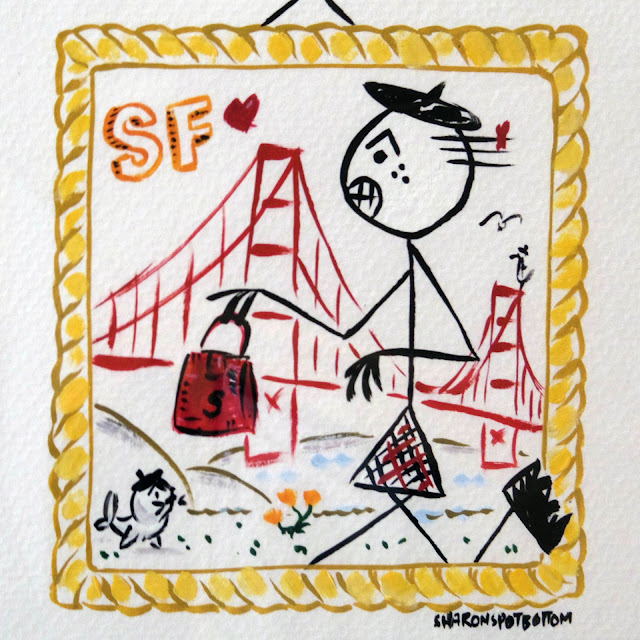
Sharon Spotbottom is just my cup of tea… Illustration: Karen Heathwood     

Art Appreciation

There are many people who helped make our San Francisco vacation a special one. If I were writing this thirty years ago I would have consulted with a travel agent, queried relatives and friends who had made a similar trip, and bought a guidebook. Now, with the magic of the internet (although I suppose anyone who grew up with it wouldn’t consider the internet ‘magic’), I received several suggestions from people who I wouldn’t have known back in those dark ages. I’ve mentioned DJ Cousin Mary’s help previously and, of course, “NorCal” Shoshanah who grew up in the area. Interestingly enough, most of the commercial travel sites on the ’net weren’t very helpful—either outdated with dead links or just fronts for numerous tour offerings. We did use the Muni and Bart sites a lot however; public transportation in San Francisco is superb and having a Clipper Card made getting around a breeze.  Most parts of the city are within a short walking distance from routes and the various buses, streetcars, and cable cars run often.

One very special blog-pal who contributed to our trip planning was Karen Heathwood: artist, illustrator and inventor. Her travel suggestions were all spot-on. Karen is also the creator of my favorite demented stick figure Sharon Spotbottom (who has been featured on FITK many times.) The Weaver and I arranged to meet her and her partner Elaine at the de Young Museum in Golden Gate Park. Many amusing and informative stories were exchanged between the four of us, including artistic assessments of the exhibits. We had tea and coffee in the museum café, and posed for pictures afterward:


Sharon, Batty, Karen at the de Young Museum, February 25, 2018

To top it off, Karen gifted me this original Sharon Spotbottom panel:


Without getting too gushy, I have to say that Karen is one person who has truly enriched my life. Her little single panel comics have amused, enlightened and even touched me on many occasions. More subtle than commercial comic strips, Sharon Spotbottom’s adventures were often reflections on the human condition and the situations we all face as we go through life. Of course some were just whimsy, and some went to some very strange outposts of the human psyche. Karen even encouraged me to try my hand in creating glimpses of Sharon’s world. The kid is alright.

Thanks again to everyone who helped make our trip a success.

See all the FITK San Francisco posts here.

By Professor Batty


Comments: 3 


Monday, August 04, 2014

Last Places

A Journey to the North

Travel writing by
Lawrence Millman
Houghton Mifflin, Boston, 1990

   If you have ever wondered what a Hunter S. Thompson travelog of remote North Atlantic locations would be like, this may be as close as you will get. Lawrence Millman has made a specialty of wandering the North, writing numerous books over the last 40 years on this and other subjects. A true raconteur, this book is filled with wild stories gleaned from his hosts in Fouli (one of the Shetland Islands), the Faroe Islands, Iceland, Greenland, Labrador and Newfoundland. Millman is not one to pull his punches; after reading this I felt as if I had been beaten up.

  His preferred mode of transportation (after walking) is by boat, and he manages to catch several rides on dubious ships with unreliable captains. Once ashore, he eschews hotels for camping, often to the amusement of the natives.  Scenes of drinking, puking and whoring are common, contrasting with Millman's poetic descriptions of nature and wildlife. Millman wrote this twenty-five years ago, several parts of the book concern the end of a way of life for many of his subjects. I should check out his more recent books; in hindsight they may offer an expanded view.

Thanks to DJ cousin Mary, for sending this book my way!

By Professor Batty


Comments: 2 


Wednesday, April 07, 2021

Elly Griffiths

The Ruth Galloway Mystery Series

The Crossing Places
The Janus Stone
The House at Sea’s End
A Room Full of Bones
A Dying Fall
The Outcast Dead
The Ghost Fields
The Woman in Blue
The Chalk Pit
The Dark Angel
The Stone Circle
The Lantern Men
The Night Hawks
The Locked Room
The Last Remains


Never had I dreamt that the adventures of an English archeologist working in a community college could be so engrossing.

I was tipped off to this series by DJ Cousin Mary and I have been thoroughly enjoying them. Ruth Galloway is a forensic archeologist living in an isolated cottage by the dismal yet beautiful salt marshes of County Norfolk in East Anglia—a location whose weather often makes its soggy presence felt in the plot. She teaches throughout the year and conducts summer digs—the novels’ archeological background adds a refreshing twist to these stories. As does the conception, birth and growth of her daughter Kate, whom Ruth is raising as a single mother. Called upon for her expertise on old bones by local DCI Harry Nelson (who also happens to be Kate’s father), Ruth becomes deeply involved with police investigations that are often related to some historical event.

This is one series that benefits from being read in order: the couplings and conflicts of the characters and how they develop are just as important as the mysteries unearthed in each installment. These antics can become somewhat soap-opera-ish at times but that only adds to the charm. Excellent action sequences are often enhanced by the appearance of Ruth’s friend Cathbad, a mysterious druid, who offers his oblique esoteric insights. This would make a great TV series (and it has been optioned by the BBC.) The overall quality is good and not too formulaic although I found The Woman in Blue to be something something of a misfire, coming off as a second-tier Midsomer Murder episode (no bones in it!) There is an installment set in Italy as well.

Griffiths also has a “Magic Men” series set in post-war Britain involving a loosely-knit group of performers (and a policeman) who had met during the war and ended up in Brighton during the end of the music hall era. It continues on into the sixties. The plots are kind of “fussy” but do work out to logical conclusions:

The Zig Zag Girl (2014)
Smoke and Mirrors (2015)
The Blood Card (2016)
The Vanishing Box (2017)
Now You See Them (2019)
The Midnight Hour (2021)


Veddy, veddy British of course; hundreds of gallons of tea are consumed in each volume. They are actually quite pleasant and humorous despite the murders. Elly also has other titles, including The Stranger Diaries, which I found somewhar clever, but I couldn’t finish The Postscript Murders which was too cute to stomach. Highest recommendation for Ruth Galloway, a marginal recommendation for the Magic Men, Blood and Vanishing are your best bets.

By Professor Batty


Comments: 2 


Friday, April 16, 2004

West Coast

Hawaii 2006:
Snarky Hula
The Tramp on the Street
The Vanishing Middle
Hula Girls Redux
Kim’s Rhinoceros
Sherwood Forest
The Glowing Icon
Hula Girls
Hau Tree Lanai

Carmel-Big Sur 2020:
Carmel Capers
More From Carmel

San Francisco 2018:
Britex-Isaia-Sear’s
Museé Mechanique
Sutro Heights-Cliff House-DJ Cousin Mary
North Beach
Chinese New Year
Hopwater Distribution
Art Appreciation
Talk to Me!
Ferry-Sausalito-Alcatraz
Del Popolo, Tonga Room, Level III
Spaces
Painted Ladies
Baker’s Dozen
Recap
Mysterious San Francisco
Joy on Powell 
Travelogues of Hell
Ain’t Got No Home
Conquest
Sammy and the Cheese
Mysterious San Francisco Redux
Double Scoop of Sharon
Tim Maleeny

Palm Springs 2017:
Midwinter Getaway
La Quinta
Joshua Tree
Palm Springs Modern
Bombay Beach
Salvation Mountain
East Jesus
Slab City Library
Signs of the Times
Road Trips

Seattle and Washington State:

2019:
The Busker’s World
The 40 Bus to Ballard
Street Scenes
Beatlemania

2017:
Farmers Market
More From Seattle
Sleepless in Seattle 

2014:
More on the Emerald City
Roadhouse (Quilcene)
Face at the Window
If You Meet the Budda on the Road…
Whistling Vivaldi on the Quad
Abstract Thoughts

2013:
Market
Dive Bar
Doors
Agalmatophilia
Voodoo Child

2011:
Life of a House
Pike Place People
Connections
Reykjavík Calling I
Reykjavík Calling II
Nordic Fashion Bash

2007:
Scenes from a Seattle Sunday
Ichiro, Rem, and Arnauldur
Snow (Mount Baker)
Strange Moment of Time (Mount Baker)
Onward! (Bellingham)
Crabby

By Professor Batty


Comments: 0 


Sunday, November 11, 2018

Iceland Airwaves Day Four


The final day of airwaves has come and gone. It was a day of subtle joys and a major disappointment. We spent the afternoon with DJ Cousin Mary and her husband Ken at the Hitt Husið, a community center for teens in downtown Reykjavík. The first performer was Hekla, not the thereminist that I had hoped for but, rather, an unassuming young woman singing songs of things important to her. It was a very sweet and honest, albeit shaky at times, performance:


Jóhanna Elísa led a six piece band with her fine playing and singing.
The string arrangements were superb:


We saw Between Mountains again, this was a much better venue for their emotional songs of the heart:


And we just had to stay to see Ateria again. They were in their element here, surrounded by friends and family. There are some very weird currents running through their music, who knows what darkness lurks in the minds of Icelandic teen-age girls?


After a break for dinner (monkfish, yum!), we went over to Floí,  a large multi-purpose room in the Harpa complex. The first act was the Faroese performer Eivør, an experienced veteran who sang, played guitar, and wielded a Celtic drum, all to great effect:
Not so great was the next act, Team Dreams: Sin Fang, Sóley & Örvar Smárason. In fact it was a disaster; quite possibly the worst musical performance of any kind I have ever endured. They announced that it would be their last gig. It sounded as if the band had already broken up  some time ago. An atrocious sound mix turned it into torture:


Finally, JFDR, who I've been wanting yearning to see perform again since I last saw her in Samaris in 2012:


The sound problems continued, almost destroying her set. She did fine when she was on her own—singing and playing guitar—but additional instruments were way out of balance. Various mid-bass and low-mid resonances made for a very unpleasant experience. Others told me that it wasn't as bad in the rear of the room, perhaps I was in a bad spot, although reviews in the Grapevine also mentioned the bad sound in Floí.

Here is a video of one of the songs of her performance:


Although Airwaves is over, I'll be back tomorrow with more

Yesterdays Airwaves coverage…

By Professor Batty


Comments: 3 


Monday, October 22, 2018

Iceland Airwaves Countdown #6


16 Days!

They posted the schedule for the official Airwaves venues last Sunday so I spent the afternoon parsing the variables and putting the somewhat confusing schedule (as pictured above) into an edited and more digestible form:


It looks like it will be a most interesting festival, with plenty of acts I want to see. Saturday night at Harpa looks to be exceptionally strong, starting with Eivør (from the Faroes), the Icelandic super-group Team Dreams, and peaking with JFDR. The other nights have at least three or four strong acts, all the venues are within a 7 minute walk of each other and our apartment. The off-venues are spread out quite a bit, that schedule has yet to be released. DJ Cousin Mary and her husband Ken will be there as well, the Weaver and I are looking forward to having breakfast with them.

On a more serious note, Iceland Airwaves has had some financial difficulties recently, it has a new, more professional, management now—which brings its own set of problems. The earlier Airwaves I attended (in 2006 and 2009) were decidedly on the DIY-side of things, and some of the more charming venues of that era have been torn down to make way for new antiseptic hotels, especially so in the case of off-venue sites. On the plus side the Nordic House will host its own mini-festival with ten acts over two days—many of whom aren’t in the regular one.

Here is another off-venue that also looks intriguing.

By Professor Batty


Comments: 4 


. . . . . . . . . . . . . . . . . . . . . . . . . . . . ©Stephen Charles Cowdery, 2004-2025 . . . . . . . . . . . . . . . . . . . . . . . . . . .