Friday, February 27, 2009

Bill Holm

"For it is life we want. We want the world, the whole beautiful world, alive —
and we alive in it. That is the actual god we long for and seek, yet we have already found it, if we open our senses, our whole bodies, thus our souls. That is why I have written, and intend to continue, until someone among you takes up the happy work of keeping the chain letter of the soul moving along into whatever future will come."

~ Bill Holm
We lost Bill Wednesday. Poet, Essayist, Musician. Bill was a Minnesota treasure, a world traveler, and a Friend of Iceland. He planted more than one seed of Icelandic discovery in me. His writing inspired me, his presence on the radio and in person lifted my spirits. A week before my second trip to Iceland (March, 2004) Bill gave a reading at a local publishing house. There was a small auditorium in the building and it was packed. Bill spoke, read, and played piano in support of an Icelandic soprano. He spoke of his writing workshop, of his summer home in Hosfós on the northern coast of Iceland. He was glowing, in his element, and we in the audience were enthralled. Last March, my wife and I had the opportunity to dine with Bill, the crowd was much smaller then, but Bill's enthusiasm was undiminished- he loved the lamb stew that was served so much that he passed the bowl around the table, urging each of us to have a taste!


To those of us who have been bitten by the "Iceland bug", Bill's writing on that subject always provided a soothing balm for that persistent itch. Here he expresses his love for the Icelandic language most eloquently:
The Icelandic Language

In this language, no industrial revolution;
no pasteurized milk; no oxygen, no telephone;
only sheep, fish, horses, water falling.
The middle class can hardly speak it.

In this language, no flush toilet;
you stumble through dark and rain with a handful of rags.
The door groans;
the old smell comes up from under the earth to meet you.

But this language believes in ghosts;
chairs rock by themselves under the lamp;
horses neigh inside an empty gully,
nothing at the bottom but moonlight and black rocks.

The woman with marble hands
whispers this language to you in your sleep;
faces come to the window and sing rhymes;
old ladies wind long hair, hum, tat, fold jam inside pancakes.

In this language, you can't chit-chat holding a highball in your hand,
can't even be polite.
Once the sentence starts its course,
all your grief and failure come clear at last.

Old inflections move from case to case,
gender to gender, softening consonants, darkening vowels,
till they sound like the sea
moving icebergs back and forth in its mouth.

~ Bill Holm


Bill has been mentioned here several times, I have a feeling he'll show up again.

By Professor Batty


Comments: 0 


Wednesday, April 15, 2009

Friends Of Bill (Holm)

There was a tribute to Bill Holm Tuesday night. Minnesota Public Radio graciously hosted this get-together celebrating Bill and his life at the Fitzgerald theater (the home of Prairie Home Companion, the radio show that Bill appeared on numerous times.) Bill has been featured here at FITK several times.


Many of Bill's close friends- fellow poets, musicians and writers- assembled on stage in a rousing start to the ceremonies and downed shots of Icelandic Vodka with the audience members in the "spirit" of Bill. There were many stories about Bill, Bill on tape, and Bill's poetry read by others. His publisher of 25 years, Emilie Buchwald, spoke at length about their relationship and announced that there will be one more book of poetry by Bill coming out.


Phebe Hanson, a poet who toured Minnesota with Bill
in the Poetry Out Loud series in the 1970s,
gently chastised Bill for breaking his promise to her-
a promise to sing an old Norwegian hymn at her funeral!


Dan Chouinard and Maria Jette performed duets
of classical music that Bill loved.


Robert Bly read a new poem about Bill. Twice.


At the end a brass band led everybody out with a
New Orleans-style version of The Sweet Bye and Bye.

As I walked out into the balmy night air the cold hard winter
seemed but a distant memory; but the spirit of Bill was within us all.


By Professor Batty


Comments: 4 


Tuesday, November 03, 2009

Bill Holm's Last Reading


There was a Bill Holm reading last night. His last new book, The Chain Letter of the Soul has just been published. The reading had been scheduled before his death, as part of a series of readings at the Plymouth Congregational Church in Downtown Minneapolis. The book has some of his last poems, along with many of his other most memorable ones. A "posse of poets" were there to read them- Bill's fellow travelers- along with 400 or so of his close friends and admirers. It was almost all Bill, with just a few anecdotes sprinkled in, but mostly poems, those poems treasured by the readers. There were new poems, old poems, Boxelder Bug variations (from the BEST BOOK EVER WRITTEN ABOUT BOXELDER BUGS!), poems of Iceland, and even the poem he wrote about the 35W bridge collapse, still so vivid in our memories. There was a pianist playing interludes between the readers; a very nice touch reflecting Bill's love for music.

A poet needs an audience, poems must be read aloud.

Bill had his last reading last night.

Others spoke his words, but it was Bill's voice we heard.

By Professor Batty


Comments: 2 


Friday, July 25, 2008

The Melancholy Quotient

Bill Holm

                        The Windows Of Brimnes

                              An American In Iceland


This book of essays by the Minnesota writer Bill Holm is poetic, angry and sad.

Poetic in its stories, poetic in its language, and poetic in its vision. It is firstly and foremost an effort to tie together the meaning of the Icelandic diaspora with Bill's own family and his personal history. These essays touch upon his youth, illuminate Iceland and its history, and bring to vivid life the people and places he has come to know while living in his small summer-house in Hofsós on the northern coast. Covering some of the same themes as his earlier book Eccentric Islands, this book is more personal.

It is a book that is angry with the America of venality, political immorality, and wasted opportunity; and also angry with Iceland and its rush to industrialize - "The stink of money" is the way Bill's father put it. There is enough vitriol here for another, different kind of book, but that book would not be nearly as rewarding as this one.

And it is a sad book, as is any book with tales of fading memories, descriptions of photos of departed ancestors, and a perspective of one's own life that is looking backwards, not forward. There is joy to be found here as well- joy in music, in friendship, in nature- an overall joy of life. But there is, on balance, more sadness; it is the same sadness that creeps in like a fog to envelop each of us as we get older and approach our own final chapters.


For another view of this book, check out Rose´s Windows of Brimnes blog post.

By Professor Batty


Comments: 9 


Wednesday, March 26, 2008

Dinner With Bill


Back at Spoonriver Restaurant for another "Salon", this time with the noted poet, essayist, and bon vivant Bill Holm. This was a most informal occasion, the six of us were clustered around Bill- eating, drinking, listening to Bill's stories, with an occasional poem thrown into the mix. Bill even passed the lamb stew (which he was enjoying immensely) around the table, so that we could all savor it.

The conversation's arc spanned a wide range of subjects: Peer Gynt at the Guthrie, Robert Bly, Iceland (of course), but also to Norway and Denmark, with a few side trips to Minneota, Minnesota, where Bill grew up and currently lives when not in Hofsós. As the dinner wound down, the talk turned to Halldór Laxness; some of the people there had never read any of his work, but I saw more than one person writing down his name and the titles which had been mentioned.

One reader at a time, one reader at a time.

By Professor Batty


Comments: 1 


Friday, January 08, 2010

Mount TBR 2010


As promised, here is a brief rundown on my new books (with another look at my ever-expanding Halldór Laxness collection!), bottom row, left to right:

The Encyclopedia of Witchcraft and Demonology, by Rossell Hope Robbins, Crown, 1959. Pretty tedious reading, but full of cool vintage woodcuts.

Stories from The New Yorker, 1950 - 1960, various, Simon and Schuster, 1960. All the big hitters of short fiction in the '50s. Really exceptional.

Buffalo for the Broken Heart, by Dan O'Brien. Random House, 2002. Received as part of a combo gift with 10 pounds of frozen bison. Heartache, buffalo and redemption on a South Dakota ranch.

Icelander, by Dustin Long. Grove/McSweeney's, 2006. Post modern mystery, not about Iceland at all.

Arctic Chill by Arnaldur Indriðason. Minotaur, 2009. I'll be writing a review when I've finished this.

Swedish Folktales & Legends. See last Tuesday's FITK.

The Chain Letter of the Soul, The Heart Can Be Filled Anywhere On Earth,
The Music of Failure
All by Bill Holm. I've been reading Bill a lot lately, These three books span the last thirty years. I may be writing an overview of his essays sometime in the future. The title essay of Music is about as close to perfection as Bill ever got in his writing.

Björk by Nicola Dibben, Indiana University Press, 2009. A scholarly treatment of Björk, her career and her music. Somewhat pedantic, but its section analyzing her music gives a greater understanding of her unique approach to composition.

TOP ROW: 14 Halldór Laxness titles and counting...

By Professor Batty


Comments: 10 


Friday, December 24, 2010

The Music of Failure

I saw a star fall from the sky,
And the people of Uruk stood around and admired it.
And I was zealous and tried to carry it away,
But I was too weak and I failed.
What does it mean?
I have not dreamed like this before…

~The Gilgamesh Epic
The calendar has always been somewhat arbitrary in its composition: the twelve months don’t fit a year nearly as neatly as thirteen would. The months and days of the week are named after a variety of gods and emperors, but the cosmological basis of the solstices and the equinoxes cannot be denied. Christmas day landing between the winter solstice and New Years day is not a coincidence.

Sometimes I think that Christmas activities are a way to avoid year-end ruminations. If the year has not gone so well, why not let loose a little? And if it has been a very good year, why not celebrate it? Any excuse for a party. If the party goes on long enough you just might miss that 3 a.m. wake-up call from your conscience: all those things that you’ve been trying to ignore throughout the year which keep bubbling up into your fitful dreams until you find yourself wide awake in the middle of the night. Things such as:
Those ten pounds you want to lose.
The car needs repairs.
The war and the economy.
How your circle of friends is fracturing.
The “Big R” (retirement.)
Christmas get togethers.
More snow.
Those ten pounds (again!)
How this year wasn’t as good as the last.
And next year may not be any better than this year.
Or, more simply stated:
The general entropy of your life’s arc.

Just try getting back to sleep.

The title of this post is based on an essay of the same name by Bill Holm. In it, Bill examines the lives of various people he grew up with in his small town, people who never made much of a mark on the greater world, people who could be considered failures in some sense, but whose lives played out to a different tune, “… the melody that counterpoints everything but is never heard… ”

The music of failure. Lives spent in the failure of living them. But Bill’s message was not one of despair. For our lives have a meaning even if the meaning is beyond our understanding: “Yet in every artery of my body, and in yours too, that music of failure plays–continually. It sounds like Bach to me, and you must make up your mind what it sounds like to you.”

I will continue to wrestle with my minor demons of the night and continue trying to pick up the fallen stars of my writing and “art” as I continue to play my own music of failure. And when I do start feeling a little down about my efforts I find these lyrics from Pascal Pinon to be a great consolation:
All the books I’ve never read
All the words and phrases I’ve never said
Is life as good as it’s going to get?

The music playing loud in my ears
I am trying to evaporate all my fears
It’s not getting any good until that clears.

Today is the one day I have left
In a whole new adventure and a whole new step
That I’m taking to another direction.

I wonder what it will be like
I am kind of excited, still terrified
I’m standing at a new beginning…

The future may be looking bright
I’m still convincing myself for what is right
But time has never been on my side…

Things I may not understand
Are slightly getting out of hand
I don’t know anything, anything at all…

Seems that I’m about to make
An overwhelming huge mistake
With everyone disagreeing…

But seeing things a positive way
Is making me feel like it’s OK
So I’m gonna enjoy the day…


~ Jófríður Ákadóttir, New Beginning

And so now, on this Christmas Eve, I offer my best wishes and good cheer to all who have struggled with tribulations in their lives, and with the serpents of self-doubt.

May each of you have a new beginning every day.

By Professor Batty


Comments: 0 


Saturday, April 10, 2004

Dogma

A collection of memorable FITK posts, sorted by year:

2025

Óx Revisited
Willey House
Endless Summer Redux
Orange Crush
Sound 80 and Me
Mosh Pit
I want to…
Strange Santa Fe
Experiments in AI
Market Day
The Eternal Dynamic

2024

Apple Loves Me
Love of an Adolescent
Adventures in Fine Woodworking
Memories Like Jazz
The Camden Motel
Cosmic Appple
Return to Shepherd’s Harvest
Kenergy
Virtual Exercise
The Best Day
Happy New Year

2023

Puzzling Perspective
Iceland 2023 Recap
RLBQ
Mothers and Daughters
Food Truck Frenzy
Clouds Over Grand Marais
Snookies Malt Shop
Finely Drawn
Retro Dance Party!
Móðir, kona, meyja
Love Hurts Twice
Soggy Sharon

2022

Day One
Lifting the Shroud
Flu Shot Saga
Simple Meals Are Best
Modern Problem
Bubble World Revisited
Job Opportunity
The Eagle Has Landed
Suicide Tourist
Another Invitation
French Connections
An Invitation

2021

Time Traveling With Bob
Fun with Dick and Joan and Bob and Mimi
Sandhill Cranes
Adventures in Linguistics
Return to Bubble World
Peggy and Her Pals
Matchbook Masterpieces
Ghost Neighborhood
Arty Party
Audio Artifacts…
Fan Dancer’s Horse
Puzzled

2020

My Last Cigar
Tony Glover Auction
Road Trip
State Fair Memories
Marlene Mania
God in the Garden
Hat Trick
Viral Sharon
Jono’s Letter
The Last Gig
My First Date Redux
Honky-Tonk Woman

2019

Waiting, Wishing, Hoping
Weekend in New Ulm
Dylan Double Down
Four More From the Fair
Bubbleworld
Beat Travel Guide
Arty Afternoon on Willy Street
Authority Figure
Golden Boy Redux
JC Revisited
Dreams on a Winter Afternoon
First Avenue

2018

Ceramic Culture
Airwaves and Gender
Anorexic
Light Birds
Red Sun
Savoury Summer
Hot Fun in the Summertime
Art-A-Whirl
Fade to Black
Godzilla Valentine
Pulp Flippist

2017

Porcelain Queen
Farmers Market
Wednesday Night…
Betra Líf
Twinned
Food Truck Frenzy
Art vs. Nature
Pastoral
Livestock
East Jesus
Baffled by Benchley
Harriet and Desha

2016

Walking with Ms. Lee
Great Minds Think Alike
How Does it Feel?
Through a Glass, Darkly
Missives from the Jazz Age
Learning to Fly
Astronauts: A Love Story
Searching for Shoshanah
Green Lake
Depth of Focus
February Thaw
All those moments…

2015

Proustian Dilemma
The Situation Girls
Fimm Konur
Four From the Fair
Girls’ Night Out
Saturday in the Park
Rivertown Ramble
Flaming Youth
Visions of Shoshanah
Woman Lake - 1980
It’s All Too Beautiful
Endless Summer

2014

Old Friends
Wanda in Art School
The Last Day of Summer
Bayfield 1984
Trail Center
From Paradise to Sunrise
Origami Litter
Art in Bloom
Face at the Window
Wanda Gág Day
Creative Writing
Germanium

2013

The Artist and the Collector
The Divine Mrs. M
45th Parallel
Blooms
I Love the Fair
The Mansion on the Hill
Iceland for Night Owls
Two Tickets to Paradise
Missed Connections
Girls Just Wanna Have Fun
Playing Hooky
Chanteuse

2012

Cindy Sherman
Sunday Night Shopper
Silent Movie
Last Days of Summer
Alice in Wonderland
Night at the Improv
Love Letters Straight from Your Heart
Howie’s
The Maestro's Farewell
Fathers and Daughters
Oral
The Wallflower

2011

Convergence
Book Review
Batty Visits Development Hell
Bill
Best Friends Forever
When Cars Had Tits
Batty’s World Tour
Patina
The Mystery of Ye Old Mill
Rituals of Courtship
Joni Mitchell’s Coyote
Walking on Thin Ice

2010

The Music of Failure
Postcards from Chennai
Sharon as Salome
Cosmic Call
Summer Hiatus
Camping With Sharon
Not Jim
Archie
Loss of a Pet
Pascal Pinon
January Thaw

2009

Mál og menning
Bill Holm's Last Reading
The Pastels
L'Opera dei Dannati
Sod
The iPad™
Haunted Castle
Ensculptic
Sex Dreams
Invader
Black Forest
Iceland at the Crossroads

2008

Saturday Matinee
Cold Comfort Farm
Richmond
Elizabeth the Great
Oh! Those BC Girls
Desperately Seeking Sharon
Milestones in haberdashery
Summer Love
Soliloquy
Door
The Visitor
Soft-core

2007

Cold Night
Single Mother
Amiina Now
Beautiful Kisses
Comica's Temptation
Green Lake
P.A.F
Twinned
Sweet Rolls and Silence
A Familial Misunderstanding
Found Object

2006

700 Year Old Disclaimer

The Boat of Longing
Hippies in the Heartland
Fine, I won’t walk around at night...
lines.
Smoking Lessons - The Pipe
Family Values
Hau Tree Lanai
Seasonal Equipoise
Water
Garden Party
More Postcards From Calcutta

2005

The bigger picture
My Funny Valentine
A day in my life
Sex-Ed 101
The Door
Button Jar
Dondi and the Waitress
Dance Party
The Accidental Traveling Companion
Ghost Blog
River Reverie
Red Zinger Tea

2004

Salome’s Dance
Mel Jass and Me
Coconut Oil
Gym Class
Flippist Industries, Inc.
José Loves Betty
Pink ‘n’ Black
Lesbians taking over the world?

By Professor Batty


Sunday, May 21, 2006

An Icelandic Home Companion

Tonight I listened to the NPR radio show A Prairie Home Companion which had been recorded earlier this week in Reykjaví­k. Garrison Keillor, its host and writer, brought a mixture of music, drama and nostalgia to Iceland at the urging of his friend, the writer and virtual "Poet Laureate" of Minnesota- Bill Holm. It is kind of hard to be objective about GK when he has been a part of your life for thirty years, the good and the bad start to even out. His morning radio show in the early 70's (pre PHC) was positively sublime, and I've seen him at his best, in person, speaking in my town (our town, he grew up here) when he spoke brilliantly for an hour at the behest of the Anoka Philolectian Society- a group of elderly librarians who gave him literary encouragement when he was just a shy teen. I've also seen him at his worst, causing real anguish to people I know who have had to deal with him professionally on his show.

Still, as the old saying goes, in show biz you are only as good as your last performance. Because Garrison does almost all of the writing, the show lives and dies on his inspiration. He has done over a thousand performances and his material is, by now, thoroughly recycled. This gives a certain uniformity to the proceedings; a fan might call it a comforting familiarity. He has taken the show on the road often and the routine is the same each time: A little monologue with local history and cultural references, a musical guest or two from the area (usually the high point of the show), then a sketch (heavily recycled), more tunes, and then the show's signature- The News From Lake Wobegon, followed with another left-over skit and some more music to end it all.

Tonight's show was typical of most, some good (especially the Icelandic singers and Mr. Holm) Some OK, (John C. Reilly) and some indifferent (skits and the monologue.)
With the upcoming Prairie Home movie the franchise is poised for another spurt in popularity; the Robert Altman-directed film is supposed to be a knockout. This week's chance for the radio show to create something unique incorporating and illuminating the Icelandic experience was lost in formatics: The show has gone on for too long, and in the same rut, it is as stale as a thirty-year-old Powdermilk Biscuit.

By Professor Batty


Comments: 1 


Wednesday, September 12, 2007

Aug. 2, 2007: American News

Bill Holm, the poet/writer/teacher from Mineota, Minnesota, spends his summers in the North of Iceland. He has written a poem about the I-35 bridge collapse, and what it means, from this distant perspective.

By Professor Batty


Comments: 6 


Monday, September 09, 2013

Reference

It has been a while since I've posted any bookshelf pictures, so, for you “snoops” out there, here are a couple images showing the “Flippist Reference Library™”:


Top left shelf contains Icelandic music and videos, along with doubles from my Halldór Laxness collection and a few “teach yourself Icelandic” books (I DIDN'T). The shelf below has the bulk of my Icelandic literature, mostly Laxness, but also some Sjón as well as a few Faroese authors. Fun for some, not for all. Moving down to the third shelf are music related books, heavy on Dylan, with Björk and Joni Mitchell. The right side has modern authors writing about Iceland (Indriðason, Nancy Marie Brown, Bill Holm, others).


Lower still are the books on Mythology (Campbell, Graves) folktales and then a mix of old fiction, art, poetry, biography and even a family genealogy. The bottom shelf has mostly art and photography (along with my High School yearbooks!)

The shelves on the right contain my music collection, They seem empty now because I recently thinned them out and also moved my DVDs which had been there to the Flippist Home Theater Media Center™  (subject of a later post.)

I've been going through a house cleaning purge lately; I can see my possessions dwindling in the future. I don't want to leave my heirs with a bunch of meaningless stuff. The Flippist Archives are safe for now; I use them for this blog. The photos and artwork on the walls as well as my modest ceramic collection (also to be featured later) have become a surprising joy to me.

All of this Proustian reflection leads to a deeper issue: as the tenth anniversary of FITK approaches I wonder what will be the ultimate fate of this site?  Discovered by new generations? Not likely. Buried in some forgotten server until a meteor blasts it out of existence? More likely. The old material here is still accessed every day by persons all around the world.  The new posts are read as well by a few dozen people, some of whom I know, some I don't (here's looking at you, Pretoria!). Facebook users also link to pages, although they never leave a comment. That's OK. It's a blog of images and ideas, not a social group. If I can brighten someone's day or offer a new perspective in my blog-posts, that is enough justification for me for me to continue its existence.

Which is more than can be said of television, the subject of Wednesday’s post.

By Professor Batty


Comments: 11 


Tuesday, June 09, 2009

Mount TBR


The Book Nook, Flippist World Headquarters

Most of the "keepers" in our book collection are stored in a corner of the bedroom. "Mount TBR" is a phrase I first heard used by correspondent Niranjana to indicate that pile of books "To Be Read." It struck a chord (C#dim 7th?) in me, for although I'm pretty much a one-at-a-timer as far as the reading of books goes, I do have those books which I know I'll revisit. I tend to purge my library of anything I know I won't read. So, just for the fun of it, let's take a "widescreen" peek at my "special" corner of the Batty library, those books I'll probably open again:


Of course Laxness leads the way, presented in order of publication, I'm only missing The Happy Warriors. I've even got Under the Glacier in Icelandic! Going down the row are various Sagas and "teach yourself Icelandic" books (I haven't given up hope yet!) and even a copy of Kristin Lavransdatter which I MUST re-read someday. A couple of Indriðason´s mysteries and my treasured Bill Holm. Going down a row, into the Biography section, Björk, Dylan and Gág share space with Huxley and Mary Magdalene. Further on are myths and tales; the rest of bookshelf contains mostly reference works.

The Weaver's shelf holds more modern literature; our tastes overlap; but there are some differences:


Snoop to your heart's content... ...UPDATE! Rose's Mount TBR is here... and Niranjana's is here...

By Professor Batty


Comments: 11 


Tuesday, March 10, 2009

Batty's Saga, Part II - Filling a Hole

I had been working part-time doing sound mixing for a bunch of guys who had an old-school R&B band, basically reworking the same material we had done twenty-five years earlier. My interests in modern music were almost at zero, as were any in serious literature. I was in a rut.

Returning home from Iceland with a Viking-besotted Scotsman in tow, my experiences of that week in March of 2000 were akin to the "seed" of grit that produces a pearl in an oyster. Suddenly there was all this stimuli happening to me: newspaper and magazine articles, music, films, literature; all of these seemed to have an Icelandic connection. I knew who Björk was; I'd hear her stuff on the radio when I was out in the car with our boys. I hadn't really listened to her, so I got one of her CD's, then another, and another. I had just about given up on Pop music, but she "opened my ears" to her many new directions. The local film society began showing all these great Icelandic movies. Bill Holm's Eccentric Islands was published. I picked up the musty old copy of Independent People which I had rescued from from my parents' basement where it had lain for FIFTY-FOUR years. I began to read: Sheep, mistrust, bitterness and a cow. And suddenly the veil which was my mundane existence lifted.

How can I even begin to explain it? Stuff happens to people all the time. What ends up in our head is either accidental (externally generated), or deliberately put there (internally generated.) I had been asleep for far too long. The idea of my return to Iceland, to gather more first-hand experience, was growing. The Weaver has always had a distaste for windy conditions, so when she put forth the idea of separate vacations my preparations began in earnest. This time there would be a difference. By 2004 the Internet had matured enough that it was now possible to not only to receive the usual commercial information, but also personal information via blogs. Places and events that were just PR copy before had now become alive- as seen through the eyes of people living in them. The quality of the writing in them was not their primary asset (although it was usually quite high) but it was their directness which captivated me. I was ready to return.

By Professor Batty


Comments: 4 


Friday, April 04, 2008

The Last Childhood Possession


"What is the shame for human beings to weep at the passage of time and feel it in the disappearance of objects from our past?"
- Bill Holm, The Windows of Brimnes

A simple dresser with five drawers, purchased from a "finish-it-yourself" place in the early fifties. It is, along with my Mickey Mantle baseball glove, about the only tangible thing I have left from my childhood. I used to keep "secret" papers underneath the bottom drawer, there was a star-chart taped to the inside back wall for the longest time; it glowed in the dark. I've never been one to cherish things (although it hasn't stopped me from collecting them) and I usually "clean house" from time to time. Yesterday we moved the dresser down into the basement (Oh! The Horror!) My sons had both used it; it been painted over a few times (which didn't help its appearance any), yet it remains perfectly functional but so anonymous that no one has ever desired it. I've got a few books and papers from high school, my sisters have the old photos, but I'm stuck with this.

No tears will be shed if it ever does leave, but it does have a place in my memory, cherished or not.

By Professor Batty


Comments: 0 


Wednesday, December 10, 2008

The Great Weaver From Kashmir

A late winter's snowstorm had left Reykjavík clad in white. After sitting down to breakfast in the day-room of Bólstaðarhlíð 8 I was soon joined by a group of grad students and their advisor who were also staying in the family-run guesthouse. We had a stimulating discussion over muesli, smoked fish, cheese, breads and, of course, skyr- none of which the students would touch but I found delightful. The doorbell's chime signaled the arrival of Þora, an older woman who would be the students' guide as they compared the Icelandic educational system with their own experiences.

Conversation turned to the city and its landmarks, notably Hallgrimskirkja, which brought forth a scornful comment from Þora, who thought that the towering cathedral was in poor taste and disrespectful of Hallgrímur Pétursson, its namesake. "We should have never left the Catholic Church, either."

So began my introduction to one of the still smoldering religious questions that has haunted Iceland for centuries. The Great Weaver from Kashmir continues this education.

Halldór Laxness wrote this unusual novel when he was 23 years old, at which time he was a practicing Catholic. This book was definitely born of that experience, large sections of it are dialectics about sin (usually meaning women), perfection and the relationship of man to God. During the time he was writing it Halldór was involved in a prayer group whose aim was to reinstall Roman Catholicism over the upstart Lutheranism as the state church in Iceland (although it too had once been the usurper, driving out paganism in the year 1000.) Laxness was struggling with many religious and political questions (as were many others in the aftermath of WWI) and this book covers them in almost tedious detail at times. If Laxness hadn't been such a good a writer this book would be as insufferable as trying to engage in meaningful conversation with a verbose, narcissistic young man. The "hero" of the story, Steinn Elliði, leaves Iceland and his adolescent sweetheart Diljá in a quest to become "the most perfect man on earth." His journey takes him deeper and deeper into the mysteries of the "one true faith", estranging his family and ultimately his humanity in the process. That Steinn's life is portrayed as a downward spiral and not a spiritual ascent shows the conflict Laxness endured; in the book lively domestic scenes exist in sharp contrast to the drab, internalized life of the abbey.

As with Laxness' World Light, (1937), this novel has a searching central character. Whereas Ólafur in Light is a light-hearted ne'er do well, Steinn plays his part in dead earnest. Even more of a contrast is comparing Weaver with Laxness' next novel Salka Valka which had the very much grounded and human Salka facing her difficult and often grim reality head-on in a way which would be unconceivable for the selfish Steinn. The other Laxness coming-of-age-novel, The Fish Can Sing, (1957) possesses a gentle, almost magical realism which is also far removed from the struggles of the unhappy Steinn.

The Great Weaver from Kashmir, while a must for Laxness completists, is a tough go for the general reader, possibly Halldór's most difficult work currently available in English.

Be sure to also check out Bill Holm's review of this most unique book.


More on Halldor Laxness at Laxness in Translation

By Professor Batty


Comments: 6 


Monday, March 09, 2009

Batty's Saga, Part I - Einmánuður, 2000

In the year 1000, Iceland was converted to Christianity.
In the year 2000, I was converted to Iceland(ity).

Being in thrall to two mortgages, private college tuition, and car payments, the Weaver and I had limited traveling options. There was a wild card in this deck, however: Icelandair's offer of a "Mid-week Madness" package. Four days and three nights in Reykjavík, an upgrade to a high-class hotel, all for a reasonable price tag. Bill Holm's Coming Home Crazy had touched upon his Icelandic experiences. My expectations were few, I knew of its dramatic scenery but not much else. Life at home had settled into a routine of work and familial obligations. Not that that was bad, but they were definitely minor variations on a theme. Iceland would be nothing like that, I was sure.

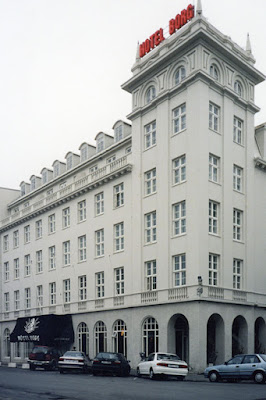
Minnesota and Iceland share similar weather twice a year- early spring and late fall. Both are quite cool, with wind and rain possible at any time. The old Icelandic name for the last month of winter is Einmánuður, which was when we arrived, the week before Easter. The trip from the airport is usually an eye-opener in any new destination and the wild lava fields surrounding the road made the welcome to Iceland unforgettable, if a bit ominous. The Flybus terminal had not yet been completed so we were unceremoniously dropped off in the parking lot of Hotel Loftleidir, to be eventually shuttled to the Hotel Borg:


The Hotel Borg was an inviting place, even to such a rustic as myself. There was a sense of friendly spirits there- although I saw no ghosts- perhaps it was just the memories of thousands of happy honeymoons and vacations. It was too small for the big corporate conventions, but it had a long history of visits by celebrities. The breakfast room was actually a fine restaurant by night, and featured a buffet complete with cod-liver-oil (and its tiny serving spoons.) Our room was a delightful mix of antiques and modern design. A shower-head the size of bird-bath deluged me with its geothermally-heated water. Bliss. Our helpful desk clerk arranged for a tour of the countryside.

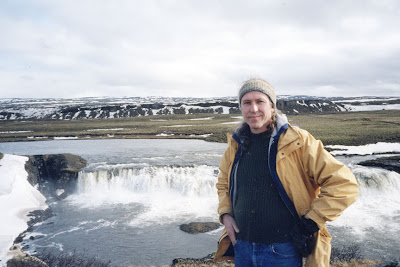
Most first-timers take a tour of the "Golden Circle." You can't go wrong with it, even with a somewhat confused bus driver. In his defense, some of the roads had just been opened (after the winter's snows), it made it seem more of an adventure ("I think I can make it over this bridge" which was only about 50 cm wider than the bus itself!) Everything there was different, there were surprises around every corner. And then there was the scent of all that fresh air, or was it the lack of a scent? Exhilarating, intoxicating, and after a day of this we were exhausted.


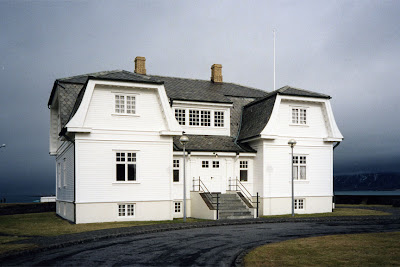
The next day was spent walking around town, seeing the oddly charming little houses almost in the center of town, and a few grander ones as well, places where the great leader of the U.S. and U.S.S.R. met to decide the planet's destiny.


Or was that to play a game of chess?

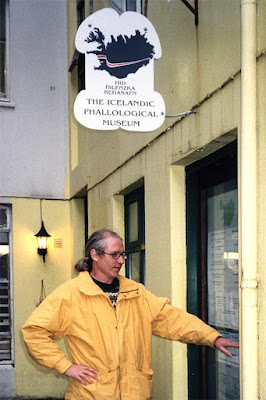
We scoured the town, ate at some unique restaurants with names such as Hornið and Jonathon Livingston Malvern, and saw museums of art and natural history, and also some that were not so traditional:

And, of course, the harbor had it charms, as does nearly every port. I leave the pictures of ships to another chapter. I had heard that there was a vital music scene in Reykjavík, but it being midweek in the off-season, I could only find a small combo doing AC-DC covers in Gaukur á Stöng.

There was evidence of change in the air as well. I didn't know it at the time, but the city was starting an explosion of demolition and building. There were forces working here that I was only dimly aware of. Some of the modern things were a bit sinister to the eyes of a naïf such as myself:


I knew, before I had even left, that I would return someday.

By Professor Batty


Comments: 4 


Monday, December 10, 2007

Top Ten: Laxness In Translation


UPDATE:
There is now an entire web site devoted to LAXNESS IN TRANSLATION. Find this post and much, much more at that site.

The celebrated Icelandic author Halldór Laxness wrote many novels, essays, plays and stories in his long career. Those of us not empowered with a fluency in Icelandic are limited to a novella, a few short stories and this list. They are available although Salka Valka and The Happy Warriors are hard to find.

Translation is an art form in itself; I'll leave any judgment concerning the English versions of these books to experts. Icelandic is a very precise language (blessed with a vibrant set of idioms) and English has a lot of Icelandic "DNA" in its structure and vocabulary which should allow for a good conversion. Not being a native Icelander, I'm sure I've missed many cultural references in these books, conversely, reading Laxness has exposed me to many facets of Icelandic history, culture and psychology. I have read that Laxness has done more to shape the Icelandic sense of national identity than any other author has for any other culture.

This post is part of a challenge from Rose, who is also a big Laxness fan. With today being the 52nd anniversary of Laxness' Nobel banquet speech it only seemed fitting to present our views at this time. (note: this post has been updated several times since it was first published)

Therefore, I hereby humbly present my personal "top ten" list of Laxness in translation...

#10. The Great Weaver From Kashmir (Vefarinn mikli frá Kasmír) (1927)
... It was his first work to gain wide recognition- the story of a self-centered young man on his quest to become the "most perfect human." Full of long philosophical passages, although brilliant at times. A full review is here.

#9. Paradise Reclaimed (Paradísarheimt) (1960)
... The "Mormon" novel, parts of it take place in Utah (kind of dry-!), in it Laxness explores religious and social themes, particularly familial estrangement. Based on a true story. Many people like this one a great deal, naturally popular with the LDS. Here is another reader's perspective.

#8. Atom Station (Atómstöðin) (1948)
... Pointed political satire aimed at the Icelandic government's acquiescence to the establishment of the United States military base in Iceland in the late 40's, with a memorable heroine in Ugla, who is a country girl who sees through the duplicity of the politicians. Her character may have been loosely based on Sigríður Tómasdóttir, who reputedly saved the waterfall Gullfoss from exploitation in the early 1900's. It has probably not been distributed in the U.S. until recently because of sub-plots concerning Communism and Anarchism. Laxness was effectively blacklisted in the U.S. because of this book. Full review here.

#7. World Light (Heimsljós) (1937-40)
... A very strange novel, first published in four parts with almost the entire first part taking place with the hero in a sick-bed! Ólafur's struggle with religion, sexuality and morality may be a bit much for a modern reader, especially after several hundred pages of his confused thoughts and morally suspect deeds. The book examines the saint/scoundrel paradox of the Icelandic Skáld (poet/writer) with insight and contains a wealth of peculiar Icelandic phrases and observations- ending with a transcendent finale. Very highly thought of by Icelandic readers.

#6. Under The Glacier (Kristnihald undir Jökli) (1968)
... The "Modern" Laxness novel, complete with new-age charlatans, a most pragmatic Pastor, the woman/goddess/fish Úa, and the hapless seminarian "Embí" who is trying to make sense of it all. A novel of ideas, very funny, very droll, its subtle humor may take repeated readings to appreciate. Quite possibly the most "Flippist" novel ever written. Susan Sontag's last review was of this book. Halldór's last original novel, written when he was in his sixties, it was much discussed in Iceland after its publication. My review is here.

#5. The Happy Warriors (Gerpla) (1952)
... Presented in a strict saga style, set in the era of transition between Christianity and Paganism, concerning two would-be "Heroes" who are out of date with the times. Masterfully written, full of cultural and historical references; it might not be the best choice for the casual reader, however. A full review here.

#4. Iceland's Bell (Íslandsklukkan) (1943-45)
... Icelandic history in the guise of a sprawling romance-saga; the English version has numerous footnotes which help to explain the mixture of Icelandic, Latin and Danish references; it is not for the attention-deficient but worth the effort, if only for Snæfríður's impassioned speech before the Danish authorities which speaks for subjugated peoples everywhere. Check out this in-depth review, in two parts, for more on this magnificent book.

#3. Independent People, (Sjálfstætt fólk) (1934-5)
... Icelandic male psychology (and much more) While reading it I found myself thinking that Bjartur, the hero, was almost exactly the same as my grandfather (and I also found more of myself in Bjartur that I'd care to admit...) Widely available, I grew up with this book in our house- it was a Book-Of-The-Month-Club selection in the late 1940's. Along with Iceland's Bell and World Light, one of the main reasons Laxness won the Nobel prize in literature. The late poet Bill Holm had been known scour used bookstores for copies to give to friends! Amazon has over sixty 5 star reviews of this book.

#2. The Fish Can Sing, (Brekkukotsannáll) (1957)
... Probably the most delightful of Laxness' novels. The orphaned Álfgrímur is, for the most part, a happy and simple child living in a world of colorful Pickwickian-style eccentrics in the turn of the century Reykjavík. His coming of age, particularly in his relationship to the mysterious Garðar Hólm, may be a metaphor for Iceland, then reluctantly emerging into the modern world. In light of the recent Icelandic presence on the world's music scene, Álfgrímur's graveyard dialog with Garðar is eerily prophetic. This is another work where nearly every paragraph holds some brilliant observation or subtle characterization. I've written about it here before, with a full review here.

#1 Salka Valka (1931-32)
I have also featured this title here; this story started out as a screenplay and it has a definite cinematic quality- it has been filmed twice. As to the book itself, I have no praise that can surpass this article by an Icelandic writer.

For a good first novel, I would suggest Fish; if you like sprawling sagas, try Bell. If you can find it, Salka is absolutely tremendous- overwhelming at times- a real find of a book, it is scandalous that it remains almost unknown in this country. Laxness also published two earlier juvenile novels and some later memoir/novels which, to the best of my knowledge, are not available in English.

You can read Rose's post here.

A final word of warning: Reading Laxness causes true addiction! Beware!

By Professor Batty


Comments: 11 


Tuesday, August 10, 2021

Greatest Hits Week - #2

Top Ten: Laxness in Translation

This is the post that started the Laxness in Translation website which has expanded over the years into a bottomless rabbit-hole of information about Iceland’s only Nobel laureate:


The celebrated Icelandic author Halldór Laxness wrote many novels, essays, plays and stories in his long career. Those of us not empowered with a fluency in Icelandic are limited to a novella, a few short stories and this list. They are available although Salka Valka and The Happy Warriors are hard to find.

Translation is an art form in itself; I'll leave any judgment concerning the English versions of these books to experts. Icelandic is a very precise language (blessed with a vibrant set of idioms) and English has a lot of Icelandic "DNA" in its structure and vocabulary which should allow for a good conversion. Not being a native Icelander, I'm sure I've missed many cultural references in these books, conversely, reading Laxness has exposed me to many facets of Icelandic history, culture and psychology. I have read that Laxness has done more to shape the Icelandic sense of national identity than any other author has for any other culture.

This post is part of a challenge from Rose, who is also a big Laxness fan. With today being the 52nd anniversary of Laxness' Nobel banquet speech it only seemed fitting to present our views at this time. (note: this post has been updated several times since it was first published.)

Therefore, I hereby humbly present my personal "top ten" list of Laxness in translation…

#10. The Great Weaver From Kashmir (Vefarinn mikli frá Kasmír) (1927) ... It was his first work to gain wide recognition- the story of a self-centered young man on his quest to become the "most perfect human." Full of long philosophical passages, although brilliant at times. A full review is here.

#9. Paradise Reclaimed (Paradísarheimt) (1960) ... The "Mormon" novel, parts of it take place in Utah (kind of dry-!), in it Laxness explores religious and social themes, particularly familial estrangement. Based on a true story. Many people like this one a great deal, naturally popular with the LDS. Here is another reader's perspective.

#8. Atom Station (Atómstöðin) (1948) ... Pointed political satire aimed at the Icelandic government's acquiescence to the establishment of the United States military base in Iceland in the late 40's, with a memorable heroine in Ugla, who is a country girl who sees through the duplicity of the politicians. Her character may have been loosely based on Sigríður Tómasdóttir, who reputedly saved the waterfall Gullfoss from exploitation in the early 1900's. It has probably not been distributed in the U.S. until recently because of sub-plots concerning Communism and Anarchism. Laxness was effectively blacklisted in the U.S. because of this book. Full review here.

#7. World Light (Heimsljós) (1937-40) ... A very strange novel, first published in four parts with almost the entire first part taking place with the hero in a sick-bed! Ólafur's struggle with religion, sexuality and morality may be a bit much for a modern reader, especially after several hundred pages of his confused thoughts and morally suspect deeds. The book examines the saint/scoundrel paradox of the Icelandic Skáld (poet/writer) with insight and contains a wealth of peculiar Icelandic phrases and observations- ending with a transcendent finale. Very highly thought of by Icelandic readers.

#6. Under The Glacier (Kristnihald undir Jökli) (1968) ... The "Modern" Laxness novel, complete with new-age charlatans, a most pragmatic Pastor, the woman/goddess/fish Úa, and the hapless seminarian "Embí" who is trying to make sense of it all. A novel of ideas, very funny, very droll, its subtle humor may take repeated readings to appreciate. Quite possibly the most "Flippist" novel ever written. Susan Sontag's last review was of this book. Halldór's last original novel, written when he was in his sixties, it was much discussed in Iceland after its publication. My review is here.

#5. The Happy Warriors (Gerpla) (1952) ... Presented in a strict saga style, set in the era of transition between Christianity and Paganism, concerning two would-be "Heroes" who are out of date with the times. Masterfully written, full of cultural and historical references; it might not be the best choice for the casual reader, however. A full review here.

#4. Iceland's Bell (Íslandsklukkan) (1943-45) ... Icelandic history in the guise of a sprawling romance-saga; the English version has numerous footnotes which help to explain the mixture of Icelandic, Latin and Danish references; it is not for the attention-deficient but worth the effort, if only for Snæfríður's impassioned speech before the Danish authorities which speaks for subjugated peoples everywhere. Check out this in-depth review, in two parts, for more on this magnificent book.

#3. Independent People, (Sjálfstætt fólk) (1934-5) ... Icelandic male psychology (and much more) While reading it I found myself thinking that Bjartur, the hero, was almost exactly the same as my grandfather (and I also found more of myself in Bjartur that I'd care to admit...) Widely available, I grew up with this book in our house- it was a Book-Of-The-Month-Club selection in the late 1940's. Along with Iceland's Bell and World Light, one of the main reasons Laxness won the Nobel prize in literature. The late poet Bill Holm had been known scour used bookstores for copies to give to friends! Amazon has over sixty 5 star reviews of this book.

#2. The Fish Can Sing, (Brekkukotsannáll) (1957) ... Probably the most delightful of Laxness' novels. The orphaned Álfgrímur is, for the most part, a happy and simple child living in a world of colorful Pickwickian-style eccentrics in the turn of the century Reykjavík. His coming of age, particularly in his relationship to the mysterious Garðar Hólm, may be a metaphor for Iceland, then reluctantly emerging into the modern world. In light of the recent Icelandic presence on the world's music scene, Álfgrímur's graveyard dialog with Garðar is eerily prophetic. This is another work where nearly every paragraph holds some brilliant observation or subtle characterization. I've written about it here before, with a full review here.

#1 Salka Valka (1931-32) I have also featured this title here; this story started out as a screenplay and it has a definite cinematic quality- it has been filmed twice. As to the book itself, I have no praise that can surpass this article by an Icelandic writer.

For a good first novel, I would suggest Fish; if you like sprawling sagas, try Bell. If you can find it, Salka is absolutely tremendous- overwhelming at times- a real find of a book, it is scandalous that it remains almost unknown in this country. Laxness also published two earlier juvenile novels and some later memoir/novels which, to the best of my knowledge, are not available in English.

You can read Rose's post here. A final word of warning: Reading Laxness causes true addiction! Beware!

By Professor Batty


Comments: 0 


. . . . . . . . . . . . . . . . . . . . . . . . . . . . ©Stephen Charles Cowdery, 2004-2025 . . . . . . . . . . . . . . . . . . . . . . . . . . .