I just received the soundtrack album for Screaming Masterpiece, a 2005 documentary on "One Thousand Years of Icelandic Music." The movie itself was a bit disjointed, but the soundtrack is an excellent distillation of the experience, with 16 full-length tracks including "Hrafnagaldur" (Odin's Raven Magic)- a thousand year old poem set to music and performed by an orchestra that also included Sigur Rós, a large choir and a pair of stone xylophones! It was a shorter track on the CD, however, that really caught my ear- Odi et Amo by Jóhann Jóhannsson, a haunting blend of strings, altered voice and keyboards that stopped time for me; taking me away from my rainy day doldrums. I'd seen Jóhann last year in Iceland, performing with three different ensembles, in three different venues, in three different genres. This track shows yet another side of the man. Worth seeking out, here's a live performance:.
Jóhann Jóhannsson, Icelandic composer extraordinaire, paid us in Minnesota a visit Tuesday night. In the moldering Southern Theater, an old vaudeville house in the West Bank area of Minneapolis, this sextet performed work from three of his albums, Englabörn, IBM 1401, a Users Manual, and Fordlandia, his latest. This is not music for those with an attention deficit disorder. Repeated themes with a mix of strings and electronica sounds duller than it was. Sometimes you have to suffer a bit before getting a release.
The biggest problem with this approach always seems to be getting the right balance between the electronic and the acoustic instruments. There were some difficulties , but overall it worked fairly well, despite a persistent hum (ground loop?) High point of the concert being Melodia (Guidelines for a Space Propulsion Device based on Heim's Quantum Theory) from Fordlandia. The crowd was enthralled and demanded an encore; Jóhann's haunting Odi et Amo. No harmonium this night, but worth it all the same...
Let´s get really crazy shall we? Start with the warmest day yet (sunbathing at the pool) and if 6 hours of music is not enough for you, how about starting things off at 17:00 in a century-old church (Fríkirkjan) by the pond with Jóhann Jóhannsson of Apparat Organ Quartet fame:
With his computers, piano, and a proper string quartet, he mixed classical and techno in a stunning fashion. An attentive crowd was transported into musical bliss. An hour later, I walked out into the twilight exhausted- and the night hadn't even begun! After a brief supper, (and a strong cup of coffee) it was back to Iðno for the Kitchen Motors (an artistic collective) night.
20:00 Siggi Ármann, a sensitive singer, verging on the precious, touched the small crowd with his sincere, emotional style.
20:45 Ólöf Arnalds, a young woman with an incredible voice and an accomplished instrumental style sings and plays tender ballads on guitar and charenga, a small lute-like instrument. Beautiful.
21:30 Kira Kira. The hall filled up with groups of friends and couples seated on the parquet floor, the atmosphere became more like a love-in. The five piece combo was led by an irrepressible woman on multiple instruments and computers. A lot of potential, the set was marred by technical problems.
22:15 Borko A quirky blend of samples and guitar rock, sounding a bit under-rehearsed.
23:00 Evil Madness. Jóhann Jóhannsson again, this time in a computer group (with a cellist) inspired by horror-movie soundtracks. Perfectly executed and scary. And people were dancing to it...This guy really gets around. GREAT STUFF!
00:00 Stórsveit Nix Noltes, a ten piece band of accomplished musicians playing eastern European-inspired music in a dynamic performance. Super high energy, the dancers got really into it. I'm running out of superlatives! Great ensemble playing and an excellent guitarist:
I finally give up at 01:00, my head still reeling. Earlier, I had talked with a music promoter from Brighton at the church and then met her again at Iðno. Later at Iðno I was speaking with a very nice young man about inkjet printing and inks. He asked if I liked Icelandic music, of course I started raving about Sigur Rós and Björk. He gave me a small smile and said "I am the lead singer of Sigur Rós."
My favorite Icelandic film composer was in town last night. I have more of his music than any Icelandic artist except Björk, so for me it was a "must-see." Although his live "performances" are somewhat static, his ideas are anything but. A perfect melding of electronica and classical, he can be challenging at times but can also be strangely uplifting. His soundtrack to "The Miners Hymns" is considered a modern classic, it has been performed live many times.
His list of awards and nominations continues to expand; he's scoring the upcoming Bladerunner 2049 remake as well. I'd seen him in person several times, both in Reykjavík and Minneapolis. Orphée, his latest opus, is based on the legend of Orpheus and is his first non-soundtrack album in six years, a "soundtrack without a movie" as it were:
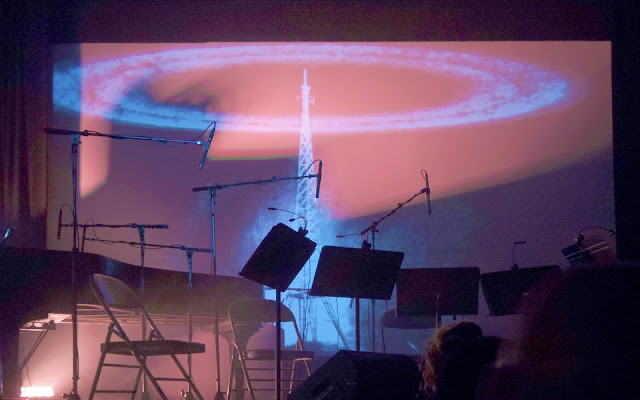
The Cedar Cultural Center may be the best intimate venue in Minnesota, the performers usually play to the "short wall", so sight lines and closeness to the stage are very good. The minimal staging was effective, especially after the fog machine and the video projection began:
Jóhann came out and played piano with a string quintet and a reel to reel tape recorder that he used throughout the concert, even changing reels from time to time:
Jóhann sequenced his compositions in movements, seamlessly segueing between the sections (and tape changes); this was the best I've seen him in a classical setting. They played for a solid 100 minutes with no intermission.
For the last number, they played the song that started my infatuation with Jóhann:
Jóhann Jóhannsson, 19 September 1969 – 9 February 2018.
Photo by Timothée Lambrecq, Reykjavík Grapevine
Oh man, this one hits hard.
Of all the Icelandic musicians I've had the joy of seeing perform, Jóhann was the most challenging. I saw him perform in Iceland—three times in two days—each group was completely different in personnel and material. Apparat Organ Quartet was the most visually stunning, four keyboardists playing vintage electronic instruments in front of a big crowd in the Art Museum:
The following night Jóhann performed with a string quintet at Fríkirkjan, doing the premiere of his IBM 1401, A Users Manual, album. Later that night he joined his buddies in Evil Madness improvising “soundtracks for an imaginary horror films.”
He came back to Minnesota in 2016, with a show featuring songs from his album Orphée as well as a greatest hits "medley" with another string quintet:
There are numerous videos of his work on YouTube; you could spend days exploring them all. The best tribute I found to Jóhann was from Seattle-based KEXP radio, with links to his excellent performances on their shows.
Jóhann performing with Apparat Organ Quartet, Reykjavík, 2006
Congrats to my favorite Icelandic film composer, who won the Golden Globe for best original score for the film The Theory of Everything. I've been a big fan of his for a long time: I've seen him perform numerous times, both in Iceland and Minnesota. I've also enjoyed several of his CD's, orchestral works as well as electronica from Apparat Organ Quartet and even pop music from Unun. I probably enjoy his music from the stage play Englabörn the most. Any of the titles listed at the links are great.
Chapter 25 of Search For a Dancer, a memoir of a week spent in Iceland in November 2022
It’s good to live in the moment when on vacation.
No what-might-have-beens, no second guessing your itinerary, no comparing this trip to another one. The weather, while still warm by November standards, had turned a bit windy, so I spent most of the afternoon in the hotpots at Vesturbæjarlaug swimming complex. There were a lot of people there with Airwaves armbands, and even a couple of performers (Hi, Pale Moon!) Lolling in the shallow oval hot-pot, laying back with my head on its rim, I gazed at the wispy clouds floating high above me. Allowing my brain to stop, just being one with them, was a moment I will long remember.
Discovering and being part of the pool culture in Iceland has been one of the great joys of my life. There is now a film about it, here is the trailer.
I spent a long time in conversation with Lárus Halldór Grimsson, a Icelandic music veteran who had been in the prog-rock band Eik in the seventies. He was full of stories; hanging out with David Bowie, writing music for plays, and had even portraying a young Halldór Laxness in a television production! Lárus seemed to know everybody in Iceland, and was full of arcane references, but I think I surprised him when he mentioned Baggalútur and I said that I not only knew of them that I had seen them performand I even had one of their CDs. I spoke of the Ákadóttir twins of Pascal Pinon and he knows their father well. We also spoke of the late, great Jóhann Jóhannsson whom he knew back in Jóhann’s days in Ham, which brought out my story about seeing Ham perform the previous night. From Ham and Johann it was just a slight turn in the conversation to Hildur Guðnadóttir, the Academy Award-winning composer. He had given her a stuffed Pink panther doll when she was a small child!
Speaking of children, a young man with a boy came into our pot, the man explained that the boy was autistic, and liked to take water-bottles! I moved my $8 medical-grade water bottle away as the scamp cavorted around the pool as we talked. The man wasn’t his father, he was just a friend of the family (and not even an Icelander!) and had some free time so he took the boy to the pool to give his parents a little time off. No big deal, it takes a village to raise a child. I managed to give the boy a side-eye wink that he caught and answered with a shy smile.
After the pool, I sauntered back to the apartment. It was a bittersweet trip; by this time tomorrow I would be in the Keflavík airport, waiting to return home. Along the way back I took lots of pictures, I know from previous trips that I will revisit them as a way to make the trip come alive again. Some people say that taking pictures doesn’t allow a person to fully experience the moment, but I would disagree. When I take pictures I pause and reflect on my surroundings and take the time to absorb details and vistas that would otherwise be lost.
I’ve been listening to the latest Pascal Pinon album a lot. What follows is not exactly a commercial review; in light of the sensitive nature of this project that would be crass. This is more of a rumination—on the music of course, but also on my circular quest for a fuller understanding of life via Icelandic culture.
By the mid-80s, when I had pretty much hung up my musical “career”, I was trying to make the home and family thing work. One escape from my domestic duties that I did have was a subscription to Andy Warhol'sInterviewmagazine, one of the few periodicals that retained a large format. The articles and photography were mostly about New York art and music scenes, but they also showcased up-and-comers from around the world. One of these blurbs featured the Icelandic band The Sugarcubes: Björk’s breakout vehicle. It was the beginning of a circle. I made a mental note of her and, in 2000, the Weaver and I did manage a short trip to Iceland. She was impressed but I was overwhelmed, especially with the omnipotence of Björk in the shops. So began a cultural odyssey. After quickly getting up to speed on Icelandic music and literature (and with the advent of blogs), I even began to make personal contacts with some of the natives. Now, five trips to Iceland later, I have come to the realization that I am approaching the end of the circle. Nothing ever stays the same, of course, and my contacts in Iceland have, like me, have moved on in their lives. The classic literature of Iceland remains great (and I adore serious Icelandic theater), its modern practitioners are gifted. Icelandic cinema remains very strong. The Icelandic music scene, however, seems to have reached some kind of peak around 2010. Although there are still some acts with international success (Sigur Rós, Of Monsters and Men), the most challenging new work is coming from Jóhann Jóhannsson, as a film music composer (Prisoners, The Theory of Everything, as well as the new Bladerunner).
All of this rambling is a preface to today’s subject: Sundur, the third album by Ásthildur and Jófríður Ákadóttir, twin sisters who call themselves Pascal Pinon. I first saw them in 2009 at Iceland Airwaves and I have always had an affection for the group. Their first release (Pascal Pinon, 2010), recorded when they were 14 years old, was a honest topography of the heart. Twosomeness, their second release (2013), brought the girls out of their bedroom and into the studio. It was, as to be expected, much more polished, while still retaining an intimate nature. Sundur goes far beyond either of these, presenting Jófríður’s lyrics "up-close-and-personal" accompanied by Ásthildur’s sure-handed production. The songs, as would be expected from the album’s title, are about love: lost, broken, or missed, with a bittersweet tinge. I could run this down track-by-track, but Jófríður has graciously already done so. Two of the stand-out cuts, Orange, and Ást,are available at the link. Ást was inspired by the writing of Halldór Laxness (another cultural circle), and is a powerful lament on love: “… the silent symphony created by stroking the strings of the heart… ”
Speaking of circles, Jófríður is featured in a recent Guardian article as being one of Björk's inspirations! Some reviewers have commented on the similarity of the two singers vocal styles. There is something to it but Jófríður is in full command of her gift; her melodies and phrasings are her own, the similarities in diction are shared by thousands of other Icelanders! She is also blessed with a twin sister who has grown musically as well. Ásthildur’s previous contributions were subtle but she is now an equal partner in this fascinating collaboration. Her assured and dynamic keyboard efforts are the equal of her sister’s vocalizations. I would even put Sundur in the same class as Joni Mitchell’s Blue, not as mature, of course (after all, they still are only 22), yet it is even more intimate than Joni’s masterwork—if such a thing could be possible. As a jaded, card-carrying curmudgeon, it takes a lot to crack my frozen attitudes. Pascal Pinon, those wyrd sisters from the North Country, not only thawed my resistance, they positively melted me.
There have been a number of notable films with strong connections to Iceland in the last few years. The IMDb lists 302 titles in its Iceland section. I'll be giving a short impression of the ones I've seen, (using English titles) seeing any one of them is definitely the next best thing to being there...
101 Reykjavík, 2000, probably the most well known release of the last ten years, an unflinching look at the wild side of "101"- the central district of Reykjavík. I had a discussion about this film with a native in the Laugardalslaug pool, he was not at all pleased with its depiction of the city.
Beowulf and Grendel, 2005, Not the Angelia Jolie film, but the same story, told pretty well on a striking Icelandic location.
Cold Fever, 1995, Japanese-Icelandic production, very good, quirky, touching at times. Lots of countryside.
Screaming Masterpiece, 2005, The Icelandic music scene, wildly uneven, a must for music fans.
Dís, 2004, Coming of age story written by a woman who was a night clerk at Hotel Borg (Shen was working the night desk the time I stayed there), not the greatest film, but lots of Reykjavik locales, with a cameo from Vigdís Finnbogadóttir and soundtrack by Jóhann Jóhannsson.
Heima, 2007, Sigur Rós concert film, and much, much more. #1 rated documentary at IMDb.
The Juniper Tree, Brothers Grimm-type story concerning witchcraft set amidst Icelandic scenery. Björk's film debut. A bit thin on drama but very good atmosphere.
Cold Light, 2004, a brooding, dark film about a man haunted by a childhood trauma. Extremely well done, not for everyone. Good views of modern life in Reykjavík.
The Seagull's Laughter 2001, great film about an extended family of women whose worthless men meet their demise in various "accidents." Told from the point of view of a girl on the verge of adolescence. A must see.
Jar City, 2006, an Inspector Arnaldur mystery. Taut mystery with good cast, very dark, excellent location shots.
Noi the Albino, 2003, a peculiar young man in an isolated town on the northern coast of Iceland. Very odd, even by Icelandic standards, well worth viewing if you enjoy a Twilight-Zone type story.
There are obviously many more, some titles I've left off because they were not directly concerned with Iceland (notably Niceland, 2004, A Little Trip to Heaven, 2005, Dancer in the Dark, 2001) and there are some I've been wanting to see but haven't yet had the chance (The Sea, Angels of the Universe) to say nothing of the Halldór Laxness books that have been filmed (Salka Valka, 1954, and Atom Station, 1984.) Most of those are in Icelandic only, some aren't available in compatible formats.
I found Noi at my local Hollywood. Netflix should have most of the others...
UPDATE! Check out Rose's reviews of selected Icelandic films!
Winner of a 2020 Golden Globe for best score for Joker.
Composer for 2020 Golden Globe winner Chernobyl.
Winner of two Grammy awards.
I first saw her perform in Iceland with Stórsveit Nix Noltes and Evil Madness in 2006, and with Múmin Minneapolis in 2009. Hildur stood out even then, especially so with Jóhann Jóhannsson's Evil Madness, an experimental outfit that played “soundtracks for imaginary horror movies”—good training for her current career!
It has been a long time since I've reviewed a new release movie. Director Denis Villeneuve’s sci-fi drama Arrival is the rare "blockbuster" that is worthy of mention. Arrival is based on based on the 1998 short story Story of Your Life by Ted Chiang. Although it has moments of awe (and vertigo) the story is the thing here, a looping, reflexive narrative that not only comes to a conclusion, but also leaves the viewer haunted. Anyone who has raised a child will be especially touched.
The small cast of actors with speaking roles is headed by Amy Adams, a linguist who is impressed into service to establish communications with aliens who have arrived at twelve points on earth in gigantic "pods." Adams gives an inspired performance that is both bold and extremely intimate. Jeremy Renner portrays a physicist, and a senior military official is played by Forest Whitaker. Michael Stuhlbarg is an antagonistic CIA agent while Tzi Ma is Chinese General Chang. All fine actors, but not exactly a typical blockbuster lineup. The real stars of the film (besides Adams, who is Oscar-worthy) are screenwriter Eric Heisserer, editor Joe Walker, and composer Jóhann Jóhannsson; their contributions are extraordinary. Villeneuve’s direction is assured and paced, although a bit hokey at times. The cinematography, by Bradford Young, is fairly murky throughout, I assume it was to give a thematic consistency to the film. His close-up work with Adams, however, would make a stunning short film by itself. His use of shallow-focus was used to great effect in the close-ups, but in group scenes many of actors were out of focus, taking away from the realism of the shot. The aliens were great.
One caveat: I saw this film in a modern multiplex cinema with digital projection. Part of the murkiness I saw may have been due to an under-powered projection lamp. A movie in 2016 should be at least as vibrant as the remastered Perry Mason episodes I’ve been watching on TV recently—and they are in black and white! This should look good on a DVD, however, but make sure that your subwoofer is up to par.
A call for materials pertaining to the late Icelandic musician/composer for an upcoming documentary prompted me to revisit some of the images I have of the man.
I first became aware of him in the avant-garde Apparat Organ Quartet at the 2006 Iceland Airwaves:
It was the start of a beautiful relationship. I became aware of his other musical pursuits: composer of music for plays and films, previous work with pop groups (Unun), and experimental hi-concept electronica.
He was gracious enough to actually come to Minneapolis, just for me it seemed (the show was sparsely attended):
Today marks the beginning of Iceland Airwaves, and I must admit that I long to be going back. Even the worst acts last year had some memorable quirks, and the good ones were simply outstanding. The venues were inviting, the people were great, even the weather was fantastic.
I tried to rationalize my desires away:
You are too old (Another gray hair won't make a difference...)
It's too expensive (35 full sets of music and five days in Iceland for about a grand... that really isn't too bad...)
The bands aren't as good this year (no Apparat Organ Quartet, but múm will be playing...)
Nothing with replace the "first time" (virginity is overrated?)
I thought I had quenched my desires, but then came the heart-breaker:
Saturday night.
Fríkirkjan.
Amiina.
I've written about Amiina before, and to be able to see them in this charming 19th century church by the pond might be just too much for this old heart to bear. The Jóhann Jóhannsson concert there last year was extremely inspirational; these women weave a magical spell that could only be enhanced by the setting. Here's hoping that it will be recorded for posterity in some form. Maybe, if they play again next year, I'll be able to catch the Airwaves, this time bringing the Weaver with me!
“Can you tell me what music is? It's completely intangible. It's something you can't grasp. You see art, watch people dancing, but you have to give part of your life to hear music. It grips you, gets into your soul, the most sublime of all the arts... There's no logic to it at all.” - George Martin
Last week I finally got some time to listen to my recordings from the Airwaves festival and the best of them sounded every bit as good as I had remembered. I’m eagerly awaiting new releases from Ölóf Arnalds, Valgeir Sigurðsson and, of course, Björk (love the hair, btw). I’ve commented on Amiina’s Kurr and have also purchased Jóhann Jóhannsson's User’s Manual. I recently read with pleasant surprise an article in the New Yorker by Alex Ross, who name-checked several of the acts I’ve “discovered” recently. Mr. Ross is a great champion of new music, in all its guises, I find it most gratifying that I am not alone in my enthusiasms.
Augh! Lonely indeed is the voice of the prophet! A solitary figure trudging through a spiritual wilderness preaching salvation to the heathen and receiving only blank stares in recompense.
The musical explosion which was the recent Iceland Airwaves Music Festival is only now starting to settle in my impressionable brain.
What keeps floating to the surface is the work of two musical/art collectives, Kitchen Motors and Bedroom Community. Each had memorable individual performers, and each had equally worthwhile collaborative efforts. The solo artists; Egill Sæbjörnsson, Ólöf Arnalds, and Siggi Ármann, each projected a very personal musical impression, refreshing in this era of "wanna-bes". Siggi, in particular, created an intense emotional field, captivating in its purity and simplicity. Ólöf and her armadillo-shell lute brought out some kind of primal response in me, her music was new and a thousand years old at the same time. Egill, with his persona (video Elvis?) was quite unlike anything else I've experienced.
The larger ensembles, Kira Kira, Stórsveit Nix Noltes, the formidable Jóhann Jóhannsson and the exquisite Valgeir Sigurðursson all fronted large groups with unique, experimental or newly imagined music, all at a very high levels of musicianship and composition. Two of the "odd men out" in these organizations are actually American, old-time folkie Sam Amidon and the Julliard grad Nico Muhly. In some respects, theirs' is the more traditional music, but still tempered by their Icelandic cohorts' contributions. Muhly is a serious composer, already with an impressive cv.
All of this music is fully realized, incredible and enjoyable. You may have noticed that I haven't yet mentioned the two 500-pound gorillas of the Icelandic music scene, Björk and Sigur Rós. Something great has been emerging from that rock in the North Atlantic, a cultural magma whose effects have yet to be fully measured.
Saw an Icelandic double feature last night- Dís and Cold Light (Kaldaljos), not an easy thing to do in this part of the world. The Icelandic film festival comes through about once a year, I have to make sure to catch them while I can (or else invest in a PAL video player!)
The subject of Dís was a twenty-three year old Icelandic woman with an existential crisis. Is it my imagination, or I have been focusing a lot of my attention on that socio-ethnic-gender group lately? It was fun to to get a taste of some of the cultural interactions from the “other side.” It was also nice to see the interior shots of the Hotel Borg. There is a cameo by Vigdís Finnbogadóttir, Iceland's first female president. Lots of attractive scenery, both urban and rural, and an excellent score from Jóhann Jóhannsson makes this slight film enjoyable. The woman who wrote and directed the film, Silja Hauksdóttir, actually was a receptionist at the Hotel Borg right about the time I stayed there!
Cold Light concerned itself with an artist, Grímur, who could foretell the future with his drawings, and switched between his adult life and troubling childhood memories. Very dark at times, and most thought-provoking. Hilmar Oddson’s film has a lot of the grim, gray scenery that doesn't usually make it into the travel brochures, yet is just as much a part of Iceland.




 There have been a number of notable films with strong connections to Iceland in the last few years.